Thatcher’s Tyrants – The Tanks, The Guns, The Christmas Cards

EXCELLENT ANALYSIS FROM MEDIA LENS

…… email_logoDoesn’t look right? View it online here
18 April 2013

Thatcher’s Tyrants – The Tanks, The Guns, The Christmas Cards

By David Edwards

The late American historian Howard Zinn wrote:

‘The truth is so often the reverse of what has been told us by our culture that we cannot turn our heads far enough around to see it.’ (The Zinn Reader – Writings on Disobedience and Democracy, Seven Stories Press, 1997, p.400)

What, for example, is the truth of the apparently intense ‘mainstream’ political and media dislike of dictators?

On the face of it, the loathing is visceral, absolute – newspapers are crammed with denunciations of the crimes of Saddam Hussein, Muammar Gaddafi and the like. The sensitivity is so acute that dissidents who compare these horrors with the West’s own crimes are reflexively accused of apologising for tyranny. Forget actions in support, journalists are outraged even by words that might be interpreted as expressing sympathy or support.

Readers will doubtless recall the media bile that greeted then Labour MP George Galloway after he told Saddam Hussein in 1994:

‘Sir, I salute your courage, your strength, your indefatigability.’

Galloway claimed his intention had been to salute the ‘Iraqi people’.

The press has never forgiven or forgotten these words. Our search of the Lexis media database (April 17, 2013) found 204 UK national newspaper articles containing the terms ‘Galloway’, ‘Saddam’ and ‘indefatigability’.

Last year, for example, the Independent reminded readers that ‘signs that Galloway’s views stretched the bounds of public acceptability’ had long been evident; for example, ‘he was memorably saluting the “indefatigability” of Saddam Hussein, long after the Kuwait invasion’. (Rob Marchant, ‘Is anyone in Britain still listening to George Galloway’s Respect Party? And should they be?,’ The Independent, November 9, 2012)

The Guardian also commented last year:

‘Indefatigability was just a word with too many syllables until [Galloway] shamelessly rolled it out for the cameras in 1994. Of course the absurdity of the occasion – obeisance to Saddam Hussein – instantly gave the word itself a new meaning.’ (Leading article, ‘In praise of… indefatigability,’ The Guardian, April 5, 2012)

However foolish, Galloway’s comments were just that – comments, words. With this example in mind, it is interesting to compare how political and media commentators have responded to the words and deeds of Margaret Thatcher who died on April 8.

Barack Obama declared Thatcher ‘one of the great champions of freedom and liberty’.

George HW Bush described her as ‘one of the 20th century’s fiercest advocates of freedom’, whose ‘principles in the end helped shape a better, freer world’.

The Economist agreed, praising Thatcher for ‘her willingness to stand up to tyranny’.

The Telegraph’s Defence Editor, Con ‘Con’ Coughlin, opined:

‘Mrs Thatcher’s uncompromising approach to dealing with the world’s dictators, from Argentina’s General Galtieri to Iraq’s Saddam Hussein, derived from her deep admiration of Churchill.’

According to Charles Powell in the Telegraph, Thatcher was driven by ‘a determination to change the world for the better, a quality which she shared with President Reagan, probably the most important strand in their relationship.’

This was admirable indeed, Powell noted, although it ‘involved being horrid to foreigners from time to time’. Well, nobody’s perfect.

Perhaps inspired by such comments, a letter published in the Birmingham Mail responded to Galloway’s ugly ‘May she burn in the hellfires’ reaction to Thatcher’s death:

‘That’s a bit rich coming from the Cuban cigar-smoking MP (what a sick joke calling his party “Respect”) who praised that tyrant Saddam Hussein for his “courage, strength and… indefatigability” and yet dishonours a British Prime Minister in the most disgraceful terms.’ (Letters, Birmingham Mail, April 13, 2013)

The letter might itself be deemed ‘a bit rich’ in light of Thatcher’s actual record.

Halabja – Twenty-Five Years Later

Coincidentally, the month prior to Thatcher’s death marked the 25th anniversary of Iraq’s March 16, 1988 gas attack on the Kurdish town of Halabja. It has been estimated that between 3,200-5,000 civilians died as part of Saddam Hussein’s Anfal campaign.

The Halabja atrocity was mentioned frequently in 2002-2003 as Western politics and media propagandised for war on Iraq, ostensibly in response to the ‘threat’ of weapons of mass destruction. The Lexis database finds (April 17, 2013) no less than 1,227 UK national newspaper articles mentioning Halabja. As we discussed in 2003, the media mostly managed to miss the damning details. By way of a rare exception, Dilip Hiro wrote in the Guardian:

‘The images of men, woman and children, frozen in instant death, relayed by the Iranian media, shocked the world. Yet no condemnation came from Washington… [I]nstead of pressuring him [Saddam] to reverse his stand, or face a ban on the sale of American military equipment and advanced technology to Iraq by the revival of the Senate’s bill, US Secretary of State George Shultz chose to say only that interviews with the Kurdish refugees in Turkey and “other sources” (which remained obscure) pointed towards Iraqi use of chemical agents. These two elements did not constitute “conclusive” evidence.

‘This was the verdict of Shultz’s British counterpart, Sir Geoffrey Howe [Thatcher’s foreign secretary]: “If conclusive evidence is obtained, then punitive measures against Iraq have not been ruled out.” As neither he nor Shultz is known to have made a further move to get at the truth, Iraq went unpunished.’ (Hiro, ‘When US turned a blind eye to poison gas,’ The Observer, September 1, 2002)

Five months after Halabja, Howe noted in a secret report that ‘opportunities for sales of defence equipment to Iran and Iraq will be considerable’. In October 1989, foreign office minister William Waldegrave wrote of Iraq: ‘I doubt if there is any future market of such a scale anywhere where the UK is potentially so well-placed’ and that ‘the priority of Iraq in our policy should be very high’. (Quoted, Mark Curtis, Web of Deceit, Vintage, 2003, p.37)

Also in the immediate aftermath of Halabja, the US approved the export of virus cultures and a $1 billion contract to design and build a petrochemical plant that the Iraqis planned to use to produce mustard gas. Profits were the bottom line. Indeed ‘so powerful was the grip of the pro-Baghdad lobby on the administration of Republican President Ronald Reagan’, Hiro noted, ‘that it got the White House to foil the Senate’s attempt to penalise Iraq for its violation of the Geneva Protocol on Chemical Weapons to which it was a signatory’.

Walter Lang, a former senior US defence intelligence officer commented:

‘The use of gas on the battlefield by the Iraqis was not a matter of deep strategic concern.’ (Patrick E. Tyler, ‘Officers say US aided Iraq in war despite use of gas,’ New York Times, August 18, 2002)

In a little over a week after Saddam Hussein was executed on December 30, 2006, Halabja was mentioned 74 times in the US press and 29 times in the UK press. It was deemed a defining example of his criminality. In the week since Thatcher died, Halabja has not been mentioned in the UK press.

In 2003, the Guardian described ‘the Thatcher government’s duplicitous record’ on Iraq:

‘For more than a decade, yellowing paper files in a government store have hidden the story of the way £1bn of Whitehall money was thrown away in propping up Saddam Hussein’s regime and doing favours for arms firms.

‘It took place when many in both the British and US administrations were covertly on President Saddam’s side.’

A leaked prime-ministerial brief recommended that the best way to avoid public outrage but still profit from Iraq was to sell only non-lethal equipment but to ‘define this narrowly’:

‘”Contracts worth over £150m have been concluded [with Iraq] in the last six months including one for £34m (for armoured recovery vehicles through Jordan),” writes Thomas Trenchard, a junior minister, in a secret letter to Mrs Thatcher in March 1981.

‘The letter also says that a meeting with Saddam Hussein “represents a significant step forward in establishing a working relationship with Iraq which… should produce both political and major commercial benefits”.

‘Mrs Thatcher wrote by hand at the top of the letter that she was “very pleased” by the progress being made.’

In 2002, Campaign Against Arms Trade (CAAT) summarised:

‘During the 1980’s much of the Campaign Against Arms Trade’s work focused on sales to Iran and Iraq, countries which had been at war with one another since September 1980…

‘The UK was not in the big league as a supplier to either side, but nonetheless did play a vital role in maintaining both military machines.’

In 1982, for example, International Military Services, a company owned by the Ministry of Defence (MoD), ‘was given permission to repair British-made Chieftain tanks captured by Iraq from Iran. The MoD said there had been no abandonment of neutrality, Britain would supply tank spares to both sides but no ammunition’.

Last year, the Guardian reported:

‘Foreign heads of state who received seasonal greetings from Thatcher in 1981 included the Libyan dictator Muammar Gaddafi – the card was addressed: “To the Leader of the Great First of September Revolution” – and the Iraqi dictator Saddam Hussein.’

The Super-Saleswoman

We have focused on Thatcher’s arming and funding of Saddam Hussein because the media is supposed to despise him and anyone who supports him or so much as ‘salutes’ him. But Thatcher’s arming and funding of the Iraqi tyrant at the height of his criminality is only the tip of a very bloody iceberg. As John Pilger commented:

‘Although British companies have long sold arms, legally and illegally, to the world’s leading tyrannies… it was Margaret Thatcher who brought a crusading zeal to the task of arming much of the world.

‘She became a super-saleswoman, making deals, talking up the finer points of fighter aircraft engines, hard-bargaining with Saudi princes, cajoling buyers and sellers alike.’ (Pilger, Hidden Agendas, Vintage, 1998, p.124)

Nima Shirazi, an independent researcher and political analyst, explains:

‘Thatcher was a staunch supporter of many of the world’s most brutal regimes, propping up and arming war criminals and dictators in service to Western imperialism, anti-Communism and neoliberal hegemony.’

Indeed, it is an astonishing list. For example, Thatcher praised the Shah of Iran as ‘one of the world’s most far-sighted statesmen, whose experience is unrivaled’. She added:

‘No other world leader has given his country more dynamic leadership. He is leading Iran through a twentieth century renaissance.’

In defending the Shah, Thatcher was supporting a political system that had the ‘highest rate of death penalties in the world, no valid system of civilian courts and a history of torture’ which was ‘beyond belief’, according to Amnesty International. It was a society in which ‘the entire population was subjected to a constant, all-pervasive terror’. (Martin Ennals, Secretary General of Amnesty International, cited in an Amnesty Publication, Matchbox, Autumn 1976)

Between 1971 and 1976 (before Thatcher became prime minister), the UK sold the Shah 1,500 state-of-the-art Chieftain main battle tanks and 250 repair vehicles costing £650 million.

Thatcher described Indonesian tyrant Suharto as ‘One of our very best and most valuable friends.’

The 1965-1966 massacres that accompanied Suharto’s rise to power claimed the lives of between 500,000 and 1 million people, mostly landless peasants. A 1977 Amnesty International report cited a tally of ‘many more than one million’ deaths. In the words of a leaked CIA report at the time, the massacre was ‘one of the worst mass murders of the 20th century’. (Declassified US CIA Directorate of Intelligence research study, ‘Indonesia – 1965: The Coup That Backfired,’ 1968; http://newsc.blogspot.com/)

Suharto’s US-armed invasion of East Timor in December 1975, killed 200,000 people out of a total of 700,000 – one of the worst genocides in history by proportion of population killed.

Britain granted Suharto hundreds of millions of pounds of loans to buy weapons before, during and after Thatcher’s time as prime minister. On her watch, hundreds of fighter-bombers, tanks, armoured cars and numerous other weapons were delivered and used to kill civilians.

Thatcher told her close friend, the Chilean dictator Augusto Pinochet, that she was ‘very much aware that it is you who brought democracy to Chile, you set up a constitution suitable for democracy, you put it into effect’.

Three weeks after Pinochet’s US-backed coup in 1973, a secret US briefing paper entitled ‘Chilean Executions’ put the ‘total dead’ from the coup at 1,500. The paper reported that the junta had summarily executed 320 individuals. After three months, 11,000 people had been killed. According to the Catholic Institute for International Relations (CIIR):

‘the single-minded ferocity of the coup and the subsequent deliberate use of torture, “disappearances” and murder had at that time no parallel in the history of Chile or Latin America, a continent with a long experience of dictatorship and military brutality’. (Quoted, Mark Curtis, The Ambiguities of Power, Zed Books, 1995, p.130)

CIIR described how the Pinochet regime instigated a ‘policy of permanent terror’.

Much of the military hardware used in the coup was supplied by UK manufacturers. In 1980, a year after she took office, Thatcher lifted the arms embargo on Pinochet – a flow of weapons, including fighter-bombers, followed.

Thatcher’s list goes on and even makes the US look principled. CAAT again:

‘The bulk of the UK arms trade to Saudi Arabia resulted from the reluctance of the United States to supply the kingdom. Each tranche of the infamous Al Yamamah deal followed refusals by Congress to allow large packages of US arms to be sold to Saudi Arabia. Thatcher’s government, however, had no qualms. The UK stepped eagerly into the gap, signing Al Yamamah I, the largest ever UK arms contract with a foreign customer, in 1986, and Al Yamamah II, “the biggest [UK] sale ever of anything to anyone”, in 1988 (Financial Times, 9.7.88). The Al Yamamah sales were a UK endorsement of a country with a history of brutal repression and a “persistent pattern of gross human rights abuses” (Amnesty International Report 1999).’

Thatcher supported Israel in its atrocities against the Palestinians. She supported Egypt’s tyrant, Hosni Mubarak, King Fahd of Saudi Arabia, P.W. Botha of South Africa, General Zia-ul-Haq in Pakistan, Pol Pot in Cambodia, and so on.

An obvious question arises: how has a media system incensed by Galloway’s mere saluting of a tyrant responded to the arming, funding and diplomatic protection of some of the world’s worst mass murderers as they were committing their worst crimes?

‘A Strong Defence Policy’ – The Missing Moral Compass

This, to remind ourselves of the media’s supposed intolerance of all who support dictators, was David Aaronovitch on George Galloway in 2003:

‘Galloway was once a genuine critic of Saddam’s… By 1994, however, he was in Baghdad famously saluting Saddam’s courage and indefatigability.’ (Aaronovitch, ‘Lies and the Left: Galloway and his supporters are foolish to believe that an enemy of America is necessarily their friend,’ Observer, April 27, 2003)

In his recent article in The Times on Thatcher, ‘She made many of us feel unwelcome in our own land’ (The Times, April 9, 2013), Aaronovitch does discuss foreign policy issues: the Falklands war, nuclear disarmament, Greenham Common, and so on. But about the most blatant and lethal feature of Thatcher’s foreign policy – her material support for many of the world’s mass murderers – he has literally nothing to say. This doesn’t make sense. How can mere words of support, a salute, be worthy of repeated condemnation, but actual arming and funding of tyrants be unworthy even of comment?

In fact, mentions of the issue have been few and far between since Thatcher’s death.

Indicatively, according to Lexis, over the past month, there have been 461 UK national newspaper articles mentioning the word ‘Thatcher’. There have been 29 articles mentioning ‘Thatcher’ and ‘Saddam’. None of these has mentioned that Thatcher armed and financed the Iraqi dictator. Anyone interested in gauging the true extent of freedom of speech in the corporate press need look no further.

Viewing all of this through the BBC’s ideological filters, political editor Nick Robinson asserts that Thatcher ‘won’ the argument for ‘a strong defence policy’, an analysis ‘which few will contest’.

A recent leading article in the Observer did at least mention Thatcher’s horrific policies:

‘the moral compass she deployed surveying the USSR and its client states served her less well on other international journeys. Among those she admired and supported were a number of men distinguished only by the craven brutality they showed in domestic affairs. Dictators such as General Zia-ul-Haq of Pakistan, Pol Pot of Cambodia and Chile’s Augusto Pinochet’.

Thatcher’s ‘moral compass’ merely ‘served her less well’, we are to believe. Readers were spared the damning evidence which we have only sampled here.

Returning to Howard Zinn’s observation, the truth is indeed both neck and mind-bending. The state-corporate system in fact does not loathe dictators, or people who support and salute them. It loathes dictators who obstruct Western power and profit. Tyrants willing to serve the West are sent tanks, guns and Christmas cards. Their crimes are buried out of sight, protected from censure at the United Nations. Likewise, outrage at dissidents’ alleged ‘support’ for tyranny is mostly a device used to attack voices threatening power and profit. The state-corporate moral compass is not malfunctioning or broken – there is no moral compass.

Contact Media Lens: editor@medialens.org

This Alert is Archived here:
Thatcher’s Tyrants – The Tanks, The Guns, The Christmas Cards

Share this media alert:
Facebook | Twitter | LinkedIn

Follow us on Twitter, on Youtube and on Facebook

The second Media Lens book, ‘NEWSPEAK in the 21st Century’ by David Edwards and David Cromwell, was published in 2009 by Pluto Press. John Pilger writes of the book:

“Not since Orwell and Chomsky has perceived reality been so skilfully revealed in the cause of truth.” Find it in the Media Lens Bookshop

In September 2012, Zero Books published ‘Why Are We The Good Guys?’ by David Cromwell. Mark Curtis, author of ‘Web of Deceit’ and ‘Unpeople’, says:

‘This book is truly essential reading, focusing on one of the key issues, if not THE issue, of our age: how to recognise the deep, everyday brainwashing to which we are subjected, and how to escape from it. This book brilliantly exposes the extent of media disinformation, and does so in a compelling and engaging way.’

Donate…

In July 2012, we reached our 11th anniversary. We would like to thank all those who have supported and encouraged us along the way. Media Lens relies on donations for its funding. If you currently support the corporate media by paying for their newspapers, why not support Media Lens instead?

www.medialens.org

……

£10 Millions for Thatcher whilst thousands face “Paupers Funerals”

Repeal the Welfare Reform Act of 2012 A new story from the campaign

Repeal the Welfare Reform Act of 2012

£10 Millions for Thatcher whilst thousands face “Paupers Funerals”

Posted by Michael Moulding (campaign founder)

Join the conversation
Share Your Story

The introduction of the “Welfare Reform Act 2012” and the Tory cuts is resulting in tens of thousands of families having to bury their loved ones in “paupers funerals”. This when this savage tory government spend £10 MILLIONS of taxpayers money on Margaret Thatchers funeral. http://links.causes.com/s/clJ7os?r=8JuS

George Osborne sheds a tear at Margaret Thatchers funeral.Have a look at him laughing like a hyena on the day he imposed poverty on millions in the UK, 2012 Autumn Statement. (pic enclosed)

Please sign our petition to have repealled the Welfare Reform Act 2012 – http://links.causes.com/s/clJ7ot?r=8JuS

eOC.jpg

Follow the Community Action Party on Facebook – http://links.causes.com/s/clJ7ou?r=8JuS

Want to get involved? See this story on Causes

PROMISED LAND – Hollywood does Fracking – released this Friday

Official Site: www.promisedlandthefilm.com

Directed by: Gus Van Sant

Written by: John Krasinski, Matt Damon and Dave Eggers

Produced by: Chris Moore

Starring: Matt Damon, John Krasinski, Frances McDormand, Lucas Black, Rosemarie DeWitt, Scoot McNairy and Hal Holbrook

Genre: Drama

Runtime:
1 hour 47 minutes (approx.)

Movie Synopsis:

Corporate salesman Steve Butler arrives in a rural town with his sales partner, Sue Thomason. With the town having been hit hard by the economic decline of recent years, the two outsiders see the local citizens as likely to accept their company’s offer, for drilling rights to their properties, as much-needed relief. What seems like an easy job for the duo becomes complicated by the objection of a respected schoolteacher with support from a grassroots campaign led by another man who counters Steve both personally and professionally.

SOUTH WALES INITIAL RELEASE VENUES:

ODEON – RED DRAGON CENTRE – CARDIFF BAY

CINEWORLD – MARY ANN ST – CARDIFF

ODEON – PARC TAWE – SWANSEA

CINEWORLD – NEWPORT RETAIL PARK – SPYTTY, NEWPORT

Nationwide release details: http://www.filmdates.co.uk/films/4813-promised-land/

REVIEWS:

GRAUNIAD: http://www.guardian.co.uk/film/2013/feb/08/promised-land-berlin-film-festival-review

INDEPENDENT: http://www.independent.co.uk/arts-entertainment/films/reviews/berlin-film-festival-review-promised-land-starring-matt-damon-is-too-dry-and-sober-8487709.html

TORYGRAPH: http://www.telegraph.co.uk/culture/film/9860858/Berlin-Film-Festival-2013-Promised-Land-review.html

Npower tax dodgers

38 Degrees Logo
Dear Andy,

Is Npower the new Starbucks? At the same time as hiking our energy bills, Npower are using accounting tricks to dodge paying their fair share of tax in the UK. Yesterday it was revealed that they haven’t paid a single penny in corporation tax for the last three years! [1]

But now this is out in the open, Npower are vulnerable. Just look what a PR disaster it was for Starbucks when their tax affairs were exposed last year. Tax dodging scandals can ruin a company’s reputation. And that can cost them their customers. [2]

Npower rely on their customer loyalty. If they realise that their tax scams are damaging their reputation, they’ll have to back down. So let’s make them feel the strength of public opposition by building a HUGE petition warning them that their customers are ready to leave them. Please click here to sign:
https://secure.38degrees.org.uk/npower-tax

A huge petition can help turn this tax dodge into a full-on PR crisis for Npower. It’ll help spread the word and raise awareness of what they’re up to. And it’ll encourage the media to keep reporting on this scam. That’s exactly what Npower’s PR team don’t want to happen!

After Starbucks’ tax scams came out, customers crossed the street to buy coffee from another cafe. Npower will already know that they’re at risk from customers switching gas and electricity providers. It’s not like it’s that difficult to switch – we proved that last year, when thousands of us switched together to get a better deal. [3]

The news of yet another huge company like Npower dodging tax stinks, and not just because it comes at a time when our gas and electricity bills are going through the roof. By dodging tax, Npower are actively contributing to the UK’s deficit – and to the stinging impact of government cuts.

Let’s force Npower to stop using accounting tricks to dodge their fair share of tax . Sign the petition to Npower now:
https://secure.38degrees.org.uk/npower-tax

Thanks for being involved,

James, Becky, Susannah and the 38 Degrees team

PS: NPower’s accounting scam works like this: they are turning UK operating profits into accounting and tax losses by making large “interest payments” to other parts of their own business, based overseas. This is currently legal – and in the longer term, we need to push the government to close this blatant loophole. But right now we have a chance to force Npower to drop this scam – so please sign the petition now: https://secure.38degrees.org.uk/npower-tax

NOTES
[1] The Sun – Energy giant pays zero tax: http://www.thesun.co.uk/sol/homepage/news/politics/4891267/Energy-giant-Npower-pays-zero-corporation-tax.html
[2] The Economist: Wake up and smell the coffee: http://www.economist.com/news/business/21568432-starbuckss-tax-troubles-are-sign-things-come-multinationals-wake-up-and-smell
[3] Read more about the Big Switch on the 38 Degrees website here: http://blog.38degrees.org.uk/2012/05/11/bigswitchresult/

More pics from Cardiff Bay Fracking event

Signed, sealed and delivered!

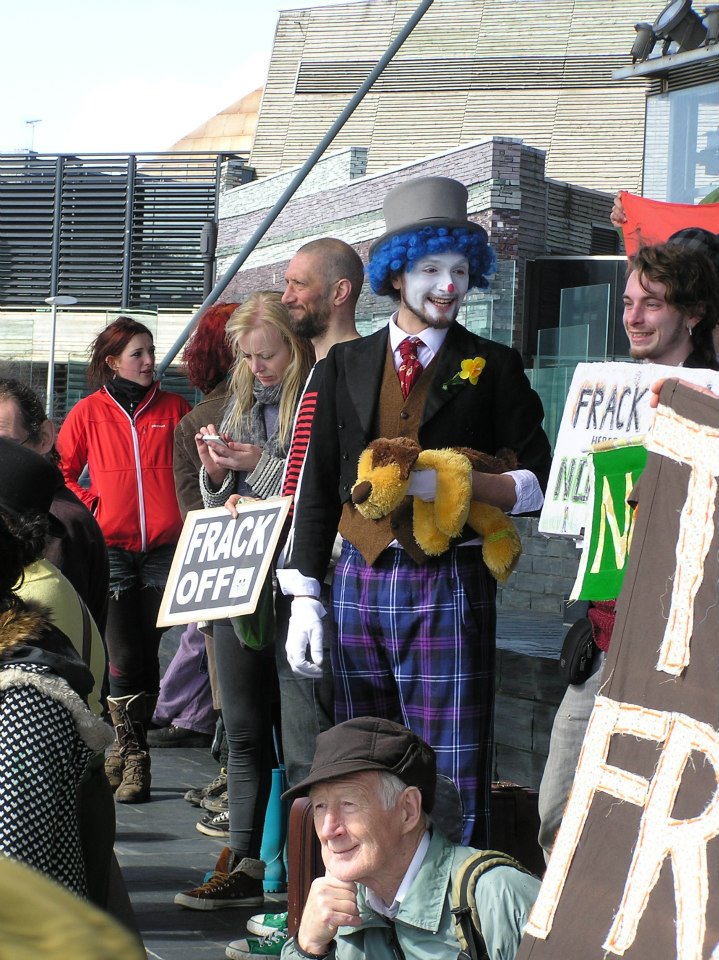
Some clowning about, while Laurie looks pensive!

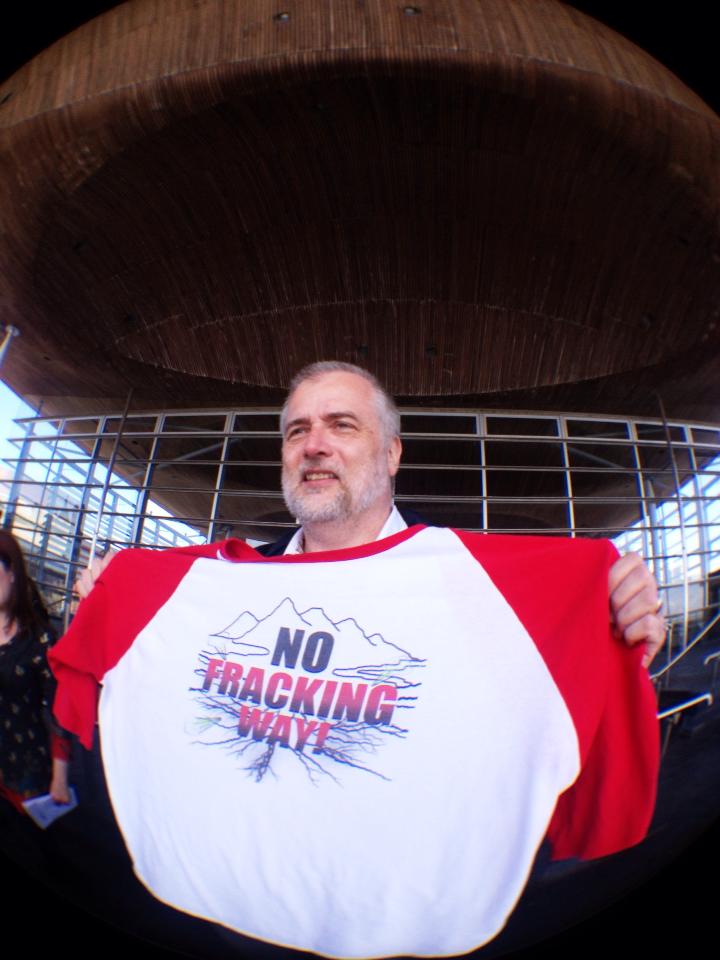
The shirt I was forced to take off before entering the Senedd.
It was considered ‘too political’!!

Good point, well made!

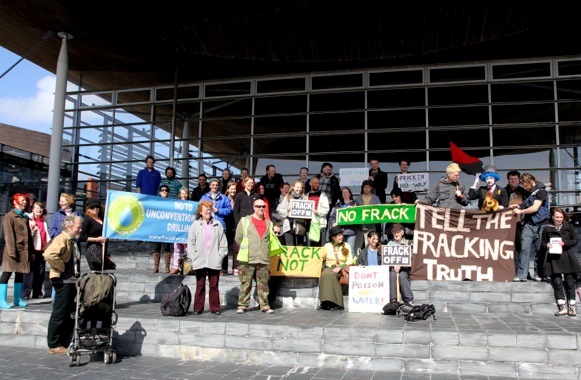
Today’s Frack-Free Wales demo in Cardiff Bay

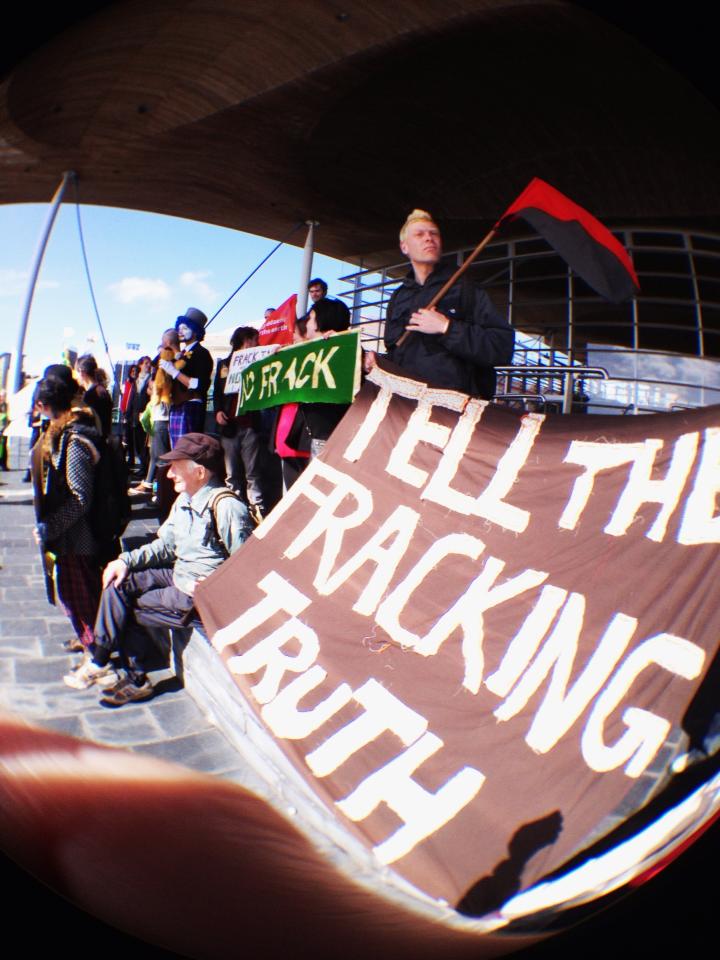
Mission accomplished!The sun shone on us as we gave voice to our opposition to the frackers threatening the environment and long-term prosperity of Wales with this crazy obsession for extreme fossil fuels that grips Westminster.The turn out was a little disappointing in terms of the shortfall from the numbers that had pledged to attend, but we nonetheless made up for this in terms of noise, colour and spirit. It was also very successful in terms of publicity and getting our message across to at least some AMs.

  • My scientific and technical briefing paper was delivered alongside letters and petitions to Carwyn Jones’ office
  • We had a slot on the ITV Wales News this evening featuring an interview with Frances Jenkins
  • I did an interview fro Capital FM Radio
  • At least two independent film makers were busy the whole time
  • Professional photographers, Peter Cook and Nigel Pugh took plenty of pictures – some of Peter’s below
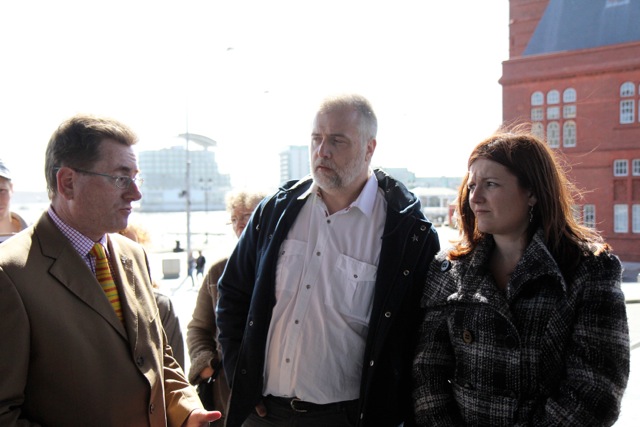
  • We had excellent and encouraging discussions with Lib Dem AM Peter Black and Plaid Cymru AM Bethan Jenkins
  • Had a good laugh that my ‘No Fraking Way’ t-shirt was deemed too political to be allowed in the Senedd – they don’t like politics in there it would seem!

It was great to see passionate activists coming from far and wide to support us – from Somerset in the East to Swansea in the West, with a healthy contingent of Bridgend Greens in attendance. Thank you, one and all!

But a special thank you to the inspirational Frances Jenkins for all the time and effort she has put into Frack-Free Wales, inspiring the the rest of us to do what we can.

Peter Black AM, Andy Chyba, Frances Jenkins (Frack-Free Wales)

Frances, Andy and Bethan Jenkins AM.

Part of the colourful and noisy crowd on the Assembly steps

MORE PICS:

 https://bridgendgreens.wordpress.com/2013/04/17/more-pics-from-cardiff-bay-fracking-event/


FFW scientific-and-technical-evidence-against-hydraulic-fracturing.pdf

Fixing the banking system for good

Email not displaying correctly? View it in your browser.
Positive Money
Dear Andrew,
Responses to the recent Cypriot banking collapse have shown that there is still a huge lack of understanding about how banks work and therefore a lot more educational work and awareness building to take part in. Read below to find new publications, videos and interesting events which give support for this work. Please share them with your friends.

1) Conference “Fixing the Banking System for Good” – Free LIVE STREAM

Screen_Shot_2013_04_16_at_15.03.41.pngA very interesting conference takes place TOMORROW (Wed 17th April) in Philadelphia, USA. Some big senior figures in the economic, monetary, and financial worlds, including Adair Turner, Laurence Kotlikoff, Michael Kumhof, will be discussing fundamental solutions to current global monetary and banking problems.

You can watch this event free online from your office or home.

(The event starts at 1:30 pm (GMT), M Kumhof at 3pm, L Kotlikoff at 3:45pm, A Turner at 6:30pm, Full agenda here)

2) Caroline Lucas, Green Party MP on Positive Money

Screen_Shot_2013_04_16_at_15.11.54.png

Watch a video message from Green Party MP, Caroline Lucas for Positive Money supporters here:

“There is no doubt that our financial system and the ecosystems on which we depend are at the point of collapse. We can tackle both problems simultaneously if we’d only admit their interdependance. If we’d only recognize that how we spend money and how we create money, has an impact on our environment.”

3) New publication: The Positive Money Proposal

Screen_Shot_2013_04_02_at_15.59.33.pngThis new document presents on 34 pages a plan for monetary reform, that is described in much greater detail in the book Modernising Money.

The reforms are outlined from the perspective of an individual, a commercial bank and the central bank. The proposal gives also an accounting perspective and describes a method for transitioning from the current monetary system to the reformed system.

This is a more technical explanation of the reforms, intended for economists and people with an understanding of banking. Some of you may prefer to read the Plain English proposal.

4) Book “Enough Is Enough: Building a Sustainable Economy in a World of Finite Resources”

Screen_Shot_2013_04_16_at_15.25.08.pngA new book Enough Is Enough from the Centre for the Advancement of the Steady State Economy identifies reform of the monetary system as one of the necessary changes that must be made to deal with the ongoing environmental crisis.

With a foreword by Professor Herman Daly, who also wrote the foreword for Positive Money’s book Modernising Money, the book states that: “Globally, we are overusing the earth’s finite resources, and yet excessive consumption is failing to improve our lives. It’s time for a new kind of economy.” and lays out a visionary but realistic alternative to “the perpetual pursuit of economic growth—an economy where the goal is enough, not more”.

5) Fixing Our Broken Money System – New York, 12 May

This event organized by the American Monetary Institute will bring together true experts that have dedicated much of their lives to solving the problems that are inherent with the system we currently use. More info here

If you or someone you know will be in New York during the time of the event, stop by and take part in the discussion!

6) Upcoming Events

Philadelphia, USA, Wed 17 Apr – Fixing the Banking System for Good (Watch free online)

Brighton, Thu 18 Apr – Screening of “97% Owned” & Discussion

London, Mon 22 Apr – Modernising Money – Reading Group

Monmouth, Wed 24 Apr – Talk in the town: Positive Money

London, Fri 10 May – Transforming Finance Conference

New York, USA, Sun 12 May – Fixing our Broken Money System

West Yorkshire, Tue 21 May – Screening of “97% Owned” & Discussion

Hay on Wye, Sat 25 May – Modernising Money at HAY Festival Wales

London, Sun 26 May – “Sunday Papers Live” with Ben Dyson

6) Latest from the Blog

New Documentary: “Jekyll Island” (Video)

Could We Accelerate the Post Reform Transition?

Dirk Bezemer about Positive Money

The alleged deflationary effect of full reserve banking

News from Ireland – Sensible Money

Economics and the Powerful – INET Conference (Video)

The Future of Central Banking – INET Conference (Video)

QE – one step closer to monetary reform?

Adair Turner’s Keynote Speech at INET Conference (Video)

open.php?u=7396d6c5dc44c9d3b64d8265c&id=ce14d3597e&e=2b992710a2

Personal message from Rod King – Dear Andy – re 20’s Plenty for Bettws

Dear Andy – 20s Plenty for Bettws

Its now nearly 10 years since I started campaigning for 20mph limits, first in Warrington and then throughout the UK. It is 5 ½ years since I set up 20s Plenty for Us in order to assist campaigners like yourself in influencing your local authority in implementing wide-area 20mph limits. And because of your efforts both individually and collectively we have made a huge change in the way that our roads are shared and in the debate on how they should be shared for the future.

With now 191 local campaigns around the country we are probably one of the largest and fastest growing grass-roots organisations. And the fact that all of this has been achieved with what are mainly volunteer resources is a testament to both the popularity of our message and the work done by you all.

In all of our campaigning I have felt there are 3 very clear objectives which we should have :-

  1. Support local campaigns
  2. Influence transport professionals on the value, benefits and popularity of 20mph limits
  3. Lobby local and central government on the need and benefits of lower speed limits.

In my time campaigning I have had quite a lot of communication with campaigners and organisations around the world. Their perspective is that in the UK we are taking a progressive and pragmatic approach to lower speeds that is, through debate and the democratic process, sensitising whole communities towards treating our streets as public spaces rather than just roads for automobiles. And whilst in some EU countries they have an even more progressive approach to lower speeds and many decades of implementation we are really showing in the UK that cultures can change and make a difference.

And that EU involvement is so important. It is a fact that the UK government is very much being influenced by our arguments and those made by local authorities to enable wide-area 20mph limits to be put in place economically and effectively. It is being recognised that we are in a transitional phase from the urban speed limit being 30mph everywhere towards a situation where 20mph is the norm. When so many of our iconic cities have less than 15% of their roads with a 30mph limits then 30mph no longer becomes a national default but merely a dated relic from the 1930s. And so it is time that we should be also looking to maximise our influence at government and pan-European level.

We are already involved with the European Citizens Initiative to get the EU commission to seriously consider setting 30km/h or 20mph as the standard for urban streets with the ability for local authorities to make alternative arrangements for vulnerable road users. Indeed, I am one of the 7 members of the citizens Committee which has set up the initiative. And we have until November to raise 55,000 signatures in the UK.

I know that many of you have already been working on this and have either influenced people to sign the initiative or sent me paper copies of signatures you have obtained personally. But we need to raise our sights and lift our game if we are to take maximum advantage of the opportunity which we have at our hands. Over the course of 29th April till 12th May there will be a major push by vulnerable road user organisations throughout Europe to raise awareness of the Initiative and increase the support and signings. This will be timed to co-incide with Global Road Safety Week under the patronage of United Nations and supported by the World Health Organisation.

I would therefore ask each and all for you to join with fellow campaigners across Europe in making a real effort to increase participation and signatories for the initiative. I would like you to take copies of the initiative and ask your friends, colleagues and family to either sign the paper copy or the on-line page. In many ways the former is so much better because you can see it signed rather than relying on someone remembering to sign it on-line.

A copy is attached and you can print off as many as you wish. If you would like us to send you some printed blanks then just let us know. Once you have got as many signatures as you can then please just mail them to me.

Of course you can also take the opportunity to include a call to action for your colleagues and other campaigners to do the same with their friends, family and colleagues.

We know that 20 is Coming. In some places its coming earlier and faster than others. But this really does give us all an opportunity to end the postcode lottery on speed limits and create an EU wide debate about how we share our streets as public spaces for all rather than just roads for automobiles.

I am sure that if we can all focus our energies on this initiative during the two weeks of Global road safety then we can really leverage all the excellent work which you have done to-date. I therefore look forward to a strong response from you all in supporting the European Citizens Initiative for 30km/h or 20mph limits.

I have attached the voting form and you may also see details on our website at www.20mph4.eu

Please get back to us if you have any questions. I also look forward to the signatory count increasing and receiving signatory forms from you all.

My best regards

Rod King

Rod.k

www.20splentyforus.org.uk

Follow us on Twitter @20splentyforus

Sign our European Citizens Initiative for 20mph limits at www.20mph4.eu

ECI_20mph_petition_UK Formular EN EBI-text II.pdf

Former Labour leaders join the Greens

An ever increasing number of disenchanted former Labour supporters are finding the Green party stands for principles and policies they believe in. They make up a large proportion of the Party’s current membership. Most have been former ‘rank and file’ Labour members; few leading activists have yet felt able to abandon the Party they have long worked hard for. There are notable exceptions, such as Peter Tatchell and a trickle of former Labour Councillors.We are now beginning to see quite senior Labour people wake up to the fact that Tory Blair’s New labour is not coming back to them. The argument, so often given to me by Labour members in Bridgend, that they feel they can achieve more by remaining in Labour than moving to the Greens is beginning to unravel as we make gradual electoral advances and see Green party members taking leading roles in left wing coalition movements such as the Coalition of Resistance, Left Unity, The People’s Assembly. Green Left is also making steady progress within the Green Party, with Green Left punching well above its weight across the Party.It can only be matter of time before Labour members in South Wales realise the extent of the betrayal by New Labour and allow the courage of their convictions to finally trump their misguided loyalty. It is happening just across the border in Worcester right now:

http://www.worcesternews.co.uk/news/10355420.Labour_leaders_shift_their_allegiance_to_the_Greens/

“Former Labour leader of the Worcester City Council and Party chrman David Barlow has joined the Green Party as has former Worcester Labour Party candidate, Peter Nielsen.

Mr Barlow led the city council in 2000 and terminated his Labour membership in 2011 after 30 years of being a member of the party. Mr Barlow said: The Green Party offers exactly the kind of credible, progressive policies which I have always supported and from which the Labour Party has drifted away.

Peter Nielsen said: “The Green Party has the ethical and moral dimension that has been lost in our traditional political parties, in particular the Labour Party. The Green Party sees environmental sustainability and social justice as inseparable. It is now 40 years old, and has matured into an impressive and credible political organisation that I am happy to join and in which I feel completely at home.”

David Barlow was a member of Worcester City Council from 1985-2004. In addition to being leader of the council, he chaired several committees, including Environmental Health, Community Services, Policy & Resources and Licensing. He was also a County Councillor (Hereford & Worcestershire), 1993-’97, where he chaired Personnel. Throughout, he had been much involved in numerous outside bodies and in local government associations regionally and nationally.”

A Review and Synopsis of the Scientific and Technical Evidence Against Hydraulic Fracturing

Report produced by Andy Chyba, commissioned by Frack-Free Wales.This will be presented to the Welsh Government by Frack-Free Wales at the demo on Tuesday.

http://frackfreewales.wordpress.com/2013/04/10/national-action-against-fracking-in-wales-16th-april-cardiff-bay-at-the-senedd/

Full report PDF via attachment at the bottom the page.

Contents:

  • The key differences between traditional conventional fracking and the recent so-called unconventional fracking
  • Borehole casings
  • Seismicity
  • Explosive fracturing
  • Hydraulic fracturing
  • Health impacts of frack chemicals
  • Disclosure of chemicals
  • Handling flowback water
  • Silica sand
  • Airborne pollution
  • Water resource implications
  • Climate change impacts
  • Population density

Conclusions:

“In conclusion, allow me to point out that most peoples concern over fracking tends to start in a NIMBYist fashion, with concern over related planning applications in their local areas. Witness the ever increasing plethora of local opposition groups across the country, indeed across the world. What invariably happens, however, is that people very quickly learn about and recognise the full range and scale of the issues involved the issues in this review, and many more such as noise, HGV traffic, property values, loss of amenity, and impacts on biodiversity, agriculture and tourism and so on. We have seen many local opposition groups thereby morph into national and international campaigns, seeking to be mutually supportive towards a common goal. This is an issue that therefore stretches beyond the scientific and technical. It has to become a political issue in which choices about our relationship with the planet we depend on are central.”

the-scientific-and-technical-evidence-against-hydraulic-fracturing.pdf