It’s polling day! Here are Bridgend’s Vote for Policies results (with postscript)

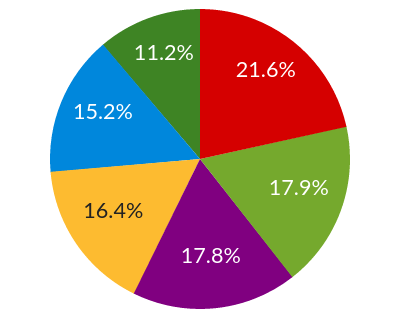
BRIDGEND SURVEYS DONE BY 836 PEOPLE – these are presumably politically literate, well-educated people (high literacy levels needed to negotiate the survey). It is a good sample size. How will the actual poll compare? There are also 4 other candidates (Pirate/TUSC/NF/Ind) to further complicate things.

This is based on gut instincts rather than any canvassing, but I predict:

  • Labour 32%
  • Cons 24%
  • UKIP 15%
  • Lib Dems 13%
  • PC 8%
  • Greens 4%
  • Others 4%

I hope I prove well off with these, with Greens saving their deposit and the collective anti-neoliberal vote (PC/Green/Pirate/TUSC) doing hugely better – but it is hard to see past Madeleine Moon continuing to show a modicum of interest in Porthcawl, ignore Bridgend town, and continuing to do as the red tory whips tell her.

Your Constituency

And did you know that 836 people took the survey in your constituency? Here are the results for Bridgend.

bridgend.png

Labour
Green Party
UKIP
Liberal Democrats
Conservatives
Plaid Cymru

If you’re still undecided, these links might be helpful:

Thanks again for using Vote for Policies. I hope the election brings a positive result for you.

Happy voting!

Matt & the team

logo.png
http://voteforpolicies.org.uk

Vote for Policies is an independent not-for-profit organisation registered in the United Kingdom (no. 8198015)

open.php?u=30240882&id=82849a35fda0425ba7408e718effcbc9P.S – My predictions proved to be a bit of a mixed bag. Labour’s 37% (my guess 32%) shows how entrenched the Labour instinct is around here despite having served no-one’s interests but their own for a long, long time. How the Tories managed to increase their share by 2% to 32% (24%) flabbers my gast. I take no pleasure in getting UKIP’s 15% spot on, and was only one off with PC at 7% (8%). The Lib Dems collapsed more than I, and just about everyone else, anticipated, losing their deposit into the bargain at 4.2% (13%). The Greens 2% (4%) was also a big disappointment, given the work we have done over the last 5 years, but parachuting in someone from outside did not help, and I guess I have to take some blame for this by withdrawing my own candidacy.

“Hard working families” – the mugs that sustain the system

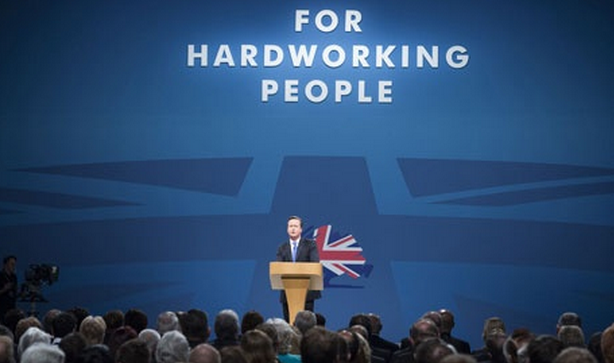
Screen Shot 2015-05-06 at 07.31.52One of the things that allows you to spot the vile neoliberals (aka free-market capitalists) is their constant appeal to the “hard-working families of this country“. As we enter the last day of the campaign, just count up how many references to “hard working families” you hear from Conservative and Labour politicians. You see, we all like to think of ourselves as ‘hard working families’ (if we are lucky enough to have a job at all) because we have been indoctrinated/conned from an early age by the neoliberal establishment (which includes the establishments schools and churches) into believing hard work is a virtue for which you eventually get your just reward (in heaven, if not in this life).

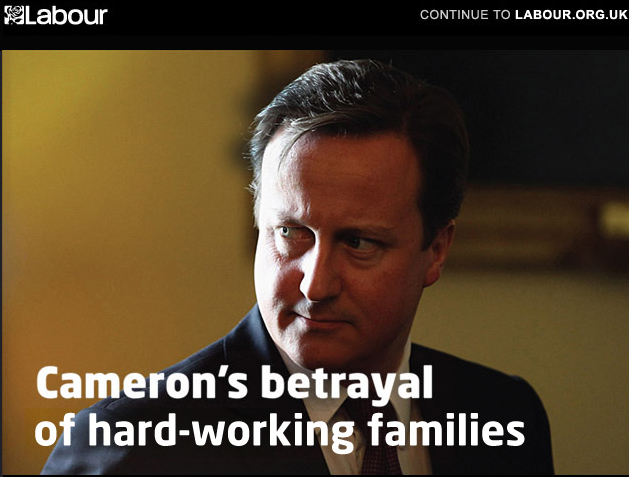
Screen Shot 2015-05-06 at 07.34.57This is a a long established con trick, but one of which the latest generation of neoliberal ‘elite’ (the hereditary old-Etonian elite that runs the Conservative Party and those aspiring to join the elite, in Blair and Kinnock’s footsteps, in the Labour Party) have gained renewed vigour for. They have read their history books and see with glee what the Victorian industrialists got away, hence the return to those kind of days with a ubiquitous minimum wage for the minions that they can’t actually live on, zero hours contracts to keep them grateful for whatever scraps they are given, the decimation of their ability to organise, and the removal of free public services that may over-educate them or allow them to live too long.

THe UK’s ‘special relationship’ with the USA means that we have followed their lead, or even shown the way at times, to ensure that, in the supposed developed world, we work the longest hours, have the lowest minimum wage and also have among the worst education and healthcare indicators, the greatest inequalities and worst social mobility. Just google “uk worst in developed world for” and see what you get. I found that we are among the:

  • worst for pensions
  • worst literacy and numeracy among the young
  • worst stillbirth rates
  • worst social mobility
  • worst child poverty
  • worst traffic jams
  • worst healthcare models
  • worst performing government bonds
  • worst for corruption
  • worst rail network
  • worst for teenage binge drinking

And this is just from the first three pages, in which close to half the items listed were focussing on our abysmal pension provisions. Makes you proud to be British, doesn’t it? This is the legacy of the decades of joint Conservative/Labour rule that we are going to see re-endorsed tomorrow.

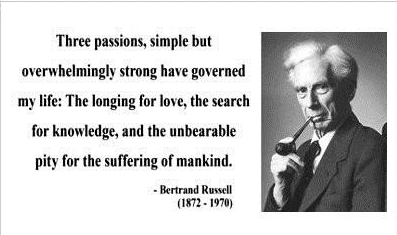
Returning to the “hard working families” con job, I stumbled across an essay by the great British philosopher, mathematician, historian, writer, social critic and political activist, Bertrand Russell when I was at University, during Thatcher’s first term. It has shaped my whole outlook on life ever since. Before, I present it to you, let me anticipate your response. You will grin broadly and think “Typical Andy! That sounds like him!” and then, as I insist it is genuinely the model we should be aspiring to and working for, you will think something like “Well, wouldn’t it be lovely, but it is just idealistic nonsense, isn’t it?” As you do so, perhaps you may begin to reflect on just how well you have been indoctrinated.

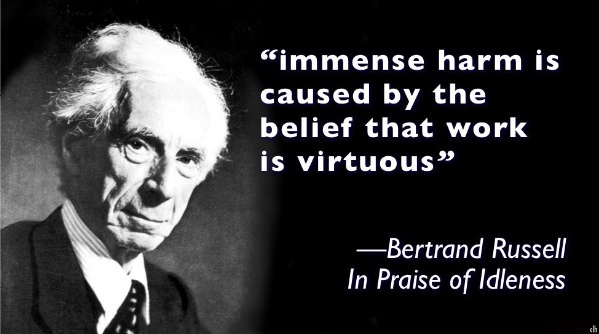
Screen Shot 2015-05-06 at 08.47.38The essay is entitled “In Praise of Idleness”. Russell published it in 1932, and as such some of its comments about Russia and women need to be kept in historical context, but apart from this it is as accurate and valid today, if not more so, than it was then. I make no apologies for reprinting it in full below (from here). Read it carefully, and perhaps you may become just a little more reticent about endorsing the bastards championing the “hard working family”!

In Praise of Idleness

By Bertrand Russell

Like most of my generation, I was brought up on the saying: ‘Satan finds some mischief for idle hands to do.’ Being a highly virtuous child, I believed all that I was told, and acquired a conscience which has kept me working hard down to the present moment. But although my conscience has controlled my actions, my opinions have undergone a revolution. I think that there is far too much work done in the world, that immense harm is caused by the belief that work is virtuous, and that what needs to be preached in modern industrial countries is quite different from what always has been preached. Everyone knows the story of the traveler in Naples who saw twelve beggars lying in the sun (it was before the days of Mussolini), and offered a lira to the laziest of them. Eleven of them jumped up to claim it, so he gave it to the twelfth. this traveler was on the right lines. But in countries which do not enjoy Mediterranean sunshine idleness is more difficult, and a great public propaganda will be required to inaugurate it. I hope that, after reading the following pages, the leaders of the YMCA will start a campaign to induce good young men to do nothing. If so, I shall not have lived in vain.

Before advancing my own arguments for laziness, I must dispose of one which I cannot accept. Whenever a person who already has enough to live on proposes to engage in some everyday kind of job, such as school-teaching or typing, he or she is told that such conduct takes the bread out of other people’s mouths, and is therefore wicked. If this argument were valid, it would only be necessary for us all to be idle in order that we should all have our mouths full of bread. What people who say such things forget is that what a man earns he usually spends, and in spending he gives employment. As long as a man spends his income, he puts just as much bread into people’s mouths in spending as he takes out of other people’s mouths in earning. The real villain, from this point of view, is the man who saves. If he merely puts his savings in a stocking, like the proverbial French peasant, it is obvious that they do not give employment. If he invests his savings, the matter is less obvious, and different cases arise.

One of the commonest things to do with savings is to lend them to some Government. In view of the fact that the bulk of the public expenditure of most civilized Governments consists in payment for past wars or preparation for future wars, the man who lends his money to a Government is in the same position as the bad men in Shakespeare who hire murderers. The net result of the man’s economical habits is to increase the armed forces of the State to which he lends his savings. Obviously it would be better if he spent the money, even if he spent it in drink or gambling.

But, I shall be told, the case is quite different when savings are invested in industrial enterprises. When such enterprises succeed, and produce something useful, this may be conceded. In these days, however, no one will deny that most enterprises fail. That means that a large amount of human labor, which might have been devoted to producing something that could be enjoyed, was expended on producing machines which, when produced, lay idle and did no good to anyone. The man who invests his savings in a concern that goes bankrupt is therefore injuring others as well as himself. If he spent his money, say, in giving parties for his friends, they (we may hope) would get pleasure, and so would all those upon whom he spent money, such as the butcher, the baker, and the bootlegger. But if he spends it (let us say) upon laying down rails for surface card in some place where surface cars turn out not to be wanted, he has diverted a mass of labor into channels where it gives pleasure to no one. Nevertheless, when he becomes poor through failure of his investment he will be regarded as a victim of undeserved misfortune, whereas the gay spendthrift, who has spent his money philanthropically, will be despised as a fool and a frivolous person.

All this is only preliminary. I want to say, in all seriousness, that a great deal of harm is being done in the modern world by belief in the virtuousness of work, and that the road to happiness and prosperity lies in an organized diminution of work.

First of all: what is work? Work is of two kinds: first, altering the position of matter at or near the earth’s surface relatively to other such matter; second, telling other people to do so. The first kind is unpleasant and ill paid; the second is pleasant and highly paid. The second kind is capable of indefinite extension: there are not only those who give orders, but those who give advice as to what orders should be given. Usually two opposite kinds of advice are given simultaneously by two organized bodies of men; this is called politics. The skill required for this kind of work is not knowledge of the subjects as to which advice is given, but knowledge of the art of persuasive speaking and writing, i.e. of advertising.

Throughout Europe, though not in America, there is a third class of men, more respected than either of the classes of workers. There are men who, through ownership of land, are able to make others pay for the privilege of being allowed to exist and to work. These landowners are idle, and I might therefore be expected to praise them. Unfortunately, their idleness is only rendered possible by the industry of others; indeed their desire for comfortable idleness is historically the source of the whole gospel of work. The last thing they have ever wished is that others should follow their example.

From the beginning of civilization until the Industrial Revolution, a man could, as a rule, produce by hard work little more than was required for the subsistence of himself and his family, although his wife worked at least as hard as he did, and his children added their labor as soon as they were old enough to do so. The small surplus above bare necessaries was not left to those who produced it, but was appropriated by warriors and priests. In times of famine there was no surplus; the warriors and priests, however, still secured as much as at other times, with the result that many of the workers died of hunger. This system persisted in Russia until 1917 [1], and still persists in the East; in England, in spite of the Industrial Revolution, it remained in full force throughout the Napoleonic wars, and until a hundred years ago, when the new class of manufacturers acquired power. In America, the system came to an end with the Revolution, except in the South, where it persisted until the Civil War. A system which lasted so long and ended so recently has naturally left a profound impress upon men’s thoughts and opinions. Much that we take for granted about the desirability of work is derived from this system, and, being pre-industrial, is not adapted to the modern world. Modern technique has made it possible for leisure, within limits, to be not the prerogative of small privileged classes, but a right evenly distributed throughout the community. The morality of work is the morality of slaves, and the modern world has no need of slavery.

It is obvious that, in primitive communities, peasants, left to themselves, would not have parted with the slender surplus upon which the warriors and priests subsisted, but would have either produced less or consumed more. At first, sheer force compelled them to produce and part with the surplus. Gradually, however, it was found possible to induce many of them to accept an ethic according to which it was their duty to work hard, although part of their work went to support others in idleness. By this means the amount of compulsion required was lessened, and the expenses of government were diminished. To this day, 99 per cent of British wage-earners would be genuinely shocked if it were proposed that the King should not have a larger income than a working man. The conception of duty, speaking historically, has been a means used by the holders of power to induce others to live for the interests of their masters rather than for their own. Of course the holders of power conceal this fact from themselves by managing to believe that their interests are identical with the larger interests of humanity. Sometimes this is true; Athenian slave-owners, for instance, employed part of their leisure in making a permanent contribution to civilization which would have been impossible under a just economic system. Leisure is essential to civilization, and in former times leisure for the few was only rendered possible by the labors of the many. But their labors were valuable, not because work is good, but because leisure is good. And with modern technique it would be possible to distribute leisure justly without injury to civilization.

Modern technique has made it possible to diminish enormously the amount of labor required to secure the necessaries of life for everyone. This was made obvious during the war. At that time all the men in the armed forces, and all the men and women engaged in the production of munitions, all the men and women engaged in spying, war propaganda, or Government offices connected with the war, were withdrawn from productive occupations. In spite of this, the general level of well-being among unskilled wage-earners on the side of the Allies was higher than before or since. The significance of this fact was concealed by finance: borrowing made it appear as if the future was nourishing the present. But that, of course, would have been impossible; a man cannot eat a loaf of bread that does not yet exist. The war showed conclusively that, by the scientific organization of production, it is possible to keep modern populations in fair comfort on a small part of the working capacity of the modern world. If, at the end of the war, the scientific organization, which had been created in order to liberate men for fighting and munition work, had been preserved, and the hours of the week had been cut down to four, all would have been well. Instead of that the old chaos was restored, those whose work was demanded were made to work long hours, and the rest were left to starve as unemployed. Why? Because work is a duty, and a man should not receive wages in proportion to what he has produced, but in proportion to his virtue as exemplified by his industry.

This is the morality of the Slave State, applied in circumstances totally unlike those in which it arose. No wonder the result has been disastrous. Let us take an illustration. Suppose that, at a given moment, a certain number of people are engaged in the manufacture of pins. They make as many pins as the world needs, working (say) eight hours a day. Someone makes an invention by which the same number of men can make twice as many pins: pins are already so cheap that hardly any more will be bought at a lower price. In a sensible world, everybody concerned in the manufacturing of pins would take to working four hours instead of eight, and everything else would go on as before. But in the actual world this would be thought demoralizing. The men still work eight hours, there are too many pins, some employers go bankrupt, and half the men previously concerned in making pins are thrown out of work. There is, in the end, just as much leisure as on the other plan, but half the men are totally idle while half are still overworked. In this way, it is insured that the unavoidable leisure shall cause misery all round instead of being a universal source of happiness. Can anything more insane be imagined?

The idea that the poor should have leisure has always been shocking to the rich. In England, in the early nineteenth century, fifteen hours was the ordinary day’s work for a man; children sometimes did as much, and very commonly did twelve hours a day. When meddlesome busybodies suggested that perhaps these hours were rather long, they were told that work kept adults from drink and children from mischief. When I was a child, shortly after urban working men had acquired the vote, certain public holidays were established by law, to the great indignation of the upper classes. I remember hearing an old Duchess say: ‘What do the poor want with holidays? They ought to work.’ People nowadays are less frank, but the sentiment persists, and is the source of much of our economic confusion.

Let us, for a moment, consider the ethics of work frankly, without superstition. Every human being, of necessity, consumes, in the course of his life, a certain amount of the produce of human labor. Assuming, as we may, that labor is on the whole disagreeable, it is unjust that a man should consume more than he produces. Of course he may provide services rather than commodities, like a medical man, for example; but he should provide something in return for his board and lodging. to this extent, the duty of work must be admitted, but to this extent only.

I shall not dwell upon the fact that, in all modern societies outside the USSR, many people escape even this minimum amount of work, namely all those who inherit money and all those who marry money. I do not think the fact that these people are allowed to be idle is nearly so harmful as the fact that wage-earners are expected to overwork or starve.

If the ordinary wage-earner worked four hours a day, there would be enough for everybody and no unemployment — assuming a certain very moderate amount of sensible organization. This idea shocks the well-to-do, because they are convinced that the poor would not know how to use so much leisure. In America men often work long hours even when they are well off; such men, naturally, are indignant at the idea of leisure for wage-earners, except as the grim punishment of unemployment; in fact, they dislike leisure even for their sons. Oddly enough, while they wish their sons to work so hard as to have no time to be civilized, they do not mind their wives and daughters having no work at all. the snobbish admiration of uselessness, which, in an aristocratic society, extends to both sexes, is, under a plutocracy, confined to women; this, however, does not make it any more in agreement with common sense.

The wise use of leisure, it must be conceded, is a product of civilization and education. A man who has worked long hours all his life will become bored if he becomes suddenly idle. But without a considerable amount of leisure a man is cut off from many of the best things. There is no longer any reason why the bulk of the population should suffer this deprivation; only a foolish asceticism, usually vicarious, makes us continue to insist on work in excessive quantities now that the need no longer exists.

In the new creed which controls the government of Russia, while there is much that is very different from the traditional teaching of the West, there are some things that are quite unchanged. The attitude of the governing classes, and especially of those who conduct educational propaganda, on the subject of the dignity of labor, is almost exactly that which the governing classes of the world have always preached to what were called the ‘honest poor’. Industry, sobriety, willingness to work long hours for distant advantages, even submissiveness to authority, all these reappear; moreover authority still represents the will of the Ruler of the Universe, Who, however, is now called by a new name, Dialectical Materialism.

The victory of the proletariat in Russia has some points in common with the victory of the feminists in some other countries. For ages, men had conceded the superior saintliness of women, and had consoled women for their inferiority by maintaining that saintliness is more desirable than power. At last the feminists decided that they would have both, since the pioneers among them believed all that the men had told them about the desirability of virtue, but not what they had told them about the worthlessness of political power. A similar thing has happened in Russia as regards manual work. For ages, the rich and their sycophants have written in praise of ‘honest toil’, have praised the simple life, have professed a religion which teaches that the poor are much more likely to go to heaven than the rich, and in general have tried to make manual workers believe that there is some special nobility about altering the position of matter in space, just as men tried to make women believe that they derived some special nobility from their sexual enslavement. In Russia, all this teaching about the excellence of manual work has been taken seriously, with the result that the manual worker is more honored than anyone else. What are, in essence, revivalist appeals are made, but not for the old purposes: they are made to secure shock workers for special tasks. Manual work is the ideal which is held before the young, and is the basis of all ethical teaching.

For the present, possibly, this is all to the good. A large country, full of natural resources, awaits development, and has has to be developed with very little use of credit. In these circumstances, hard work is necessary, and is likely to bring a great reward. But what will happen when the point has been reached where everybody could be comfortable without working long hours?

In the West, we have various ways of dealing with this problem. We have no attempt at economic justice, so that a large proportion of the total produce goes to a small minority of the population, many of whom do no work at all. Owing to the absence of any central control over production, we produce hosts of things that are not wanted. We keep a large percentage of the working population idle, because we can dispense with their labor by making the others overwork. When all these methods prove inadequate, we have a war: we cause a number of people to manufacture high explosives, and a number of others to explode them, as if we were children who had just discovered fireworks. By a combination of all these devices we manage, though with difficulty, to keep alive the notion that a great deal of severe manual work must be the lot of the average man.

In Russia, owing to more economic justice and central control over production, the problem will have to be differently solved. the rational solution would be, as soon as the necessaries and elementary comforts can be provided for all, to reduce the hours of labor gradually, allowing a popular vote to decide, at each stage, whether more leisure or more goods were to be preferred. But, having taught the supreme virtue of hard work, it is difficult to see how the authorities can aim at a paradise in which there will be much leisure and little work. It seems more likely that they will find continually fresh schemes, by which present leisure is to be sacrificed to future productivity. I read recently of an ingenious plan put forward by Russian engineers, for making the White Sea and the northern coasts of Siberia warm, by putting a dam across the Kara Sea. An admirable project, but liable to postpone proletarian comfort for a generation, while the nobility of toil is being displayed amid the ice-fields and snowstorms of the Arctic Ocean. This sort of thing, if it happens, will be the result of regarding the virtue of hard work as an end in itself, rather than as a means to a state of affairs in which it is no longer needed.

The fact is that moving matter about, while a certain amount of it is necessary to our existence, is emphatically not one of the ends of human life. If it were, we should have to consider every navvy superior to Shakespeare. We have been misled in this matter by two causes. One is the necessity of keeping the poor contented, which has led the rich, for thousands of years, to preach the dignity of labor, while taking care themselves to remain undignified in this respect. The other is the new pleasure in mechanism, which makes us delight in the astonishingly clever changes that we can produce on the earth’s surface. Neither of these motives makes any great appeal to the actual worker. If you ask him what he thinks the best part of his life, he is not likely to say: ‘I enjoy manual work because it makes me feel that I am fulfilling man’s noblest task, and because I like to think how much man can transform his planet. It is true that my body demands periods of rest, which I have to fill in as best I may, but I am never so happy as when the morning comes and I can return to the toil from which my contentment springs.’ I have never heard working men say this sort of thing. They consider work, as it should be considered, a necessary means to a livelihood, and it is from their leisure that they derive whatever happiness they may enjoy.

It will be said that, while a little leisure is pleasant, men would not know how to fill their days if they had only four hours of work out of the twenty-four. In so far as this is true in the modern world, it is a condemnation of our civilization; it would not have been true at any earlier period. There was formerly a capacity for light-heartedness and play which has been to some extent inhibited by the cult of efficiency. The modern man thinks that everything ought to be done for the sake of something else, and never for its own sake. Serious-minded persons, for example, are continually condemning the habit of going to the cinema, and telling us that it leads the young into crime. But all the work that goes to producing a cinema is respectable, because it is work, and because it brings a money profit. The notion that the desirable activities are those that bring a profit has made everything topsy-turvy. The butcher who provides you with meat and the baker who provides you with bread are praiseworthy, because they are making money; but when you enjoy the food they have provided, you are merely frivolous, unless you eat only to get strength for your work. Broadly speaking, it is held that getting money is good and spending money is bad. Seeing that they are two sides of one transaction, this is absurd; one might as well maintain that keys are good, but keyholes are bad. Whatever merit there may be in the production of goods must be entirely derivative from the advantage to be obtained by consuming them. The individual, in our society, works for profit; but the social purpose of his work lies in the consumption of what he produces. It is this divorce between the individual and the social purpose of production that makes it so difficult for men to think clearly in a world in which profit-making is the incentive to industry. We think too much of production, and too little of consumption. One result is that we attach too little importance to enjoyment and simple happiness, and that we do not judge production by the pleasure that it gives to the consumer.

When I suggest that working hours should be reduced to four, I am not meaning to imply that all the remaining time should necessarily be spent in pure frivolity. I mean that four hours’ work a day should entitle a man to the necessities and elementary comforts of life, and that the rest of his time should be his to use as he might see fit. It is an essential part of any such social system that education should be carried further than it usually is at present, and should aim, in part, at providing tastes which would enable a man to use leisure intelligently. I am not thinking mainly of the sort of things that would be considered ‘highbrow’. Peasant dances have died out except in remote rural areas, but the impulses which caused them to be cultivated must still exist in human nature. The pleasures of urban populations have become mainly passive: seeing cinemas, watching football matches, listening to the radio, and so on. This results from the fact that their active energies are fully taken up with work; if they had more leisure, they would again enjoy pleasures in which they took an active part.

In the past, there was a small leisure class and a larger working class. The leisure class enjoyed advantages for which there was no basis in social justice; this necessarily made it oppressive, limited its sympathies, and caused it to invent theories by which to justify its privileges. These facts greatly diminished its excellence, but in spite of this drawback it contributed nearly the whole of what we call civilization. It cultivated the arts and discovered the sciences; it wrote the books, invented the philosophies, and refined social relations. Even the liberation of the oppressed has usually been inaugurated from above. Without the leisure class, mankind would never have emerged from barbarism.

The method of a leisure class without duties was, however, extraordinarily wasteful. None of the members of the class had to be taught to be industrious, and the class as a whole was not exceptionally intelligent. The class might produce one Darwin, but against him had to be set tens of thousands of country gentlemen who never thought of anything more intelligent than fox-hunting and punishing poachers. At present, the universities are supposed to provide, in a more systematic way, what the leisure class provided accidentally and as a by-product. This is a great improvement, but it has certain drawbacks. University life is so different from life in the world at large that men who live in academic milieu tend to be unaware of the preoccupations and problems of ordinary men and women; moreover their ways of expressing themselves are usually such as to rob their opinions of the influence that they ought to have upon the general public. Another disadvantage is that in universities studies are organized, and the man who thinks of some original line of research is likely to be discouraged. Academic institutions, therefore, useful as they are, are not adequate guardians of the interests of civilization in a world where everyone outside their walls is too busy for unutilitarian pursuits.

In a world where no one is compelled to work more than four hours a day, every person possessed of scientific curiosity will be able to indulge it, and every painter will be able to paint without starving, however excellent his pictures may be. Young writers will not be obliged to draw attention to themselves by sensational pot-boilers, with a view to acquiring the economic independence needed for monumental works, for which, when the time at last comes, they will have lost the taste and capacity. Men who, in their professional work, have become interested in some phase of economics or government, will be able to develop their ideas without the academic detachment that makes the work of university economists often seem lacking in reality. Medical men will have the time to learn about the progress of medicine, teachers will not be exasperatedly struggling to teach by routine methods things which they learnt in their youth, which may, in the interval, have been proved to be untrue.

Above all, there will be happiness and joy of life, instead of frayed nerves, weariness, and dyspepsia. The work exacted will be enough to make leisure delightful, but not enough to produce exhaustion. Since men will not be tired in their spare time, they will not demand only such amusements as are passive and vapid. At least one per cent will probably devote the time not spent in professional work to pursuits of some public importance, and, since they will not depend upon these pursuits for their livelihood, their originality will be unhampered, and there will be no need to conform to the standards set by elderly pundits. But it is not only in these exceptional cases that the advantages of leisure will appear. Ordinary men and women, having the opportunity of a happy life, will become more kindly and less persecuting and less inclined to view others with suspicion. The taste for war will die out, partly for this reason, and partly because it will involve long and severe work for all. Good nature is, of all moral qualities, the one that the world needs most, and good nature is the result of ease and security, not of a life of arduous struggle. Modern methods of production have given us the possibility of ease and security for all; we have chosen, instead, to have overwork for some and starvation for others. Hitherto we have continued to be as energetic as we were before there were machines; in this we have been foolish, but there is no reason to go on being foolish forever.

[1] Since then, members of the Communist Party have succeeded to this privilege of the warriors and priests.
Screen Shot 2015-05-06 at 08.47.13

Here’s what we Greens believe

Hello Andy

As a Green Party member I know you share our vision for a better future for everyone.

With the election the day after tomorrow, I wanted to share with you a reminder of how we will make our vision a reality.

Whilst the Tories and Labour can spend millions of pounds on advertising, we rely on you, our members to share our message.

We’ve created these six brilliant short animations for you to pass on:

Climate.png
Rob supports the Green Party’s call to keep fossil fuels in the ground.

NHS.png
Junior Doctor, Sara, sees the Green Party as the only hope to save our NHS.

Economy.png
Hugh, believes only the Green Party has economic policies for the real world.

Transport.png
Lucy wants to see public transport brought back into public hands.

Education.png
Rachel thinks that quality affordable education is a fundamental right.

housing_youtube%281%29.png
Londoner, Scott, is used to seeing people struggle to keep a roof over their heads.

Share all of these films in one easy 12 minute playlist.

Thanks for all you are doing. Every single person you convince to vote Green on May 7th will make a real difference.

Thank you

Amelia Womack
Deputy Leader
Green Party of England and Wales

p.s. If you’d like to spread our message spread even further, please chip in for the last few days of our urgent breakthrough appeal.

green-party.gif

The corporate fascism that has made our democracy a sham

As we are all about to traipse to the polls to put our precious cross in the box of our choice, most of us know deep down that it is going to make naff all difference to our lives. I am less certain that many understand the real reasons that this is the case, especially after listening to people at a dinner party last night.

Screen Shot 2015-05-04 at 20.17.24Most seem to ascribe it to the two-party dominance brought about by the FPTP voting system. Given that the two big parties, as in the US, are barely distinguishable in any meaningful sense, then there is never going to be much of a discernible difference apart from, perhaps, a few people around the fringes of society. On this basis, a Labour government may be seen as preferable a Tory one, in the same way that I would prefer to have my left arm chopped off, rather than my right arm.

The real problem, I would maintain, is that we are not voting for the real movers and shakers in the world today. As I explained in my last article,  both Conservatives and Labour are utterly beholden to big business and have become unwilling, perhaps even incapable, of doing anything about it anymore.

When I describe corporations as being essentially fascist, I mean it the sense that power goes strictly top-down, from the board of directors, through the management hierarchy, down to the people on the shop floor (the ones creating the wealth for those above them). Ultimately, the power rests with those that provide the initial financing; the investors, owners and banks. The bigger they are, the more powerful they are. Governments, in theory at least, can exert some constraints in terms of legal regulation and imposition of taxes, but the PR machine has made both these concepts ‘dirty words’ today. There are specific references in just about all the parties’ manifestoes about ‘reducing red tape’, as if that benefits me and you. All it does is free up businesses to do what the fuck they please, even more than they do already.

So what can we, the general public, do about it? We can try to be disruptive, within the confines of ever stricter legal restrictions. We can have a say at election time, but few are interested in listening, such is their resignation to the two-party hegemony. Beyond that we can choose who we work for and choose whose goods and services to buy, but even that assumes we have sufficient means to be able to choose more than the first and/or the cheapest on offer. From the corporations’ perspective, the extent to which they have to consider people at all, be it their workers or their customers, is to the extent that it impacts on their only real objectives – profit, market share and control of the system.

Screen Shot 2015-05-04 at 20.20.41Thus we have a system that gives the illusion of being a functioning, participatory democracy, but the reality is anything but. Historically, the working class masses were referred to as ‘the rabble’. By the 1920s, Walter Lippmann’s “Phantom Public” was presenting a more sophisticated view of the electorate that still holds true today. The Phantom Public discusses the “disenchanted man” who has become disillusioned not only with democracy, but also with reform. According to Lippmann, the average voter is incapable of governance; what is called the public is merely a “phantom.” In terms of policy-making, the distinction should not be experts versus amateurs, but insiders versus outsiders. Thus he refers to me and you as the ignorant and meddlesome outsiders” and suggests that we should be content to let the “responsible men” make the decisions while the “bewildered herd” are kept in line – spectators, at best, rather than participants in the ‘democratic’ process.

Thus, we will dutifully queue up next Thursday to ratify programmes that have already been decided and are well underway. The ‘governing’ party will have about one third of the the vote, in a two thirds turnout; somewhere between 20 and 25% of the electorate’s support. But it really matters not, very much, whether it be Cameron or Milliband heading the next government, nor whether it be in coalition with other neoliberals (the Lib Dems or SNP or UKIP), or with a whopping majority. The important thing is, we will be told, that we have had our say, that it is the will of the people, that they have been given a mandate. And thereby they can continue, claiming a legitimacy that is ephemeral at best.

This was kinda the argument presented by Russell Brand for not voting (until he came upon the argument about left arms and right arms I put earlier [para2], and has decided to back Milliband today!). I would probably go along with this argument about not voting if there were only neoliberal ‘status quo’ parties on offer, but that is not the case.

Although they are far from homogeneously so, there are genuine socialist and ecosocialist alternatives available. Bridgend is especially blessed, having a former communist standing for the Greens, along with an ecosocialist leaning Plaid Cymru candidate, a TUSC candidate and a former Green libertarian leftie Pirate candidate. Even with their votes added together, they will not win in Bridgend. All but one or two will lose their deposits. In places such as Ceredigion and Bristol West, however, PC and Greens respectively can conceivably nick seats off the establishment parties – and we should do our best to see that this happens.

These are the people to vote for – any one of them will do where none of them can win – as they all represent anti-establishment, anti-statu quo votes that reduce the legitimacy of the neoliberal ‘elite’. It is a positive vote for change, rather than an apathetic act of indifference.

Screen Shot 2015-05-04 at 20.23.14

(See: http://anotherangryvoice.blogspot.co.uk/2014/05/reasons-to-vote-alternative-2014.html Written in the context of last year’s Euro elections, but the analysis of the parties still stands )

The rise and rise of corrupt government in the UK

As we enter the final few days of the 2015 General Election campaign, the only real sense of the establishment parties getting a well-deserved kicking is with the SNP assault on Labour in Scotland. The fact of the matter is that the neoliberal establishment parties will still be forming the basis of our next government and nothing much will change. However appallingly they act, the British public seem reluctant to seek out radical change.

Sleaze has become the accepted norm it seems. We have had ‘cash-for-questions’ and we have had the MP’s expenses scandal. Plenty of those involved are still on the scene and there even MPs forced out by expenses scandals in 2009/10 that have the audacity to seek election again this time.

The big scandal in recent years (2013) came to light when a Tory MP and a bunch of peers were caught on camera taking cash from journalists posing as representatives of foreign companies. The Right Honourable Lord (Jack) Cunningham of Felling (pic>), Blair’s cabinet ‘enforcer’, was caught asking for a mere £12,000 per month  – which I am sure he only wanted to support the food banks in his former constituency in Whitehaven, being a good Labour socialist!!

Cameron and Clegg were suitably horrified (by the indiscretion at least) and pledged to stamp out such corrupt parliamentary influence-peddling. And their first, and so far as I know only, target was? …….. Why, of course, the Trade Unions! They hastily created a register of lobbyists, allowing the policing of union membership lists, and also curbs on union spending on election campaigns . I somehow doubt Lord Fucking’em of Cunning has his Union membership paid up these days.

Cameron’s and Clegg’s cynicism has been breath-taking. The register has done absolutely nothing to to prevent most of the high level lobbying carrying on as before, as it only applies to lobbying firms (aka influence brokers). Those taken directly onto corporate payrolls remain exempt. So it may be a bit trickier for backbench sleaze balls – but the big guns will continue to lap up the cream.

Cameron, was of course, a former lobbyist himself, so he knows only too well how it all works. His election adviser is that well known “master of the dark political arts”, Lynton Crosby. As a prominent lobbyist for those nice corporations peddling tobacco, alcohol, oil and gas, he has ensured proposals for plain fag packets and minimum prices for alcohol have not got anywhere.

Conservative Party treasurer, former banker Peter Cruddas had to resign when he was exposed for selling access to Cameron in return for a party ‘donation’ of £250,000. Liam Fox quit after it was revealed he had obtained £157,000 from Tory donors purely to allow his chum Adam Werrity to hold his hand on global trips as Defence Secretary. And these are just the ones that we know about – the tip of an iceberg, no doubt.

But even all this doesn’t begin to cover the full extent of corporate influence. We have been rapidly learning (or been taught) about how it works by the masters of it all based in the USA. Read Chomsky’s ‘How the World Works‘ for a readable account. Over half of the Tories’ funds come from bankers and financiers. Six-figure donations routinely buy a government jobs. In fact, there is an ever growing merry-go-round of politicians, lobbyists, civil servants, bankers, corporate advisers all just swapping jobs. Thus business and Government interests become mutual and interchangeable.

A bit of googling and Wikipedia research quickly throws up some interesting examples:

  • David Hartnett – was the head of tax at HMRC who let Starbucks and Vodafone avoid paying billions in tax. Moved to Deloittes accountants in the City, who work for …… Vodafone!
  • Hector Sants – was head of the FSA, and thus in charge of regulating the banks. Left to join ……. Barclays!!
  • Jeremy Heywood – moved from the Treasury to join Tony Blair’s office, from where he moved onto Morgan Stanley investment bakers, and then on to working for David Cameron.
  • Tony Blair – rakes in at least £20m a year from banks and dodgy governments. The ultimate champagne socialist!

All just choice examples of common place practices. There is a constant flow of people between the big auditing firms and government. How else are they to devise new loopholes for the big corporations quicker than we can close them? Government regulators often become the prized assets of the corporations they used to regulate. There are plenty of ex-military and defence ministry people making good money from arms companies. Politicians, civil servants and intelligence officers often have portfolios of lucrative directorships to ease them towards their dotage.

In this context, the inexorable march of privatisation in our public services is assured. Let’s not forget, Labour lambasted John Major for introducing some piffling PFI contracts to the Civil Service, but it was Labour who embraced it and introduced it to the NHS. It has proven to be more expensive, less accountable and have lower standards, yet with 142 (cross-party) peers in the Lords involved with private healthcare companies, the 2012 Health Bill heralded a new round of outsourcing.

As with the US, corporate and financial power have usurped government power. It is patently obvious that things cannot change with any of the Con/Lab/Lib collaborators in government. Radical alternatives are on offer from the Green Party and others.

We can ban ministers and civil servants working for private companies. We can reverse the tide of privatisation. We can implement a redistribution of income that caps executive pay. We can bring manufacturing back to the skilled hands of people in this country, rather have an economy built on the sands of financial wheeling and dealing. We can, but there is, sad to say, negligible chance of it starting next week.

The battles against insanity and inequality are intertwined

One of the unexpected consequences of my recent breakdown has been rediscovering a passion for reading, study and learning. I have now completed the 8-week Mindfulness programme and I am beginning to emerge from the gloom and look to fill my time positively.

To this end, I have enrolled onto the Open University’s Futurelearn programme of free online courses and have just completed the first week of a Mental Health and Well-being 6 week course that I am already getting a lot from. Particularly encouraging and timely has been the fact that much of what I have long-felt to be true – and is reflected in the Green Party’s philosophical basis to an extent – is becoming increasingly accepted as the way forward.

For example, a recent report prepared by the British Psychological Society, entitled A psychological perspective on very serious health problems, has highlighted the following preventative strategies:

  • Equality

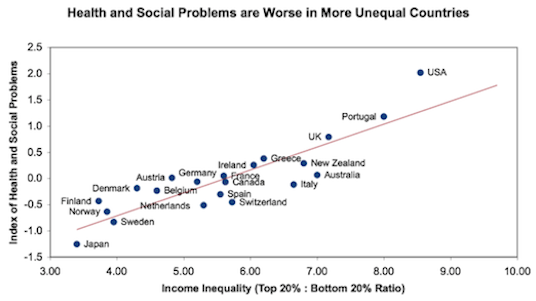
Evidence shows that a major contribution to serious emotional distress is not only poverty but particularly income inequality – the growing gap between the richest and poorest people in society. In their influential book The Spirit Level, sociologists Richard Wilkinson and Kate Pickett demonstrate that mental health problems are highest in those countries with the greatest gaps between rich and poor, and lowest in countries with smaller differences. Equal societies are associated with more trust and less paranoia. This suggests that rather than primarily targeting our efforts at individuals, the most effective way to reduce rates of ‘mental illness’ might well be to reduce inequality in society.

(Source: http://inequality.org/)

  • Reducing discrimination and oppression

A classic paper on this was published in 1994, entitled Environmental failure – Oppression is the only cause of psychopathology. Whilst some might think that goes too far, there is no doubt that people who have been subject to oppression, and particularly discrimination (racism, homophobia, discrimination on grounds or gender, disability or ‘mental health’) are put at risk by these experiences. We can all work to combat discrimination and promote a more tolerant and accepting society, the paper suggests. Tell that to ukippers!

  • Reducing harmful drug use and addressing its causes

Alcohol and tobacco are unquestionably the most serious substance-related public health issues, but cannabis and other drugs have been associated with mental health problems in general and psychosis in particular. Over-use of recreational drugs appears to make it more likely that someone will experience a psychotic crisis.
This does not necessarily mean that we need a stronger clamp-down on drugs and many people (including most Greens) argue that de-criminalising the possession and use of drugs would be an important positive step towards protecting people’s health. It is also important to address the social problems that lead people to turn to taking drugs, including poverty, inequality, unemployment, hopelessness and feeling disenfranchised from society. The supposed ‘war on drugs’ we hear so much about is, according to commentators such as Noam Chomsky, merely a cover for international interventions and, domestically, a distraction that allows repression in the inner cities and an excuse for attacks on civil liberties.

(various online sources)

The Spirit Level was a book I first read back in 2010, when it was first published. I read a review of it around the time I joined the Green Party and it resonated with the geographer in me and helped confirm my view that the income inequality was quite possibly the most important issue facing the country, the world and our role as guardians of the planet. It is an essential read for any ecosocialist. It has, of course not been anywhere near universally acclaimed, but the solid research underpinning it makes its assertions as irrefutable as, say, the evidence for global warming – i.e. it is only not clear to fuckwits and/or vested interests.

Of course, some of those vested interests control our media, so don’t expect rational coverage of such ideas. After all, 98% of scientists are in agreement on global warming, yet the media feel ‘obliged’ to offer both sides of the non-existent debate! The public therefore often form an opinion that there is a lot more controversy than there really is. These attempts to overthrow large bodies of scientific evidence that may have important political implications are a well-established practice, and the subject of another interesting read, Merchants of doubt: How a Handful of Scientists Obscured the Truth on Issues from Tobacco Smoke to Global Warming.

It may be beginning to sound as if I have been seduced by conspiracy theories and paranoia. Why would vested interests want to deceive us about global warming and work against drives for a more equal society? Well, don’t take it from me – take it from Noam Chomsky – arguably the most important intellectual alive today. I have been revisiting some of his views on ‘How the World Works’. It has re-affirmed my confidence in ecosocialism as the way forward – and re-inforced my loathing of the USA.

Chomsky explains how, ever since the Second World War, successive US governments have been committed to maintaining a right-wing status quo. For Republican, read Conservative (Tory); for Democrat, read Labour (Tory-lite). (Similarly, for Tea Party, read UKIP (ultra-Tory)) This means, in practice, business interests are always allowed to prevail, workers are divided and weakened, and the burden of reconstruction after wars/economic recessions/environmental disasters etc. is placed squarely on the shoulders of the working classes and the poor. Sound at all familiar?

Antifascists, socialists of any sort, and any campaigners for a fairer society, be they charitable organisations, religious orders, or intellectuals, were and are an obvious and unacceptable threat to this now-traditional order of things. The US became adept at installing fascists and Nazi collaborators in places where social revolution raised its ‘ugly’ head. If it required extreme violence (or even if it didn’t), that was never a problem. Sometimes softer measures sufficed – such as subverting elections or withholding/obstructing aid. Chomsky points out that the threat of a good example was considered such a danger to the status quo that no country would be exempt from being dealt with – no matter how weak or poor it was. He cites these examples:

“Take Laos in the 1960s, probably the poorest country in the world. Most of the people who lived there didn’t even know there was such a thing as Laos; they just knew they had a little village and there was another little village nearby. But as soon as a very low-level social revolution began to develop there, Washington subjected Laos to a murderous ‘secret bombing’, virtually wiping out large settled areas in operations, it was conceded, had nothing to do with the war the US was waging in South Vietnam.”

“Grenada has a hundred thousand people who produce a little nutmeg, and you could hardly find it on a map. But when Grenada began to undergo a mild social revolution, Washington quickly moved to destroy the threat.”
(Being a Commonwealth country, this was a rare occasion of British dissent against US intervention. The UK Government had no such problems with most of the following litany – Grenada did not break the ‘Special Relationship’)

Chomsky goes on to write the following, explaining and condemning the US responsibility for these devastating interventions (I have added some cultural references in brackets which prove we weren’t all blind to what was going on):

This is just a sample of the large scale war crimes the US and its friends (Thatcher and Blair to the fore) have been up to and getting away with. See a fuller selection here (and this is just up to 1999).

This makes every US President (and most UK Prime Ministers), since World War Two, war criminals – certainly by the standards they themselves set at the Nuremberg Tribunals. This is up to and including Obama and Cameron.

Looking forward, the question needs to be asked as to just how long left-wing progress, in places like Greece (Syriza) and Spain (Podemos), will be allowed before the ‘right’ attempts to orchestrate its catastrophic demise.

In the meantime, Syriza in particular has offered us a shining beacon of hope that change via parliamentary democracy may yet be just about possible. There have been rumblings of change around the globe. The Arab Spring and Occupy have been effectively nipped in the bud, but what of rumblings in these isles? There is a very tangible wave of anti-Westminster sentiment sweeping the land from an eclectic range of sources; be it UKIP, the Scottish YES campaign, the anti-austerity alliance (potentially) of the SNP, Plaid Cymru and the Greens, or Russel Brand’s no-vote ‘Revolution’.

Has anyone noticed the media spin on all this? Years of apathy and, by inference, tolerance of the status quo, was portrayed as stability. Now that people are finally beginning to get off their backsides and organise, we are in a crisis of democracy! The Economist recently portrayed it thus:
“Between 1980 and 2000 democracy experienced a few setbacks, but since 2000 there have been many”   Really?
This is a classic example of right wing propaganda. It is targeting the politically literate (maybe 20%) who may have some role in decision making. Their acceptance of the underlying doctrine is crucial. They are constantly drip fed it through the broadsheets and the BBC. The vast majority, however, are sometimes characterised as ‘the bewildered herd‘.They are supposed to just do as they are told and put their trust in the ‘responsible’ people. They are the target audience for the less subtle mass media – the tabloids, the sitcoms, Premier League football etc.

The undermining paradox of tory doctrine (be it the full-fat, lite or ultra variety) is that creating greater inequalities actually increases the need for big government – more police, more prisons, more health and social services. These services are always expensive and never fully effective. The most effective and civilised way to achieve the Tories’ purported dream of a smaller state is reducing inequality. The Scandinavians sussed this out a long time ago. It is not rocket science, so it suggests that Chomsky’s critique is the one prevailing. There will be no ‘good example’ here in a hurry! Corruption and the unbridled greed of the ruling classes will see to that. Thatcher and Blair have embedded a tolerance of this in the UK public, which we see today in the pro-austerity agenda of the Con/Lab/Libs at this General Election.

The Labour Party has to take the greatest responsibility for perpetuating the appalling status quo. We expect nothing else from the Conservatives, but with its history of emerging from the workers movements and trade unions, with proud achievements such as the creation of the NHS, the Labour Party has become a disgusting travesty. Watching Lord (vomit) Kinnock and Saint Blair milk their status to the max must be making Milliband’s mouth water. After all, Kinnock never even managed to win a General Election, losing two even when Thatcher had been rumbled as the Wicked Witch of the West.

To quote from The Spirit Level:
“It is now time egalitarians returned to the public arena. We need to do so confident that our intuitions have been validated and found to be truer than most of us ever imagined. Because the evidence shows that few people are aware of the actual scale of inequality and injustice in our societies, or recognise how it damages the vast majority of the population, the first task is to provide education and information.”

I guess this is what I am hoping to achieve as my contribution to the revolution we need to bring about. We need to address the bewildered masses. We are on the right tracks. We need to keep asking questions, keep demonstrating, keep writing letters, keep voting. It has to be sustained and organised. We need to keep learning from our mistakes and keep working with the right people in a non-sectarian way for the common good.

But we had better watch our backs and beware of the biggest single threat to any possible peaceable revolution, ‘the world’s rent-a-thug’ as Chomsky calls the USA, appropriately enough. History tells us that when they feel the winds of social change gathering momentum, they will stop at nothing. With the British Establishment as longstanding allies, it is almost certain to get ugly at some point.

But to end on a more positive note, I will now go and meditate on this now:

Green Party 2015 General Election Manifesto

A couple of days ago, the Green Party (GPEW) launched its manifesto for the GE in three weeks time. Indeed all the parties have been busy launching their manifestoes in the last few days. They make interesting reading.

A manifesto is a published declaration of the intentions, motives, or views of the political party. A manifesto should usually accept previously published policy but can promote new ideas and prescriptive notions for carrying out changes the author(s) believe(s) should be made.

I can assure everybody that the Green Party does this properly and rigourously (in part because I was responsible for a small part of it – yes, on fracking). I would like to publicly commend the work of Brian Heatley, in particular, and all the many other contributors, for providing such a well written, thorough document that is accessible to all (via the full range of versions available)

Lots of work has gone into costing the pledges within it, which makes it disappointing when we hear Natalie Bennett and Pippa Bartolotti floundering around for a few headline figures in interviews, and even more disappointing and disingenuous of some of the media to exploit these personal weaknesses when the figures are readily enough to hand. Sample pledges:

  • Investment in renewables (£35bn)
  • Increase in NHS budget (£12bn, then 1.2% p.a)
  • Early years education (£8bn p.a.)
  • Class size reductions (£1.5bn p.a)
  • Abolition of tuition fees (£4.5bn)
  • Cancellation of existing student debts (£30bn)
  • Increase in Social Housing budget (£4.5bn p.a.)
  • VAT reduction to 5% on restaurants/tourism and related + home renovation (£7.6bn p.a.)

Sample budget increases:

  • Cancelling Trident and nuclear disarmament (£100bn+ over 30 years)
  • Stopping landlords writing off mortgage interest against tax (£5.8bn)
  • Increasing minimum wage to £10p/h (£2.4bn p.a. saved on tax credits + £1.5bn increase tax/N.I. revenue)
  • Wealth tax of 2% on top 1% (£10bn in 2016 and rising)
  • Robin Hood Tax (£5bn in 2016 and rising)
  • Abolition of upper NI threshold (£14.5bn in 2016 and rising)
  • Increase in Corporation Tax (£12.5bn in 2016)
  • Reducing tax evasion (£12bn in 2016 and rising)
  • VAT & fuel duty on aviation fuel (£16bn in 2016)

Over the course of a 5 year parliament, the manifesto details £672.7bn of revenue increases to set against £136.9bn of revenue decreases. This gives a net increase in revenues to fund our programmes of £535.8bn. Of course, some of these issues, especially regarding health and education, are devolved matters. Which brings us to Wales Green Party. Available in English and Welsh (of course), they have produced a kind of addendum designed to go alongside the GPEW manifesto. Sounds fair enough, but at the time of writing the links to it on the Wales Green Party website are not working – possibly due to an attempt at rectifying a bit of a gaffe (shurely not!) over the ever-sensitive issue of Welsh independence. The manifesto for the Green Party of England and Wales states:

“Greens have long supported the process of devolution in Wales. We believe that the people of Wales should enjoy the degree of autonomy, perhaps including self-government or independence, that they wish to have, as expressed in a referendum. “Up until such referendum, Greens in Wales will focus on improving and maximising the potential of the current settlement.”

Hear, hear! But the Welsh addendum doesn’t mention a referendum. Au contraire, their stated approach to Welsh governance is pretty much identical to the mainstream neoliberal parties with Wales having to settle for a ‘reserved matters’ form of devolution. The Welsh manifesto addendum states:

“We believe that the starting position should be that all powers are devolved from Westminster to the Welsh Government except for those that are best retained at a UK level.”

Not surprisingly, this discrepancy is already being jumped on to illustrate how out of tune WGP continues to be with GPEW. I had better stop here methinks!

P.S. The link to the Wales addendum became functional again a few hours later – unamended as far as I can tell. On reflection, it seems to be more of an early bid for support in the Welsh Assembly elections next year than having much relevance to the General Election this year, but that is fair enough and more realistic I suppose. Achieving some success in those WA elections would be all the more realistic with some form of pact with PC in place – but WGP’s position (at odds with GPEW) on Welsh governance makes it clear that this will not happen.

Votes for Policies – if you dare!

VOTES FOR POLICIES https://voteforpolicies.org.uk/

I thought I better check where I stand theses days, and it looks like I am still a rock solid Green:

And it also looks encouraging for the Greens in Bridgend, if they get their act together to put a candidate up!

If you keep visiting the site, it will update the figures as we approach the election. Despite all this, I still predict a probable lost deposit and 5th or 6th place, if the Greens stand. Finishing ahead of UKIP would represent some sort of worthwhile outcome.
As well as the usual Lab/Con/Dems, we also have Plaid Cymru, TUSC and our friends in the Pirate Party vying for some of our target audience (and UKIP).
With FPTP, it is a lot easier to hang on to votes you shouldn’t have, than to gain votes you should have.

Voting for what you really want is a tactic that too few run with – and the strategy of the left factions standing against each other makes it so.

If there was a SYRIZA-like coalition of the left, between Greens/PC/TUSC/Pirates, Labour MP Madeleine Moon would be out on her ear and have to start paying for her own jolly trips all over the world, instead of having another 5 years serving Porthcawl (I doubt she even knows where Wildmill is) handed to her on a plate.

Hey ho!

P.S. Just to bang on about the same point a little more – here are the current scores for Ogmore constituency. The potential for a joint Green/PC assault on this safe Labour seat is clear enough. Instead, we have two people I have the utmost respect for going head-to-head and getting nowhere (I suspect).

Screen Shot 2015-03-24 at 14.25.35

Andy’s PV solar panels’ performance – 32% saving

We had this installed in late November 2013 by A Shade Greener at absolutely no cost to us whatsoever, and have found the company as good as their word at every stage. They get the ‘Feed In Tariff’ for all the electricity generated. We get to use as much of the electricity generated that we can for free, with the rest feeding into the grid. The onus is on us to organise our household and activities to gain the optimum benefit, but the bottom line is that we gain some benefit every time the panels produce anything (there are always appliances such as fridges/freezers, and things on standby, using some electricity). We will always have an electricity bill for what we use over and above what the panels produce at a given time – and through the night of course!

A few things need to be taken account of before looking at the figures.

  • This is a maximum size installation of 4kWp, using slightly bigger than usual panels.
  • Our house faces a bearing of 210 degrees, which is 30 degrees off the due South which gives optimum performance.
  • The company will consider installations up to 45 degrees either side of due south i.e. anywhere between bearings of 135 (SE) and 225 (SW) degrees.

SO, WHAT SAVINGS HAVE WE MADE?

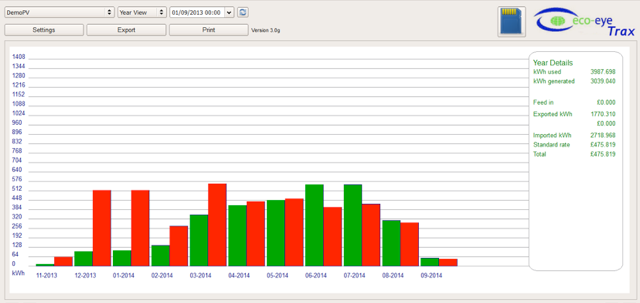
The data comes from our eco-eye monitor, which cost us £60. This is the only outlay we have made, as A Shade Greener don’t supply one (it makes no odds to them whether we use the electricity produced or not), but I would say it is very worthwhile as it flags up when there is surplus electricity available for us to use – time to put the washing machine or dishwasher on – and also provides the data below (and masses more):

(I had hoped to show the whole of 2014, but the memory card became full in early September, so ignore the incomplete months of Nov “13 and Sep “14)

The graph indicates the electricity we used in red and the electricity generated by the panels in green.
I am puzzled why we used so little in February last year, but otherwise the pattern is much as may be expected. We find:

  • Peak consumption in Dec/Jan/March; lowest consumption in (bar odd data for Feb) in Jun/Jul/Aug
  • Peak production was in Jul/Jun/May; with lowest production in Dec/Jan/Feb
  • Production actually exceeded consumption in Ju/Jul/Aug

However, there is always a mismatch between times of production and times of consumption, so how does this pan out?

Of the 3039kWh generated by the panels, we exported 1770kWh, so we used 1269kwh of it (42%). Had we managed to use all 3039kWh, this would not have covered all of our consumption – but would have covered 76% of it.

Over the period, the house used 3988kWh, importing 2710kWh of it (68%), so we have a headline figure of 32% saving – just below the 37% average saving cited by A Shade Greener:

In monetary terms, it depends what unit rate you are paying. We currently pay 14.04p per unit to Ecotricity.
The 1269kWh we got from the panels was therefore worth about £178, but this excluded Sep/Oct/Nov. If we assume these would have been average months, the annual saving would be around the £235 mark.
There is plenty more we could do to optimise our use of the panels’ production, but we are getting worthwhile savings and also passing our surplus into the grid, reducing the need for non-renewable production.

It really is a no-brainer!

P.S. If you call A Shade Greener in, don’t forget to mention my name!

There’s a black dog on my shoulder again

‘Black dog’ as a metaphor for depression: a brief history

Apologies for my rather sudden disappearance from social media (feel free to share this page if you see fit) and withdrawal from my usual activities. I suffered something like a perfect storm of work, political and personal setbacks that, over a considerable period brought me crashing down a few weeks ago.

I am just about beginning to function again, but it may take a while before normal service is resumed – if it ever is.

I am, however, beginning to become hopeful of taming the black dog and managing its behaviour to avoid another meltdown on this scale again (this is my third major episode), and this is the reason I am writing this post – to share the source of this hope.

Depression is the scourge of modern living and the facts and figures speak for themselves: Mental Health Statistics

Screen Shot 2015-03-16 at 21.12.52

So, a quarter of you probably have some sort of idea what it is like to be a sufferer, which means three quarters of you haven’t a clue, because you really cannot know what it is like if you haven’t been there.

Because it effects people everywhere and of any background, it does mean great intellectuals and artists suffer at least their fair share (there is some evidence that rationalists may suffer more). Some have attempted to share and explain the experience.

The Manic Street Preachers ‘Black Dog’ song above comes from their ‘This is my truth, tell me yours‘ album that contains some other insights such as:

Another perhaps unlikely source of insight into depression is Ruby Wax. She has suffered a lot more severely than I have and describes it well here: 

Screen Shot 2015-03-16 at 21.15.27

“I remember why depression is so awful now that I’m back in that land; there is no specific sharp, jabbing or throbbing pain, there is no feeling. This is the sensation people are after when they take certain drugs to forget but even then they know it’ll wear off. This isn’t recreational it’s terrifying. There is no one in your body to even register pain. There is nothing, empty space, whoever you were who lived in your skin has left the building, vanished. I can recall back in a fog that I had a fast mind, a quick wit, insight into others; it feels like I’m talking about a distant relative. People remind you that you’ve accomplished things I’m sure it’s true but then I was someone else not this thing. That what it feels like in reality I know it’s not true but this again is a symptom of the disease.”

However, she goes on to explain that, although she has not got a cure, she has found a way of managing and taming it – a way that has connected with me too:

“This time I’m not fearful about having the actual depression. Having studied it, I know this is what it is. I’m not fearful that I’m making this up and I can ‘snap’ out of it. That said, fear is a symptom of the disease; I feel I’m in full emergency mode because my chemicals are in full emergency mode, not dependent on any outside stimuli but because they have started to flood my brain and cause havoc.”

Screen Shot 2015-03-16 at 21.17.45This starts to give a clue as to how to handle the ‘black dog’ of depression. There is something physiological going on in terms of chemicals at work in the brain. This is why medication can and does help. What medication cannot do, however, is help you manage the thought processes that can trigger, accentuate and perpetuate the downward spiral into a depressive state. This is where counselling and talking (cognitive behaviour) therapies have been developed, along with all manner of ‘alternative’ therapies. But there are a couple of major problems with most of these. Firstly, you only get a referral to such services once the depression has taken hold and is relatively severe. Secondly, they are often built around stuff that is easy to dismiss as wooly and/or mumbo jumbo. If you buy into it, like a good placebo, it is likely to have a positive impact, but for rationalists like myself and Ruby Wax, if we don’t understand it, we won’t buy into it and it will never work. This is perhaps why rationalists end up suffering more.

What we need is something that we can see having a scientific basis and underpinning, alongside something we can build into our daily lives to help avert and manage our depressions. Ruby Wax has done the due diligence and found something that is (all too) slowly becoming a recognised way forward. It is called MINDFULNESS-BASED COGNITIVE THERAPY (MBCT) – I’ll simply call it ‘mindfulness’.

Ruby Wax went to the extreme lengths of studying it for a Masters degree from Oxford University, where the whole concept has been developed (with others) by a guy who has become one of my gurus, Professor Mark Williams. I use the term guru quite deliberately as the the whole programme, as the Prof fully acknowledges, owes a lot to the ancient wisdom of Buddhist traditions in terms of mindful meditations. I have long acknowledged the Buddhist world view and traditions as vastly superior to other (religious) traditions, and I am happy to advocate MBCT as a bit like Buddhism minus the paraphernalia but bolstered by science.

I was first introduced to mindfulness and Prof Williams’ work by my GP quite a while ago. However, he threw me straight into undertaking the meditations and I quickly dismissed it all as more wooly nonsense and refused to buy into it. It wasn’t until I recently heard Ruby Wax advocating it, and joining up a few dots for me, that I finally bought into it properly and started to do my own diligent research.

Here’s Ruby’s TED  talk.

Screen Shot 2015-03-16 at 21.19.57
Here’s her (a) book  Screen Shot 2015-03-16 at 21.23.09

(b) audiobook and

(c) tour.

Here is Prof Mark Williams’ introducing the concept in a reasonably accessible way: Science Live lecture 2012. His calm, engaging voice helps inspire confidence and I recommend sticking to his publications and recordings.

Screen Shot 2015-03-16 at 21.27.13        Screen Shot 2015-03-16 at 21.28.52

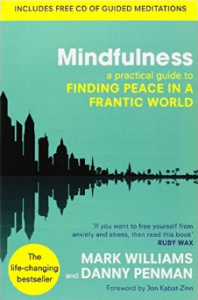
The beauty of the 8-week programme is that it is easy enough to self-administer with the aid of one book and its accompanying CD     (Audiobook format)

I am currently into week three of the eight week programme. Although it is impossible to say whether the small improvements in my condition are down to increased medication, or being signed off work, or the mindfulness guided meditations, or the love and support received from family and friends, or any possible combination of these factors – I can say quite categorically that the meditations are something I look forward to doing for the peace they give me for a few minutes at least (nothing offered me proper peace of mind before). I can also say categorically that I now understand the principles (if not the detail) of the science behind the whole approach, and thereby buy in to the whole strategy. It offers real hope of being able to cope much better with the mad world we live in.

What it all means for me returning to campaigning and politics remains to be seen. Being in the Green Party is swimming against the tide (the green surge has slowed the tide, not reversed it). Being an ecosocialist within Wales Green Party is battling against a further rip current. I became exhausted and drowned. I will not be rushing back to that environment. I have other more pressing priorities for when I am in good enough shape to take them on – namely sorting out my employment situation and properly attending to the wonderful people in my life that I may have taken for granted and neglected for too long. They have been my lifesavers and I owe them everything.

I fully acknowledge that part of the great depression that envelops many people is not having the support of other people around them. But at the end of the day, sufferers of depression, and indeed everyone living the rat race of a life we have created for ourselves, have everything to gain and nothing to lose from allowing mindfulness to give you that little bit extra control of your mind and the life your mind creates for you.

As Ruby Wax explains in her TED talk, we are simply not designed for the lifestyles we have created for ourselves. Material wealth and all the opportunity to ‘progress’ in the world does not create happy, well-adjusted people. Coming to terms with this truism and learning to enjoy the here and now has to be (at least part of) the way forward.

I have exhausted myself now. I will leave you with Ruby’s words, as she expresses it better than I can:

“It’s hard for me to write this and come up with words and sentences because it feels like no one is at the wheel of the ship – so who’s writing this? I’m pushing myself to keep going so I can remember what it looks like when it’s written down and for everyone else who suffers with this to say this is not your imagination, you are not being self indulgent (I’m fighting my mind on that one). It’s exactly what it says on the bottle, it’s poison, terrifying and a complete mummification in nothingness. This is physical and some part of your brain is trying, as it always does, to find a reason. For other illnesses when you feel sick there’s an explanation – you might say to yourself, “Of course I feel terrible I have an infection, a virus, cancer” (pick one). With dementia at least you might be the last to know that something is wrong, but with depression you’re completely aware and cognisant that you’re gone and what’s left of you is on auto pilot that tries to steer you into the bathroom and find food and that’s about it. I feel I’m on a sinking ship and this writing is an SOS signal.”

There is no need to send me a lifeboat, but a little patience while I get my shit together would be appreciated. Thanks.

PS – I just stumbled across this video from another of my idols: Rational and Rambling 

Screen Shot 2015-03-16 at 20.59.10