My first reaction, after the the outcome of the General Election became clear, was that I should pack my bags and move to Scotland. This was a gut reaction, but one that has given me serious pause for thought; thoughts that I feel need sharing if we are to ever share Scotland’s new air of optimism and commitment to real change, rather than continue under a cloud of despair as we find ourselves faced with Cameron et al completely untethered and unleashed, shaping our destinies.
My starting point has got be why I did not vote Plaid Cymru. It is well documented that I fully recognise the extent to which Plaid Cymru’s manifesto shares most of my ecosocialist core values. I also fully acknowledge Leanne Wood as one of the most talented politicians in Wales. The bottom line is that if they cannot persuade me to vote for them, then their chances of getting 50% of the vote and sweeping all before them, as the SNP have just done, are non-existent.
I believe that there are three main ingredients needed to connect with the electorate as the SNP have just done:
- Image
- Messaging
- Leadership
The SNP, after years of floundering around, finally got these spot on, and this allowed them to successfully capitalise on being in the right place at the right time. After failing to get the outcome that they were committed to in the Independence referendum last year, it would have been all too easy for them to have withered away.
Replacing Alex Salmond with Nicola Sturgeon was the first essential piece of the jigsaw. Salmond was excellent and instrumental in getting the SNP to be seen as a viable party of government in the Scottish Parliament. He was also the right person to head the YES campaign re independence. He could not have carried on into this General Election campaign, however, and credibly delivered the messaging required to appeal to Scots across the land (that voted both Yes and No last year) and achieve the astonishing gains witnessed this week. But in Nicola Sturgeon, he had an excellent apprentice who could set about subtly reshaping the image and messaging required. This took outstanding strategic leadership, alongside the personal characteristics to convincingly sell the message to the electorate.
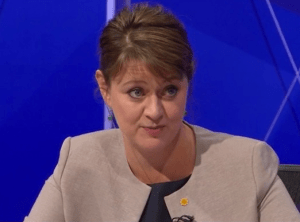 Leanne Wood is on a par with Nicola Sturgeon, in my opinion. She has a natural ease and sense of conviction that connects with people. She has an engaging smile and a sense of fun, but can equally turn on the ‘don’t mess with me, I’m a Valleys girl‘ glare that stops anybody taking liberties with her. She is the right leader, especially given the lack of any appealing alternatives. Her personal image is just fine. The image issues are with her party.
At this point, I am going to inevitably start rattling some very predictable cages. I do so with some trepidation as I have fallen foul of the Welsh language fascists (in this sense) before, but I do so in the hope that they will hear me through and see that I offer this analysis in a spirit of friendship and wanting to help Plaid Cymru emulate the SNP’s success. The first thing I need to stress is that these are not just my views in isolation. I am drawing on published sources as much as possible.
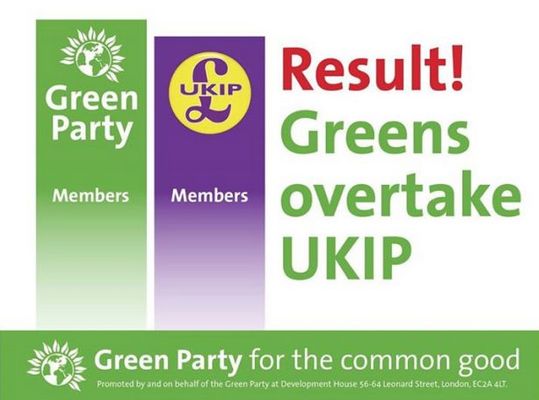
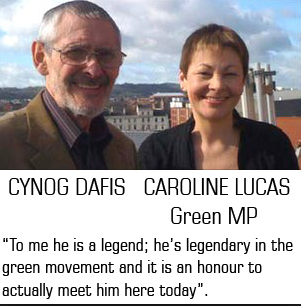
In dealing with problems of image, it is not even necessarily the case that the problem is grounded in reality. The Green Party, for instance, has longed been dogged by its image as the ‘hippy environmentalist fringe party‘, the classic ‘single issue party’ image that is totally at odds with the reality of a comprehensive ecosocialist agenda that they struggle to get people to listen to. The name does not help. Mentioning the environmental issues, that are taken as given, is a no win situation. Having members that are only too willing to pander to the stereotypical images seals the deal.
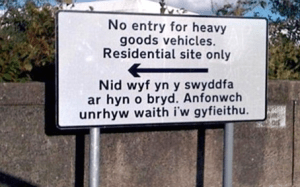
Click image to get the story behind this sign
Plaid Cymru has exactly the same set of problems. Its prevailing image is as the ‘Welsh language preservation society‘, the classic ‘single issue party’ image that is totally at odds with the reality of a comprehensive ecosocialist agenda that they struggle to get people to listen to. The name does not help. Mentioning protecting and promoting the language, that is a given, is a no win situation. Having members that are only too willing to pander to the stereotypical images seals the deal.
A New Statesmen article, written just a few weeks ago, cites this issue as its main answer to the question ‘Why aren’t Plaid Cymru surging?‘. I quote:
“The biggest problem for Plaid in the areas where it is failing to make the breakthrough only becomes apparent as I head north. Complaints about the amount the Welsh government spends on dual-language signs become laments about the vanishing language as English speakers move north. Fears about the mortgage become concern about being priced out by holiday homes. And public transport – and with it, links to the English cities of Liverpool and Chester, which ought to be the engines of growth, are brittle and unreliable.”
 When your image is inextricably linked to one issue (Scotland, Ireland, Brittany, Cornwall all have some dual-language road signs without brow beating everybody about the languages), you alienate everybody, like me, that might agree with everything else you have to say, who have simply found no need to embrace the language despite living here 25 years, because you pander to the more unpleasant aspects of nationalism, such as racism, bigotry and hostility towards outsiders that are present in a small part of the membership. The New Statesmen article goes on to conclude:
“One Labour MP in Scotland mused to me recently that “the SNP’s great strength is their grievance is imaginary – it’s about a better state, a better way of living your life, a better politics…and that is very hard to fight”. Plaid Cymru’s weakness is that their grievances are more concrete: a fading language, communities cut off from the prosperous south of the country or England’s Northern cities. Progress in tackling them, far from strengthening the party, actually weakens it: one Plaid activist describes how, in years gone past, the Welsh language attracted hostility on the doorstep. “Now people think it’s sweet,” they sigh. And that may be the biggest problem of all for Plaid Cymru.”
Amongst the general electorate and typical Labour voter, whose political illiteracy cannot be over-estimated, certainly in the extensive parts of South Wales in which I live and work (I work with adults with poor literacy and numeracy), these image issues are usually the first, and certainly the most-cited, reason for not voting Plaid Cymru.
Q. “Why not vote for the strong socialist policies of Plaid Cymru?”
A1. “Well, I don’t speak Welsh!”
A2. “I might be Welsh, but I’m not that Welsh!”
It staggers me just how many don’t even know what Plaid Cymru translates to. They recognise it as welsh words, and many recognise the Cymru bit, but the Plaid bit flummoxes many. A woman I considered reasonably intelligent told me it meant ‘kilt’. Or should I say cilt? The SNP have no such problems. Scottish National Party is clear and unambiguous. And being universally known by the initials is even better. It is snappier and tucks away the ‘N’ word that puts some off. Plaid Cymru runs into problems relying on its initials, as PC has too many other uses with unfortunate connotations.
Professor Roger Scully (Professor of Political Science at Cardiff University) has been known to compare Plaid Cymru to Radio Three: “People are glad it is there, they are well-diposed to it, but they don’t want to listen to it themselves”. This re-enforces the ‘Welsh language preservation society’ image, and sits alongside the ‘Museum’ attitude of saying I want things preserved for posterity and to preserve our culture, but don’t expect me to visit it very often, even if you make it easy and free!
The SNP and PC are both seeking to be parties of their country’s best interests, so how can such ‘national’ parties dodge the intrinsically vile connotations of ‘nationalism’ to become parties of the people? The SNP have managed it, and PC patently have not. Beyond the image issues already discussed, the secret has got be in simple, consistent, straightforward messaging.
The SNP and Nicola Sturgeon, got this spot on. The messages were:
- We are NOT talking about independence
- We are against the unnecessary austerity agenda of the Westminster establishment parties (broken down for the many that are unclear what ‘austerity’ means – protecting the public services we rely on; ending exploitative work practices; ending poverty; a positive future for the young)
- Labour have consistently let us down because they have sold their souls to become part of the Westminster establishment
- The Westminster parties should be given no mandate to control Scottish lives – we can do better for ourselves.
In essence, it was a very clear anti-austerity, anti-Tory, anti-Westminster message, and not an attempt to foster a post-referendum rise in nationalism (which would have failed). Sturgeon mentioned Westminster for more times than she mentioned Scotland in all of her dialogue. The message was always primarily about fighting the forces of evil, that everybody could relate to, rather than banging on about Scottish identity and making it a ‘Scotland hates the English’ thing that would have turned people off. It was underpinned by a strong record in power in the Scottish Parliament and a strong record in local government. This is the order of things. You build credibility from the ground up – via first local councils and then national assemblies. Only then can you aspire to dominate at UK elections as the SNP have done.
Plaid Cymru have a strong base of councillors on which to build, but they need to quadruple the numbers to overtake Labour (as the SNP have done in Scotland) and they need to start controlling some councils successfully too (PC control none at present, unlike the SNP). From here success can happen at Welsh Government level – where PC need to treble their representation to take control.
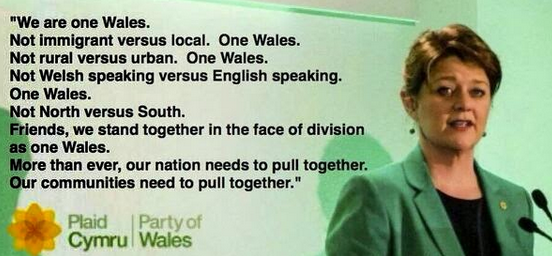
PC therefore simply did not have the right base from which to surge as dramatically as the SNP – but there are no reasons why they should not aspire to make huge inroads in the WG elections next year. Given that the SNP managed to re-position itself after the Independence referendum so successfully in such a short space of time, PC do still have the time to get it right, if they can get the image and messaging right. Leanne needs to stop banging on about fighting for the people of Wales (which gets subliminally translated as the proper Welsh people; you know, the ones that can speak Welsh, or at least pretend they can by having a few Welsh lessons), and keep the focus on the common enemy, which is the Westminster elite (including Labour) and their austerity programme of robbing the poor to give to the rich (although 11 constituencies voted for exactly this by electing Tories!! Another problem the SNP didn’t have to face as there was only one Tory seat to start with in Scotland – one of only 3 to resist the SNP tsunami). It was a tacit confession that this needs addressing when Leanne said this: 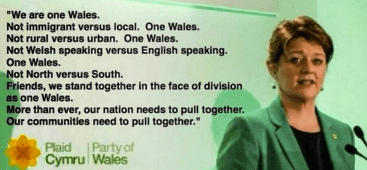
On top of the messages that were central to the SNP’s success (above), PC can add the leverage of Scottish Labour’s demise, and their woeful performance in both England and Wales, to press home the message that Labour are a spent force, finally being outed as the traitors to their proud heritage that has long been happening, but only now being widely recognised. (Labour MPs who voted in Jan 2015 for Tories ‘Charter for Budget Responsibility’ requiring £30bn of cuts in next 5 years: here)
If this is the way PC choose to go forward, then I am in, and will fight alongside them, indeed with them. If they want to carry on being seen as as little more than cultural guardians, then so be it. Valuable work, but not for me. There are far more pressing battles I want to fight and win.
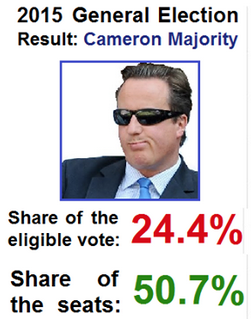
One obstacle to me supporting Plaid Cymru has already fallen. I no longer see a future for the UK. Given the surge in Conservative support (Tory and UKIP) that has swept through England (they are effectively English Nationalists), leaving us with the prospect an unbridled assault on the vulnerable by Cameron and co., I have come to the conclusion that whatever the difficulties it might bring, home rule for Wales is the only way to get out of their firing line. It is very surely time to exercise our right to self-determination, as the future we can determine for ourselves can only be better than that which the Tories will leave us. Without 40 plus seats in Scotland for Labour, it is hard to see how we can ever shake off the hold of the Tories. A renewed drive for Scottish independence seems almost inevitable, leaving us with these unpalatable images (of the 2015 GE outcome and a post Scottish Independence UK) to digest:
If Plaid Cymru cannot welcome in a committed ecosocialist, who happens to also be a bit of a cultural heathen, then it has no prospect at all of appealing to the size of support achieved by the SNP currently. Let us see what happens.

 Despite their emasculation since Thatcher’s time, trade unions still represent the best protection we have from workplace bullying. Find the best one for you here: UNION FINDER