A Review and Synopsis of the Scientific and Technical Evidence Against Hydraulic Fracturing (or ‘Fracking’).

A Review and Synopsis of the Scientific and Technical Evidence Against Hydraulic Fracturing (or ‘Fracking’).

Andy Chyba B.Sc. (Hons)

Revised edition, September 2015. On behalf of Frack Free Wales

Preface

This paper seeks to present a summary of the key scientific and technical evidence against hydraulic fracturing. In this sense it does not pretend to be balanced in terms of looking at evidence supporting the industry. It is incumbent on the industry and its supporters to produce any such evidence and to combat the evidence I present here. I have, however, done my best to use credible and respected sources throughout. This is also not exhaustive in terms of issues related to hydraulic fracturing. Issues such as noise, HGV traffic, property values, loss of amenity, and impacts on biodiversity, agriculture and tourism are outside the remit of this paper, but also far from insignificant.

CONTENTS:

1.     INTRODUCTION                                                                                                                         

2.     BOREHOLE CASINGS                                                               

3.     SEISMICITY                                                                                   

4.     EXPLOSIVE FRACTURING                                                     

5.     HYDRAULIC FRACTURING (fracking)                             

6.     HEALTH IMPACTS OF FRACK CHEMICALS                 

7.     DISCLOSURE OF CHEMICALS                                             

8.     HANDLING FLOWBACK WATER                                       

9.     SILICA SAND                                                                                

10.  AIRBORNE POLLUTION                                                          

11.  WATER RESOURCE IMPLICATIONS                                 

12.  CLIMATE CHANGE IMPACTS                                             

13.  IN CONCLUSION                                                                        


1. INTRODUCTION

1. The technical and scientific problems/issues with the new generation of hydraulic fracturing (fracking) methods span the spectrum from the molecular to the global scales. The key differences between traditional ‘conventional’ fracking and the recent so-called ‘unconventional’ innovations of the last 15 years or so are summarised in Table 1[1]:

CONVENTIONAL DRILLING

UNCONVENTIONAL DRILLING

Well type

Vertical

Horizontal

Well pad footprint

1 to 3 acres

3 to 6 acres

Water requirement per frack

20,000 to 80,000 gallons

2 to 9 million gallons (ave. 4mill)

Chemicals required

Few

Many and varied

Fracking frequency

Rarely

Frequently

Nature of resource

Large pocket of resource; easy to extract

Scattered throughout the rock; hard to extract

Table 1

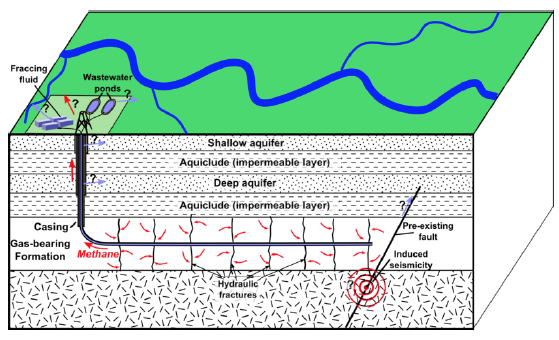
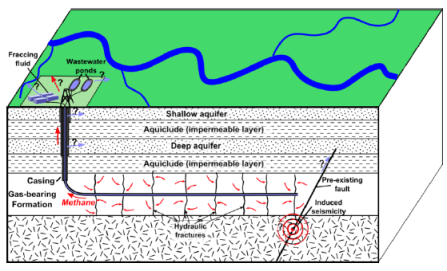
2. The unconventional process is shown schematically in Figure 2 [2]. Note the 7 question marks, which highlight just some of the problem areas.
Screen Shot 2015-10-08 at 22.31.52

Fig 2

? = (Left to right, top to bottom): frack fluid spills; blow-outs and pressure release vapourisation; safe handling and disposal of produced wastewater; poor fitting casements and leaks into soil/regolith near the surface; contamination of deep aquifers through cement faults; pre-existing faults through aquiclude exacerbated by fracking itself; seismic activity creating new faults, extending existing ones; destroying integrity of casings.

2. BOREHOLE CASINGS

1. Once the drilling has taken place, the process of casing the borehole is undertaken. This is the process that is supposed to ensure there are no subterranean water contamination issues.  “It’s an engineering process that is too hard to do perfectly,” said Tony Ingraffea, a professor in Cornell’s School of Civil and Environmental Engineering, “even with the best personnel, cements and equipment.” [3]  He has found that some leaking (of gas and fluid) is inevitable due to failures in the metal casing or cement, contaminating underground sources of drinking water and damaging air quality. In fact, statistics show that even new wells fail and that a higher percentage fails with age. The gas industry has been studying the ongoing problem for decades, and knows these statistics full well.

Screen Shot 2015-10-08 at 22.34.402. In a report entitled “Well Integrity Failure Presentation“, drilling service company Archer reports that nearly 20 percent of all oil and gas wells are leaking worldwide. A 2003 joint industry publication from Schlumberger, the world’s No. 1 fracking company, and oil and gas giant ConocoPhillips, cites astronomical failure rates of 60 percent over a 30-year span. [4]

3. The casings fail for many reasons: failure to ensure gas tight fitting of the metal components; the technical difficulties of ensuring consistent flows and quality in the cement (just about impossible with such long and non-straight boreholes); ground shrinkage around the boreholes; poor mud displacement; and seismicity (natural or induced) destroying the integrity of the cement and distorting the fit of the metal casings.

4. Rumours of self-healing concrete have abounded for quite a few years, but commercially useable versions are only just coming to market. It has been proven effective on buildings, but remains unproven in borehole casings. Predictably, it is also very expensive, currently costing twice the price of conventional concrete. [5]

3. SEISMICITY

1. With reference to seismicity, not only is fracking highly likely to induce it[6], but the sorts of area that are being explored in the UK are amongst the most seismically active parts of the country. The January 2015 quake in Leicestershire, while not fracking related, would have been more than enough to threaten the integrity of borehole casings for many miles around. Parts of Leicestershire are in the frackers sights. The lies and deceit of people in the industry are demonstrated by Cuadrilla’s CEO stating on BBC television that: “There are procedures we can put in place to practise earthquake prevention” [7]. The fact of the matter is that, to quote the US Geological Survey, People can’t stop earthquakes from happening. People can significantly mitigate their effects by identifying hazards, building safer structures, and learning about earthquake safety” [8]. Fracking is, patently, the absolute antithesis of earthquake mitigation.

4. EXPLOSIVE FRACTURING

1. Once they have drilled into the gas bearing rocks (e.g. shale) the next stage is the triggering of explosions at regular intervals along the horizontal section of the borehole within the target strata.  Predicting the extent of the resultant cracks is hard enough in a theoretical model, but in absolute terms is impossible due to the vagaries of deep subterranean geology. Pre-existing faults can be very difficult to identify by current survey techniques and continues to be an area of intense research efforts[9]. Very minor ones can also be accentuated by the fracking explosions. Fractures can extend for 2500 ft and are frequently up to 1000ft. They can spread to neighbouring strata and through the target strata to neighbouring wells [10]. This means that there is no assurance that the aquiclude layer is secure above the target strata, either before or, especially, after fracking operations.


 5. HYDRAULIC FRACTURING (fracking)
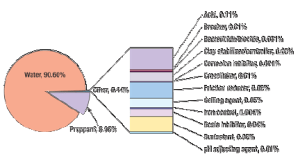
Screen Shot 2015-10-08 at 22.36.481. Once the explosive fracturing has happened, the hydraulic fracturing is undertaken to extend the fractures still further and prop them open with sand. With the old conventional methods, there was rarely any need to use more than water and sand (the sand acts as the proppant in the cracks).  But the newer unconventional methods (because of the length of boreholes, the drilling technology, the high pressures being used and the nature of the geology) require a whole cocktail of chemical additives to facilitate the processes.

The industry itself admits to the frequent need for the following ingredients [11]:

·                Strong acids to dissolve minerals

·                Numerous poisonous biocides to eliminate bacteria and algae

·                Friction reducers such as acrylamides and mineral oils

·                Corrosion inhibitors to protect drills and well casings (cont.>)

·                Scale inhibitors to prevent furring

·                Surfactants and cross-linkers to adjust fluid viscosity

·                Acidity regulators

·                Breakers

·                Iron control agents [12]


6. HEALTH IMPACTS OF FRACK CHEMICALS
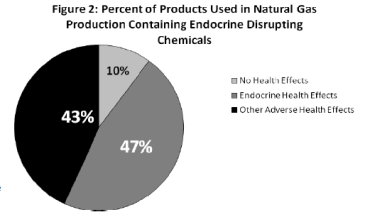
Screen Shot 2015-10-08 at 22.38.101. The leading authority on the health impacts of the chemicals used in fracking is Dr Theo Colborn, of the world renowned TEDX (The Endocrine Disruption Exchange) [13].  Doctor Colborn has identified a wide range of compounds in frack fluids and discerned a staggering array of serious health consequences that range from the immediate to the slow developing. In many cases only minute concentrations can cause devastating consequences (parts per billion)[14].  Over 78% of the chemicals are associated with skin, eye or sensory organ effects, respiratory effects and gastrointestinal or liver effects. The brain and nervous system can be harmed by 55% of the chemicals. Other affects, including cancer, organ damage, and harm to the endocrine system, may not appear for months or years later. Between 22% and 47% of the chemicals were associated with these possibly longer-term health effects.


7. DISCLOSURE OF CHEMICALS

1. There are well-documented issues with disclosure of the chemicals used in the USA (the infamous ‘Halliburton loophole’) [15] and frequent misconceptions that we are assured of full disclosure of chemicals in the UK. This is a dangerous myth. Assurances about the EA requiring full disclosure of chemicals used in fracking are undermined by a few inconvenient truths. There is no such thing as proprietary frack fluid. You do not buy it off the shelf, with a nice contents label and a MSDS. It varies at every fracking stage and with variations in local geology. You would need a presence at every single ‘frack job’, at every single site, to sample the fluid used every time. This is a practical impossibility. So the EA asks the industry to declare what it is using. The deceits that UK frackers, Cuadrilla and their friends, tell about the chemicals they use are well established [16].

2. The EA undertook some analysis of the flowback waters from the fracking operations in Lancashire [17]. Despite the high profile of this, the first fracking in the UK, the analysis only looked for one of the declared frack fluid ingredients, polyacrylamide, in one solitary sample (and found it). They acknowledged that this is known to break down into the nerve toxin acrylamide (see pg3). They also conclude that the levels of various radioactive isotopes (radium-226, potassium-40, radium-228, plutonium-241) now necessitate a permit if Cuadrilla want to continue disposing of these fluids to the nearest waste water treatment works (c.40 miles away), because the levels measured, combined with the expected quantities of flowback fluid, exceed new (but arguably still inadequate) limits.

3. What the analysis did not mention was the particularly toxic BTEX compounds (benzene, toluene, ethylbenzene, and xylenes) found in petroleum derivatives. Cuadrilla never publicly mentions using such things, but it is admitted on a data sheet [18], under the guise of ‘hydrocarbon oil’. It would appear that the EA did not even attempt looking for this – or the non-specific biocides Cuadrilla also own up to using, without ever being specific.

8. HANDLING FLOWBACK WATER

1. It is believed by local campaigners that some flowback water was discharged into the Manchester Ship Canal, after treatment at the Daveyhulme Water Treatment plant, but before the EA analysis was able to be done. The reality is that the treatment plants would have nowhere near enough capacity to handle the massive quantities of flowback that full-scale production would generate, and it would be difficult and costly to eliminate all the toxins. Currently the flowback fluid is being stored in double skinned tanks on site pending a permit application.

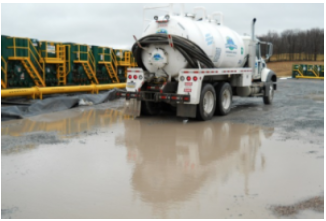
To be fair, Cuadrilla is not taking any chances. In their own words: Upon returning to the surface, they [frack fluids] are stored in steel tanks and at no point come in contact with the ground. In the unlikely event that any liquid was spilt on the surface, seepage at ground level is prevented by the installation of an impermeable membrane on land at and surrounding the well site.” [19] Extraordinary precautions, I would suggest, for fluids we are told we should not worry about.  Screen Shot 2015-10-08 at 22.39.54Storage is one thing, but avoiding spills while transferring fluids to tanker trucks, for example, is another [20].


9. SILICA SAND

1. Over and above the issues with chemicals, the sand used in unconventional fracking has serious health issues too. The best sand to use as a proppant in frack jobs is 99% silica sand, because of its hardness and grain shape. However, there is now well established research that handling such sand, and breathing in the dust from it, is a very serious health risk. The medical journal, the Lancet, cited research (no longer online) that shale gas workers around the world are experiencing unacceptable risks of silicosis – which is debilitating, irreversible and has no cure.  It is also leading to big surge of claims for damages by workers in the industry[21]


10. OTHER AIRBORNE POLLUTION

1. Airborne pollution is not confined to silica dust, and is increasingly seen as a major issue with fracking activities. A major study by the Colorado School of Public Health, entitled “Human Health Risk Assessment of Air Emissions from Development of Unconventional Natural Gas Resources”  [22],  has shown that air pollution caused by fracking may contribute to acute and chronic health problems for those living near natural gas drilling sites.  There was considerable anecdotal evidence of aggravated breathing/lung problems in the aftermath of the Lancashire fracking incidents. “The health science community is now looking at why health complaints are rising in fracking areas, particularly among children,” says Nadia Steinzor of Earthworks [23]. She says that some people who live near fracking areas have been complaining of headaches, nausea, bloody noses and nerve problems.

2. The sources of the air pollution are considered to be from two main sources. One is the large amount of very heavy diesel powered machinery used in the drilling and fracking operations. Typically the pumping equipment would amount to “a maximum pressure rating of 20,000 pounds per square inch, and a power rating of 2000 hydraulic horsepower each, with all twelve pumps totalling 24,000 horsepower”  [24].

Screen Shot 2015-10-08 at 22.42.283. The second serious source of air pollution is from methane leaks and fugitive emissions[25]. With the methane comes a variety of other volatile organic compounds (VOCs) which can contribute to the formation of smog. Even where these gases are flared, the gas flare can also lead to the formation of secondary pollutants, such as sulphur compounds, and of nitrogen oxides which also increase air pollution. The health effects of these compounds are well documented [26].

4. Even if there were no issues with pollution whatsoever, there are 2 massive issues to consider; namely water resource implications and impacts on global warming.

11. WATER RESOURCE IMPLICATIONS

1. The scale of water usage in both drilling and fracking is hard to fully appreciate and difficult to ascertain exactly. An independent review of the subject by the Pacific Institute, one of the world’s leading non-profit research and policy organisations focussing on creating a healthier planet and sustainable communities, highlighted the confusion and obfuscation of the facts created by the industry. Entitled “Hydraulic Fracturing and Water Resources: Separating the Frack from the Fiction”  [27], and published in June 2012, it is probably the definitive study on the subject.

2. It establishes six key water resource issues: (1) water withdrawals; (2) groundwater contamination associated with well drilling and production; (3) wastewater management; (4) truck traffic and its impacts on water quality; (5) surface spills and leaks; and (6) stormwater management.

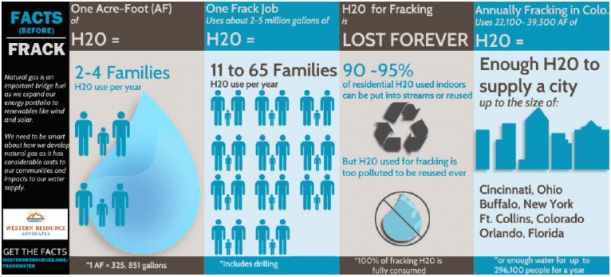
3. ‘Water withdrawals’ refers to the water that needs to be withdrawn from existing resources for fracking activities. The report highlights the huge variability in amounts used, but broadly supports established estimates that it takes about 500,000 gallons to drill the average well, and takes an average of about 4 million gallons for each frack job. These figures are huge enough if you are talking about one frack job, in one well, on one well pad. Once you begin to appreciate the potential scale of the industry in the UK, the figures soon become astronomical.

4. Using industry estimates throughout (probably conservative, at the very least), each well can expect to be fracked about 6 times in its lifetime (range observed in the literature = 3-20). Each well pad will have about 10 wells radiating out from it (range 6 -16). This gives an estimate of 4x6x10 million gallons per well pad = 240 million gallons. Cuadrilla have explicit plans for 80 sites in Lancashire = 19,200 million gallons. This would only be a fraction of the sites needed to exploit the full potential of the Bowland Shale in that part of the country. Current technology would put the optimum spacing of sites at something like 2km apart. Pedl licences cover 10km squares. So that is 25 sites per 10 km square. There are currently about 210 of these 10km squares under licence onshore (as of 18/08/2015) and all are potential targets of the frackers [28]A further 130+ are planned and under consultation, making 340 in total.

5. Continuing the mathematics, this makes an estimated 240x25x340 = a staggering 2,040,000 million gallons of water used for fracking. Add on the water used in drilling (0.5x10x25x340=42,500 million gallons) for a (conservative) estimate of 2,082,500 million gallons of water. This represents well in excess of 3.5 billion Olympic swimming pools, or approximately 30 Lake Windermeres!!

6. To put this into a fuller context, only about 30% of the water used in fracking is ever recovered. It is often as low as 10% [29]. If the industry is to be believed, it is putting this water safely below deep aquicludes. We have examined reasons to doubt this, but if they are right we are talking about putting water outside the water cycle. It will become (highly contaminated) fossil water that may not see the light of day for many millions of years. In an era of ever increasing pressure on water supplies, for a huge range of reasons [30], it is completely irresponsible to be putting 12 Lake Windermeres worth of precious water supply beyond reach.
Screen Shot 2015-10-08 at 22.43.45

7. (Western Resource Advocates report shows that fracking in Colorado uses enough water to supply 166,000 to 296,000 people for a year for household use[31].  As for gas being a ‘bridge fuel’, this is considered below.)


 12. CLIMATE CHANGE IMPACTS

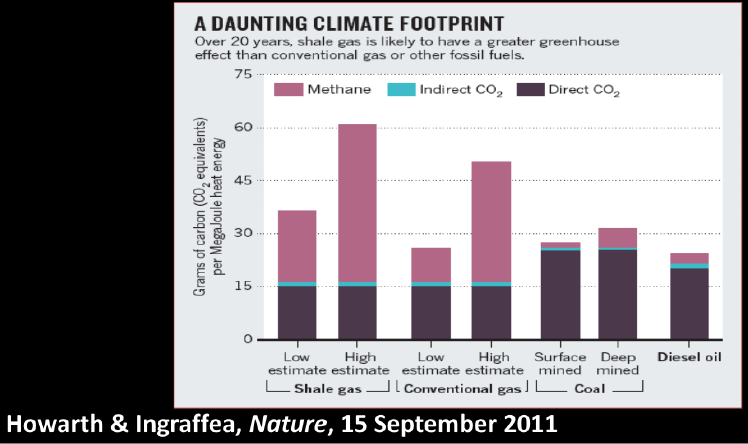
1. This brings me to the last major issue – one that can only exacerbate water resource issues – the impact of exploiting shale gas on greenhouse gas (GHG) emissions. The definitive work on this subject has been done by the Tyndall Centre for Climate Change Research, at Manchester University. Its report, “Shale gas: an updated assessment of environmental and climate change impacts” [32] is compelling. The report concludes that in an energy hungry world, any new fossil fuel resource will only lead to additional carbon emissions, thereby wrecking claims that shale gas can be seen as a transitional (or bridge) fuel as we move towards a low carbon energy future. Its use can only delay the introduction of renewable energy alternatives by putting off the imperative. “Consequently, if we are serious in our commitment to avoid dangerous climate change, the only safe place for shale gas remains in the ground” says Professor Kevin Anderson of the Tyndall Centre.

(A thoughtful and useful comment has been added on this particular topic)

Screen Shot 2015-10-08 at 22.44.45

2. In addition to concerns about groundwater and GHG emissions, the Tyndall Report also points out how important it is, in considering possible shale gas extraction in the UK, to recognise that high population density is likely to amplify many of the issues that have been faced in the US. Those that claim that the US experience cannot happen here are in complete denial of the distinct possibility that the environmental and health consequences could be significantly worse on these relatively crowded little islands of ours.


 13. IN CONCLUSION

In conclusion, allow me to point out that most people’s concern over fracking tends to start in a NIMBYist fashion, with concern over related planning applications in their local areas. Witness the ever increasing plethora of local opposition groups across the country, indeed across the world. What invariably happens, however, is that people very quickly learn about and recognise the full range and scale of the issues involved – the issues in this review, and many more such as noise, HGV traffic, property values, loss of amenity, and impacts on biodiversity, agriculture and tourism and so on. We have seen local opposition groups thereby morph into national and international campaigns, seeking to be mutually supportive towards a common goal. This is an issue that therefore stretches far beyond the scientific and technical. It has to become a political issue, and even a human rights issue, in which choices about our relationship with the planet we depend on are central and fundamental.


REFERENCES:

[1] Paleontological Research Institute paper:  http://www.museumoftheearth.org/files/marcellus/Marcellus_issue6.pdf 

[2] MJ Whiticar, Biogeochemistry Dept., University of Victoria, British Columbia:  http://www.energybc.ca/profiles/naturalgas/fracking.html#frackingdiagram

[3] http://www.news.cornell.edu/stories/June12/DCfracking.html

[4] http://www.timesunion.com/opinion/article/Fracking-is-hardly-leakproof-3646458.php

[5] http://www.iflscience.com/chemistry/self-healing-concrete-repairs-its-own-cracks

[6] http://science.time.com/2011/12/12/fracking-sizing-up-the-quakes-that-come-from-hydraulic-fracturing

[7] http://www.bbc.co.uk/news/uk-england-lancashire-15550458

[8] http://earthquake.usgs.gov/learn/topics/megaquakes.php

[9] From Feb 2015 http://www.researchgate.net/publication/272381884_Linear_Pattern_Detection_of_Geological_Faults_via_a_Topology_and_Shape_Optimization_Method

[10] static.ewg.org/reports/2011/fracking/cracks_in_the_facade.pdf

[11] http://www.worldoil.com/Marcellus-groundwater-claims-A-case-for-scientifically-informed-decisions.html

[12] See the Congressional Committee sequence near the end of the Gasland film. (from 5:00 of this clip: http://www.youtube.com/watch?v=VWYCxY9dx5w )

[13] http://www.endocrinedisruption.com/chemicals.introduction.php

[14] http://www.endocrinedisruption.com/files/Multistatesummary1-27-11Final.pdf

[15] https://www.earthworksaction.org/issues/detail/inadequate_regulation_of_hydraulic_fracturing

[16] See the second half of: https://greenleftie.uk/2011/06/15/collated-fracking-notes-on-earthquakes-frack-fluid-and-wellhead-density/

[17] http://www.environment-agency.gov.uk/static/documents/Business/6th_Dec_-_Shale_gas_-_North_West_-_Monitoring_of_flowback_water_-_update_%283%29.pdf   Not available as at Sept. 2015, and unable to locate elsewhere.

[18] http://www.cuadrillaresources.com/wp-content/uploads/2012/02/Chemical-Disclosure-PH-1.jpg     Also withdrawn and no longer available.

[19] http://www.cuadrillaresources.com/what-we-do/technology/fracturing-fluid/  No longer available either!

[20] http://www.minutemanspill.com/hydraulic-fracturing-fluid-services/

[21] http://www.law360.com/articles/383752/another-wave-of-silicosis-claims-may-be-on-the-horizon

[22] http://www.sciencedaily.com/releases/2012/03/120319095008.htm

[23] https://student.societyforscience.org/article/fracking-fuels-energy-debate

[24] http://www.oilandgastechnology.net/upstream/halliburton-technology-used-gas-power-fracking-rigs

[25] http://stop-csg-illawarra.org/csg-risks/leaking-methane/

[26] http://www.endocrinedisruption.com/assets/media/images/Supplemental%20material%2020131209.pdf

[27] http://pacinst.org/wp-content/uploads/sites/21/2014/04/fracking-water-sources.pdf

[28] As of 01/09/2015 https://www.gov.uk/government/uploads/system/uploads/attachment_data/file/457662/Landfields_Lics.pdf

[29] https://www.earthworksaction.org/issues/detail/hydraulic_fracturing_101

[30] http://webarchive.nationalarchives.gov.uk/20140328084622/http://cdn.environment-agency.gov.uk/geho1208bpas-e-e.pdf

[31] http://frackfreesprings.org/resources/fracking-our-water/

[32] http://www.tyndall.ac.uk/sites/default/files/coop_shale_gas_report_update_v3.10.pdf

Defra report reveals extent of impacts on people living near fracking wells

Energy Fileshttp://energydesk.greenpeace.org/2015/07/01/energy-files-defra-report-reveals-extent-of-impacts-on-people-living-near-fracking-wells/

July 1, 2015 – 6:07 pm
Photoby Christine Ottery

People that live near fracking sites could be affected by health problems and financial hardships – and fracking might not even help climate change – a government report has revealed.
The report – which was initially heavily redacted but has now been fully published after the Information Commissioner ordered the government to do so – includes striking passages that were previously blacked out on the risks of living near a fracking well, most dramatically that:
“Properties located within a 1 – 5 mile radius of the fracking operation may also incur an additional cost of insurance to cover losses in case of explosion on the site.”
“Such an event would clearly have social impacts,” some genius notes.
There are also several other health impacts and financial impacts on local rural communities that have been detailed — and are now revealed.
On climate change, the report says that fracking in the UK could cause a gross increase in global CO2 emissions if the LNG or other fossil fuels that would otherwise be burnt in the UK are burnt elsewhere — and we are still emitting from burning fracking gas.

Energydesk put in the Freedom of Information request for the report last summer, and repeatedly asked Defra to fill in the blacked-out blanks in the back-end last year.

We’ve finally been able to properly scour the report — and here’s what’s come to light:

Health: Water, noise, light and air pollution

People could experience the consequences of surface water contamination from fracking — not from drinking water but “it can affect human health indirectly through consumption of contaminated wildlife, livestock, or agricultural products”.

Noise and light pollution from rigs could also lead to problems, the internal Defra report acknowledges. It says: “Some residents may experience deafening noise; light pollution that affects sleeping patterns.”

“Noxious odours from venting gases can also impact on air quality for local residents,” it adds.

Truck movements to and from the site – about 14 to 51 journeys a day over a period of weeks – could also impact air pollution and noise.

And if you have resulting health problems you might find your local services stretched with the additional demand from the influx of fracking workers.

The report says that it’s unclear whether the extra funding given to communities “will be sufficient to meet the additional demand if new schools or hospitals are needed to ensure service provision for existing rural communities is maintained”.

Money: Housing and jobs

So, your house might be worth up to 7% less if you live within a mile of a fracking site (though other estimates say 10% or even up to 70% of the value could be wiped off) — and you might have to pay more for your house insurance in case of an explosion on site.

And if you rent, rent prices are expected to rise as new workers come into the area.

Fracking is also a mixed bag for local economies — short term benefits belie costs in terms of industries including “agriculture, tourism, organic farming, hunting, fishing, and outdoor recreation.”

The report also highlights concerns about what happens to local economies after the frackers leave.

In case local people were thinking of working in the fracking industry, there is also uncertainty over “how sustainable the shale gas investments will be in the future and whether rural communities have the right mix of skills to take advantage of the new jobs and wider benefits on offer”.

Regulatory uncertainty

And at a time of deep cuts to DECC, the Environment Agency and HSE – the people responsible for regulating the fracking industry – it is tricky that the report recommends that “regulatory capacity may need to be increased”.

A Defra statement said: “This document was drawn up as a draft internal discussion paper – it is not analytically robust, has not been peer-reviewed and remains incomplete.

“It does not contain any new data or evidence, and many of the conclusions amount to unsubstantiated conjecture, which do not represent the views of officials or ministers.”

Read the UNREDACTED Defra report in its entirety here.

Why the surprise at VW conning people?

Screen Shot 2015-09-24 at 08.59.54

Quote attributed to New York muralist James De La Vega

Why is anyone remotely surprised that car makers (Volkswagen will not be alone) have sought to deceive everybody over the fuel emissions?

Screen Shot 2015-09-24 at 09.21.46Adverts like this try to pretend 136g CO2/km is ‘clean’. When a sparrow shits on your head instead of a seagull, you don’t feel pleased about it and pretend it has made you in some way cleaner!

Screen Shot 2015-09-24 at 09.25.00

And when we get reviews like this, we don’t see too many people getting incredulous. Cleaner than my tiny light IQ no less! Wow! How do they do that? Now we know! I like the way that they have dodged using the word Green, instead calling it BlueMotion, which could so easily translate as Tory Shit.

The drive for this particular capitalist con has been the Vehicle Excise Duty framework in this and many other countries that has rated cars on their purported emissions. It has looked like this for the last few years:

Screen Shot 2015-09-24 at 09.42.58Thus the incentive to get new cars below the 130 g/km threshold and the further drive to get cars for the cost conscious motorist below the 100g/km threshold. This would be all well and good if the system to assess these cars emissions ever had any credibility. Running the tests in laboratories was only ever going to yield unrealistic figures compared to real life driving conditions, but also opened up the process to easy manipulation, as now uncovered with Volkswagen.

But this is nothing new at all. The same has been going on for donkey’s years with fuel consumption figures. We expect them to be ridiculously over optimistic, but they give us some sort of benchmark for relative comparisons. And this is the potential real scandal of the VW story. Have they pulled a stunt that their competitors have missed out on? The industry will be up in arms if that is the case and will seek retribution and vengeance on behalf of their shareholders, not their consumers! But I suspect this not to be the case at all. I suspect that many will have been at it. We shall see.

Screen Shot 2015-09-24 at 09.44.21In any case, as far as this country is concerned, our ‘Greenest Government’ has largely resolved this issue with his recent budget scrapping any green incentive in the Vehicle Excise Duty scheme. This is how it will look from April 2017:

The first year rate is a pathetic gesture to greenwash the gullible, but the reality is that apart from zero emissions full-electric cars, all cars will pay a flat rate £140 per year. For some bizarre reason cars that retail over £40,000 will have a kind of ‘wealth tax’ imposed for 5 years – but this is irrespective of emissions, and once they get older and begin to get more inefficient this surcharge goes. Well done George!

There is, in fact, so much in this story that simply underlines all the established criticisms of capitalism that I could go on and on. Instead, just keep this story in mind as you read this:
https://en.wikipedia.org/wiki/Criticism_of_capitalism

Also, please read the attached reply/comment from Doug Rouxel which develops some of these points.

But for those who want a glimpse of what green cars can look like in a capitalist world, if all we did was eradicate the now ancient technology of the internal combustion engine, if only our ‘green’ Tory bullshitters were brave enough, this should keep you satisfied:

Screen Shot 2015-09-24 at 10.24.13

To where should an ecosocialist in Wales turn? Into the wilderness?

As we start the build up to the Welsh Assembly elections next year, I find myself in the political wilderness, and pleased to be so.

Wildernesses are generally beautiful places, populated by few people, but those you come across there are invariably fascinating characters with tremendous survival instincts. There is peace and time to think clearly. Survival is built upon respect for your surroundings and your companions.

I am defining the political wilderness as that space on the political landscape outside of the political conurbations of the political parties, inhabited by self-sufficient political activists working to their own political agenda. I have stumbled across more truly impressive, comradely people here than in any party I have ever been associated with.

Screen Shot 2015-09-07 at 14.31.22For the sake of clarity, I recently completely cancelled my membership of the Green Party of England & Wales. I am no longer attached to any political party, and it feels great.

Many have long suspected that I might be tempted to join Plaid Cymru. I have indeed been tempted, I will admit. But on close inspection, I saw nothing significantly different to the Green Party that I had become so disillusioned with. The differences are there, but they are are largely subtle.

Neither party is an ecosocialist panacea, although both are much nearer to it than anything else on offer. For example, both have (contrasting) problems with nuclear policy. Both have integrity issues brought about by casting aside avowed policy for political expediency at the merest whiff of (short-term) electoral success – making longer-term progress nigh on impossible. Both allow sectarianism to go unchallenged and thereby destroy any prospect of pulling together, to mutual and wider benefit. In other words, they are both pretty much like any other political party, when push comes to shove.

Screen Shot 2015-09-07 at 14.33.32Screen Shot 2015-09-07 at 14.36.55Politics does, however, have too much influence on our lives to be ignored completely. But I increasingly find that focussed single-issue apolitical campaigns can have more success in influencing policy and outcomes than direct involvement in politics. It achieves tangible results for people and is thereby a much more satisfying use of my time and money. For example, I will continue to focus energy on the anti-fracking and bedroom tax campaigns until these issues are successfully resolved.

I will also vote in elections – but not out of blind party loyalty. I will look at who is placed before me and make strategic decisions as to how best to vote to get an outcome that represents at least some sort of step in the right direction. In the absence of a credible electoral system and the lack of any tactical nous by parties, in terms of managing to work together to counter the democratic deficit, it is incumbent on voters to vote tactically as best they can. In our current sham democracy tactical voting is the only option left to us. It should not be frowned upon, but encouraged – and you can’t do that easily when you are in a political party (although I tried!).

In most cases, the choice in Wales ought to be between a Green candidate and Plaid Cymru candidate. But there are individuals (very few, but some) in other parties that I would happily endorse if they were on the ballot paper in front of me (one Labour candidate, two Lib Dems and a Pirate come to mind straight away). There are also a small number of individuals in both the Green Party and Plaid Cymru that I find objectionable enough to not be able to vote for or endorse.

For those interested enough, I may well share my views on who I would vote for around Wales nearer the time. In the meantime, I am going to relax and enjoy the tranquility of the wilderness for a while.

Gerwyn Williams (Coastal Oil & Gas etc) – new friends?

Gerwyn Williams’ stable of largely valueless companies, including Coastal Oil & Gas and UK Methane, have found themselves a new home.

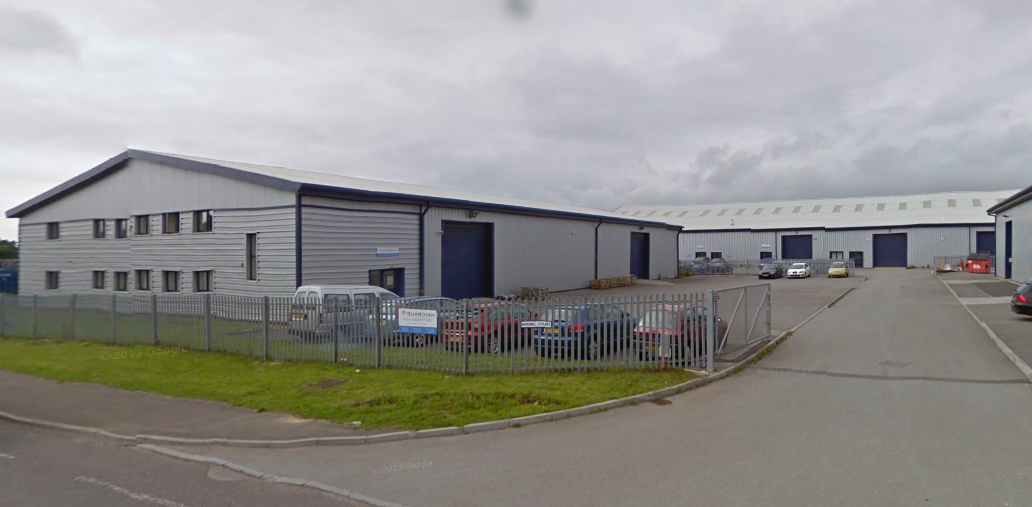
Screen Shot 2015-09-04 at 09.00.21Given the apparently parlous state of his finances, I suppose that paying out rent for an office on Bridgend Industrial Estate, that he barely ever used for anything but a glorified mailing address, was a luxury that had to go in these austere times. Luckily, he appears to have been offered a helping hand from a company with a vested interest in fracking worldwide – Guardian Global Technology Ltd of Village Farm Industrial Estate in Pyle.

The registered address of all Gerwyn’s companies has recently been changed to match that of Guardian’s site. According to their website their mission statement is:
“To use our intrinsic culture of innovative thinking to deliver leading edge technology to our clients in the global oil and gas industry, enabling them to capitalise on increasingly challenging opportunities.”

Those clients include some of the major players in the fracking industry worldwide, including Halliburton and Schlumberger. Curiously, their website makes no direct reference to fracking and hydraulic fracturing. Perhaps they don’t want the association and/or search engines connecting them. But we know that frackers are a core part of their target market because one of their executive and board members, Chief Technology Officer Iain Maxted, was kind enough to make this clear when he appeared at a Sustainable Wick public meeting in Wick a few months ago, where Frack Free Wales were doing a presentation..

Iain Maxted - looked smarter at the Wick meeting with his queen blue linen jacket and neatly ironed kerchief jutting from his top pocket.

Iain Maxted – looked smarter at the Wick meeting with his queen blue linen jacket and neatly ironed kerchief jutting from his top pocket.

Iain Maxted is a Wick resident, so I suppose he just could not stay away when he heard of our public meeting. It turns out that he is a quite a colourful character of some local notoriety.

I wouldn’t dream of questioning his credentials as a mining engineer. I wouldn’t be surprised if crude oil courses through his veins, so steeped in the industry he evidently is from his CV. But not untypically, when talking about other aspects of the industry, including his knowledge of the markets, there was a unmistakeable whiff of you-know-what (or perhaps the cows had been grazing too close to the Community Centre that day).

His disregard for the countryside is also beyond question too, and one reason for his local notoriety. I don’t suppose anyone would be surprised that a guy like this would drive a big 4×4, but this guy owns a fleet of them that he parks on the pavements outside his house to the perpetual annoyance of many of his neighbours. This picture is a screenshot from Google maps – taken in 2013 apparently.

Screen Shot 2015-09-03 at 23.06.33

When we drove past recently we saw two of the fleet on the pavement and we got another indication of this guy’s mentality when we clocked the number plates:

Screen Shot 2015-09-04 at 08.27.47Screen Shot 2015-09-04 at 08.28.08

A quick online check suggests these plates are worth about £1500 each. I wouldn’t mind betting he’s got another one at least. Screen Shot 2015-09-03 at 23.13.56For just £15 he could have bought one of these t-shirts and achieved much the same affect, but hey!

That yellow beast, by the way, is a phenomenally powerful V8 Dakar 4×4 pure off-roader. In his current job, Iain doesn’t get to tear up the countryside directly. He just supplies the kit to let the frackers do it. But with this big boy’s Tonka toy, he can go ripping and roaring his way around the countryside to his cold heart’s content.

I digress, but there is irony here. Not everyone in the oil and gas industry is as patently obnoxious as Iain Maxted. I actually have come to quite like Gerwyn Williams. He is a pretty straight guy just trying to rustle up enough to retire peacefully to his luxury home, currently being constructed for him next to the gorgeous Newton Beach on the outskirts of Porthcawl.

Gerwyn's luxury retirement home looking like a multi-storey car park a year ago, and with the only visible addiation this year of some glazing, looking like a small supermarket at the moment.

Gerwyn’s luxury retirement home looking like a multi-storey car park a year ago, and with the only visible addition this year of some glazing, looking like a small supermarket at the moment.

But things just aren’t working out as planned for Gerwyn. His home is progressing at a snail’s pace, as he clearly cannot afford to finish what he has started. The same is true with his PEDL licences. He may well have got Environment permits sorted for a couple of sites recently, but I seriously doubt he has the resources to do the test drilling. Having lost the backing of people like Eden Energy, I can’t see Guardian’s magnanimity extending to a 7 or 8 figure loan!!

Things have not exactly been going as planned for Guardian either. Only last year, they extended their Pyle plant (extension opened by none other than Carwyn Jones) and took on extra workers. But now they too are struggling, having already made 29 of their 80 employees redundant earlier this year. 

Screen Shot 2015-09-04 at 09.25.23With the next devolution bill coming soon, we will get towards the end game of all this and see an outright fracking ban in place across Wales. Any significant investment at this stage has surely got to be throwing good money after bad. Iain Maxted and Guardian might not be too bothered – their business does not rely on Wales – but given their own current woes, it easy to see why they may dream of a fracking boom in Wales. But such are the vagaries of this industry,  it is clearly impossible to build a reliable future on it.

Gerwyn Williams. Plans in ruins?

Gerwyn Williams.
Plans in ruins?

Overall, I think, Gerwyn, you should choose your friends more carefully. Cut your losses, pal, and finish off that house. You have blotted the landscape at Newton with what you have there at the moment. You must realise by now that your plans to blot and blight across South Wales are doomed to fail. Wouldn’t it be nicer to just be able to sit and reminisce about all this over a pint in the Jolly Sailor, than have to continue to put up with working with arses like Maxted? Life really is too short.

PSC Demo at Wales v Israel football game

From Jeff Hurford:

(Pictures added by me)

2.00 SUNDAY 6 SEPTEMBER – CITY HALL CARDIFF

March to Cardiff City Stadium

Protesters are set to descend on Cardiff City Stadium when Wales play Israel in scenes that will be reminiscent of the sporting boycott of apartheid South Africa.
On 6 September, when Israel play Wales, thousands of people are expected to protest in a call for UEFA and FIFA to expel Israel and for action to be taken against its apartheid state. Organisers hope the protest, labelled Fair Play for Palestine, Don’t Play Israeli Apartheid, could spark a movement reminiscent of the 1980s that saw South Africa banished from the sporting world and led to international pressure help end apartheid and free Nelson Mandela.

The boycott saw South African teams in sports such as rugby union and cricket expelled from playing international matches after boycotts, pitch invasions and protests.

The match could be one of the biggest in Welsh football history with the potential of Wales qualifying for their first major competition since 1858 if they win their next two games.

Former South African minister and ANC leader Ronnie Kasrils is supporting the campaign and organisers were given a boost when a vocal supporter of Israel and Zionism admitted Israel is an apartheid state for its treatment and separation of Palestinians.

Bradley Burston, a convinced Zionist and senior editor of the Israeli daily newspaper Haaretz, has joined those who now regard Israel as an apartheid state.

Writing in Haaretz he says: “I used to be one of those people who took issue with the label of apartheid as applied to Israel. I was one of those people who could be counted on to argue that, while the country’s settlement and occupation policies were anti-democratic and brutal and slow-dose suicidal, the word apartheid did not apply.

“I’m not one of those people any more. Not after the last few weeks.

Not after terrorists firebombed a West Bank Palestinian home, annihilating a family, murdering an 18-month-old boy and his father, burning his mother over 90 percent of her body – only to have Israel’s government rule the family ineligible for the financial support and compensation automatically granted Israeli victims of terrorism, settlers included.

“Not after Israel’s Justice Minister Ayelet Shaked, explicitly declaring stone-throwing to be terrorism, drove the passage of a bill holding stone-throwers liable to up to 20 years in prison.

“The law did not specify that it targeted only Palestinian stone-throwers. It didn’t have to.

“Just one week later, pro-settlement Jews hurled rocks, furniture, and bottles of urine at Israeli soldiers and police at a West Bank settlement, and in response, Benjamin Netanyahu immediately rewarded the Jewish stone-throwers with a pledge to build hundreds of new settlement homes.

“This is what has become of the rule of law. Two sets of books. One for Us, and one to throw at Them. Apartheid.”

John Rose, a Jewish campaigner and author of ‘The Myths of Zionism’ will be speaking at the demonstration on 6 September.

Screen Shot 2015-08-29 at 22.01.39He said: “In Britain the best way to achieve solidarity with the Palestinians fighting the Apartheid state is to become active in the Boycott Disinvestment & Sanctions campaign, BDS.

“The Israeli government is so panicked by BDS that it has established a special unit to try and combat it.

As a member of the UCU, the University & College Lecturers Union, I helped introduce BDS onto campuses. Resolutions supporting BDS have been carried by our union’s annual congress.”

Apartheid does not exclude football and Palestinian players have been prevented from playing at international tournaments, while stadiums have been demolished, players shot at checkpoints, while Arab players and fans face vile abuse from many Israeli terraces.

The demonstration has been called by the Palestine Solidarity Campaign (PSC), with support from PCS Wales, Red Card Israeli Racism, Friends of Al Aqsa and others in a bid to extend the Boycott Divestment and Sanctions Campaign (BDS) into sport.

Jeff Hurford of PSC said: “This the first mass demonstration calling for a sporting boycott of apartheid since the defeat of South African apartheid.

“All sporting links should be broken with the apartheid Israeli state that oppresses the Palestinians. Fair play means siding with the Palestinians who face constant violence, harassment and murderous attacks -most recently last summer in Gaza.

Screen Shot 2015-08-29 at 22.22.43“Israel has launched a war on football in Palestine: footballers have been killed, stadiums bombed and players have been refused permission to travel to matches.

“We are near a “tipping point” where Israel faces its “South Africa moment” and becomes very broadly isolated and vilified, and 6 September will bring that movement to Wales to act as a catalyst for the rest of the UK and world.

“Israel has launched a war on football in Palestine: footballers have been killed, stadiums bombed and players have been refused permission to travel to matches.

“There can be no normal sport in the abnormal situation that exists between Israel and Palestine. We stand for a free Palestine and an end to Israel apartheid.”

Buses have already been booked from across the country for the demonstration and activists have had a warm response leafleting Cardiff City matches, mosques and Cardiff city centre.

How are the Wales Green Party and Plaid Cymru doing in the polls since their unprecedented exposure in the General Election campaign?

Screen Shot 2015-08-23 at 23.23.00I have just been looking for opinion poll information since the General Election to see how the supposed progressive left parties have managed to build on their unprecedented media exposure.

The short answer is that neither Wales Green Party, nor Plaid Cymru have anything to boast about, sad to say, but Plaid Cymru would seem to at least be heading in the right direction, be it painfully slowly.

Looking at these polls from April 2014, from just before the ‘Green Surge’ in members kicked in and before the Greens, PC and the SNP announced their potential alliance in December 2014, the Greens initially saw a rise from their Regional Vote level in 2011 of around 5% to the dizzy heights of 7-8%, before plummeting back down to a disappointing 3% between the Welsh leaders debates and polling day. The latest figure of 4% is exactly where they were 18 months ago.

It is barely much better for Plaid Cymru. Their low point of 15% coincided with the Greens high point of 8% just after the ‘three party alliance’ was floated, but bounced upwards well from here to hover around 20-21% for the last 6 months. But again, this is no real advance on where the were 18 months ago (19%). In relative terms though, the PC:WGP ratio has gone from 2:1 in January 2015 to 5:1 in June 2015. This must reflect their growing strength within the progressive left of Welsh politics, even if the progressive left as a whole not really seen any advance at all.

The June 2015 poll also includes ratings of the party leaders in Wales. These are quite revealing too:

Screen Shot 2015-08-23 at 22.01.43Screen Shot 2015-08-23 at 22.01.12

Perhaps most disappointing for Pippa is that despite two televised debates and considerable other media coverage 61% of the sample still don’t know her (at least enough to have an opinion on her).This means the scores of 0 – 10 for those that had an opinion on her are actually out of just 39. Screen Shot 2015-08-23 at 23.18.33Putting these into % terms reveals the following:

  • 0 = 18%
  • 1 = 8%
  • 2 = 10%
  • 3 = 10%
  • 4 = 10%
  • 5 = 24%
  • 6 = 8%
  • 7 = 8%
  • 8 = 2%
  • 9 = 0%
  • 10= 2%

With a score of 5 representing a neutral (neither like of dislike) score, Pippa has 56% of varying degrees of dislike, 26% giving her the lowest scores of 0 or 1 out of 10. Just 20% give her any sort of positive like score, with only 2% giving her on of the top scores of 9 or 10 out of 10. With figures like this, it is probably just as well that 60% don’t know her!

Leanne’s scores have to be recalculated out 78 meanwhile, giving the following:

  • Screen Shot 2015-08-23 at 23.20.380 = 12%
  • 1 = 5%
  • 2 = 7%
  • 3 = 7%
  • 4 = 6%
  • 5 = 17%
  • 6 = 12%
  • 7 = 14%
  • 8 = 10%
  • 9 = 4%
  • 10= 6%

With a score of 5 representing a neutral (neither like of dislike) score, Leanne has 37% of varying degrees of dislike, 17% giving her the lowest scores of 0 or 1 out of 10. A pretty good 46% give her a positive like score of some kind, with 10% giving her on of the top scores of 9 or 10 out of 10.

So we see that of those people that know them enough to have an opinion on them, more than twice as many people dislike Pippa than like her; whereas significantly more people like Leanne than dislike her. Her figures were comfortably the best of all the Welsh leaders. Only Carwyn Jones, of the others managed a small net ‘like’ score. Pippa’s were almost identical to UKIP’s Nathan Gill (all the way down in fact). Kirsty Williams scored a small net ‘dislike’ and Andrew Davies scored a significant net ‘dislike’, but not as bad as PB or NG.

It may be a bit too simplistic to conclude that Leanne is an asset to her party, whereas Pippa is a liability to hers, even though many may have suspected this for a long time, but as both parties strive for elusive breakthroughs at the polls that count, it something they probably both need to reflect long and hard about.

A progressive alliance? The problem in a (rather big) nutshell

Ever since well before the General Election we have heard a lot (and I have written a lot) about the need for the progressive left to get its act together and work together for common aims. What is increasingly evident is that are not enough progressive left members in any party in Wales to make this a realistic possibility.

I have consistently argued for such attitudes within Wales Green Party and, for example, Vicky Moller has done much the same from within Plaid Cymru. We are routinely savaged by members of each other’s parties and even members of our own parties for doing so. There are full-time mischief makers, character assassins and trolls active in both parties, but it when rank and file members and especially non-party members start spouting the the sectarian, tribalist bile, more commonly associated with UKIP and the far right, that we have to recognise we are in big trouble.

Screen Shot 2015-08-20 at 15.35.36Below is a Facebook discussion that I think encapsulates exactly what we are up against. It is in response to a post by James Luchte on the Anti-Austerity UK Alliance public group, that James Luchte set up in response to the positive moves made by Nicola Sturgeon, Leanne Wood and Natalie Bennett towards an anti-austerity alliance in Westminster. Luchte (below) is himself an interesting character; ‘an expatriate American’ (i.e. immigrant) ‘philosopher, author, writer and poet based for over a decade in West Wales and in the United Kingdom since 1995’. He is a Plaid Cymru supporter.

James Luchte's psychedelic phase!

James Luchte’s psychedelic phase!

I very much doubt he expected the thread below to develop as it did. It is also dangerous to draw too wider conclusions from the contributions of the individuals involved. My own contributions could perhaps have been better put, but that is one of the dangers of social media quick fire responses. But taken as a whole, I think it does go a considerable way to understanding why Wales has no hope of any sort of progressive alliance working anytime soon, and also, perhaps, why Plaid Cymru has failed to replicate the success of the SNP in Scotland.

I am actually a bit hesitant about posting this at all. My hope is that it might give some people pause for thought (it has me) about our attitudes to each other on the left flank of Welsh politics. My fear is that it may be used as more grist to the mill of the the tribalists and mischief makers. The net result will almost certainly be no change to anything. To nick a quote from Ian Woodall on the thread:

“Witness the People’s Front of Judea take on the Judean People’s Front. And all the time they are arguing the Romans tighten their grip.”
Screen Shot 2015-08-20 at 15.48.32Screen Shot 2015-08-20 at 15.49.49

The Facebook thread (pics added by me):


James Luchte
 
Yesterday at 12:50

#‎ProgressiveAlliance

Could post-Corbyn Labour form progressive alliance with Plaid, Libs and Greens?Plaid Cymru’s Adam Price suggests Labour, Plaid and Greens could form ‘progressive alliance’WWW.WALESONLINE.CO.UK|BY DAVID WILLIAMSON

Like   Comment   

Share

You and 33 others like this.

Ian Woodall It should. It won’t  Yesterday at 12:57 · Like · 2

Darren Mumford this ^  Yesterday at 13:01 · Like

Sean Dawson Davis Would be cool, but there’s still too much imperealisim and unionism in labour and even the greens.  Yesterday at 13:09 · Like

Alan Caig Wilson The left-wing caucus is already forming – cfCompassonline.org.

Screen Shot 2015-08-20 at 16.41.33COMPASS Online COMPASS coordinated and conducted a five-day communication and leadership training in Sweden for… COMPASSONLINE.ORG   Yesterday at 13:09 · Like

Paul Rubyshine this would and had been my dream for many years, a strong opposition is essentiall if the tory-pigs are to be kept at bay. Onwards….   Yesterday at 13:12 · Like · 1

Kirstein Rummery and SNP?!   Yesterday at 13:18 · Like · 2

Ian Woodall Sean Dawson Davis in what way are we Greens imperialist? English and scottish green parties are separate. We were on the SNPs side in the referendum. Feeling a bit miffed by that.  Yesterday at 13:52 · Edited · Like

Sean Dawson Davis Almost every candidate in Wales for the greens is English. They dont like our language, they dont like our culture and they dont want to listen to any Welsh problems that are caused by England. Head in the sand. I agree with almost all their policies. But there are issues here unique to the Welsh that they dont want to listen too. Too many snides  Yesterday at 14:01 · Edited · Like · 1

Ian Woodall Ok…. look thanks for raising that. Being a bloody saxon from Staffordshire that has passed me by. I will take it to conference with me.  Yesterday at 14:02 · Like

Sean Dawson Davis I’m sure they will listen intentivly  Yesterday at 14:04 · Edited · Like · 1

Ian Woodall Actually you could come yourself. Our conferences are open and we welcome input from outsiders both in the policy forums and the hall.  We just politely request you dont actually vote unless you have a party card. I am half serious actually. It may be we could do a joint platform fringe meeting and even get the idea of alliances discussed on the floor of the conference.  Yesterday at 14:09 · Like

Paul Rubyshine I’m Green and live in Wales, I like plaid too, we should not compete for the same seats IMO. Many of the policies are similar.  23 hrs · Unlike · 3

Andy Chyba Paul/Sean, unfortunately there are a small number of people in both the Welsh Greens and Plaid Cymru that do all that they can to wreck any chance of constructive relations between the parties. Tarring everybody in a group with the same brush is prejudice and discriminatory and barrier to progress.  22 hrs · Like

Sean Dawson Davis Don’t lecture a welsh man on prejudice and discrimination we are well versed.  21 hrs · Like

Sean Dawson Davis Its an unwillingness to listen that stops progress.  21 hrs · Like

Andy Chyba Couldn’t agree more with your last point.  18 hrs · Like

Sean Dawson Davis Its not acknowledging the first one that creats alot of devision between us. England’s legacy with Wales is not going anywhere . I’m all for a clean slate. But its going to have to be faced, no matter how uncomfortable or unpopular it is. But no one want to listen yet. The popular response is “you have a chip on your shoulder” or that we are ” anti English” These are the things the greens ignore also.  17 hrs · Like · 1

Sean Dawson Davis It sucks but its part of the deal as far as I’m concerned. and I’m not alone. There are reasons we feel the way we do about you. The blame cannot always be conveniently placed on us.  17 hrs · Like

David Ford I wouldn’t want it for the Greens.  17 hrs · Like

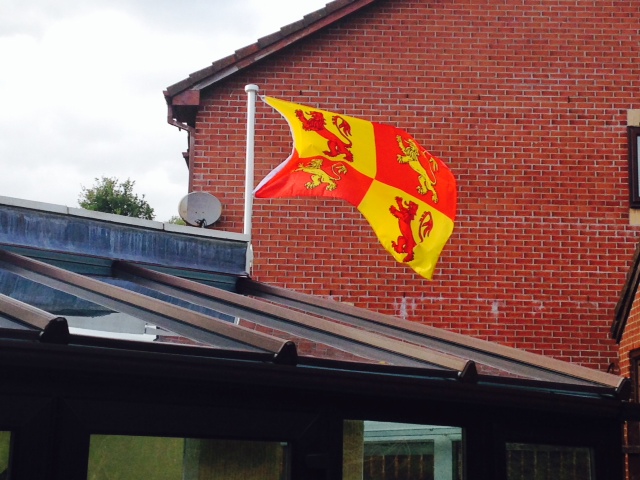
photoAndy Chyba As an Englishman living in Wales for half my 53 years. I have grown to love the Welsh and hate what England stands for. I have an Owain Glyndwr standard flying in my garden. But every time threads like this harp on about what it is or isn’t to be Welsh or English, we get distracted from the task of working together for a better future for us all. It is why I have left the Welsh Greens and why I am not interested in joining Plaid Cymru. When the sectarianism ends and there is genuine desire to build alliances, ie there is real hope if achieving something, then I hope to re-engage with welsh politics. In the meantime I will focus on particular campaigns that are successfully non-partisan and achieving a lot more.  7 hrs · Like

Sean Dawson Davis But your assuming everyone here wants to work together. And not wanting to do so is something negative, worthy of distancing yourself? Independence would remove Wales from so many of the Uk’s problems. Their not ours to fix nor do we have the power to fix them. Not wanting to help England stitch together this crooked union or fight its own demons does not make me or anyone else a bad person. So many countries in the world have the right to sovereignty and to fight for themselves, to focus on their own problems. Why cant we? Why is that so offensive to you? So wrong?  15 hrs · Edited · Like

Sean Dawson Davis And tbh Welsh politics never speaks about these things. I know people in Plaid. They know how bad Wales has it but they never dare mention it in public. Because they know they would get ruined Politically  15 hrs · Edited · Like

Andy Chyba Someone is not listening. It took a while, a long while, but I am now firmly of the opinion that Wales would be best served by full independence from England and the that the whole world would be better off if the UK was broken up. I support full independence for Scotland and the re-unification of Ireland. What I find offensive is the attitude I get from too many Screen Shot 2015-08-20 at 17.08.56Plaid supporters that you are not ‘proper welsh’ if you don’t speak, or at least pretend to speak Welsh. Implicit in these people’s attitudes is that not all citizens of Wales today are regarded as equals. It is the UKIP style, blame the immigrants, especially if their English, mentality. This is, in my opinion, why PC has not had the same success as the SNP. The SNP are seen to fight for the Scottish nation – everybody living in Scotland. Plaid Cymru, rightly (in the case of too many supporters) or wrongly (in the case of most of the leadership) are seen to fight for the welsh people (the ‘proper welsh’ people). When we are all ecosocialists together, pulling in the same direction together, and completely unbothered where our fathers and grandfathers were born we might start getting somewhere – together.  14 hrs · Like · 2

David Ford Sean, I think your on the wrong page. Anti Austerity Alliance, not I’m Welsh we don’t want to work with anyone. bullshit. It’s ridiculous and child like.  14 hrs · Edited · Unlike · 1

Sean Dawson Davis Now who’s painting with the same brush? I certainly ain’t native welsh in my genetics, and I don’t speak the language either. Your over simplifying it. I’m not against the English living here either. I’m against the speed at which they have been moving here. Look at the fuss that is kicked up over England’s 13% non native born population.

Ours is over 20% just from England alone in Wales. Its constant double standards and hypocrisy. I don’t see why you cant see that. And if we got our independence tommow I wouldn’t ask not one of them to move. I accept our reality. But doesn’t mean id want the rate of migration to continue, and I’m not blaming this for all of our problems. But it is a problem, to us. Unique to us. And it gets ignored. Just talking about it. Or how our English population earns over £2 and hour more than their welsh counterparts for example gets me called childish /\. We have battles we can fight together. But some are unique to this Country. And you have shown despite living here you don’t see it as a problem. But many here do, its doesn’t make us bad and your gonna have to at least try and see it from our perspective one day. instead of simplifying it to convenient little judgements. I want more balance and the truth to have its day. Its not going to be skimmed over in the name of working together (admirable as it is I don’t see our incentive, or why you expect it, like Wales owes you something). Wales is like a Beaton housewife who is being demanded to bail her ex husband out of his problems. No, sort it out yourselves. We can help but not without sovereignty, not without a restraining order.   4 hrs · Like

Ian Woodall And, that ladies and gents, boys and girls the problem it in a nutshell. The above thread is the reason why an alliance of anti Tory parties will not work.  Witness the People’s Front of Judea take on the Judean People’s Front. And all the time they are arguing the Romans tighten their grip.  3 hrs · Edited · Unlike · 1

Karen Linley hahaha ian …saxon lol   3 hrs · Like

Sean Dawson Davis Trust has to be rebuild. Credibility needs to be rebuilt. But there is none atm. Our mistreatment is predictable. We need convincing to help. And this work with us or get judged is not the way to do it.  3 hrs · Like

Sean Dawson Davis You need to understand why we are the way we are, stop judging ot.  3 hrs · Like

Ian Woodall 1. Takes mouse  2. Clicks on ”unfollow thread”  3. Wonders off to make a cup of tea even more convinced that trying to talk to the Nats, Libs and Labour is a fruitless task  4. Considers Canadian citizenship application because the progressives here have cursed us with 20 more years of Tory rule.  3hrs · Unlike · 1

Sean Dawson Davis Your voters have curses us with Tory rule. Time and time again. But yes ignore and run away. Doesn’t prove my point at all  3 hrs · Like

James Luchte We need to see the big picture and drop the tribalism.  1 hr · Like

It carries on a way from here!!

What to make of this? Sean is a tad extreme, but sadly representative of a body of opinion I encounter too often among people identifying as nationalists. He states more than once that plenty of others share his perspective. This includes many Plaid members/supporters – but rarely Plaid activists I am pleased to say.

It is, no doubt, not helped by insensitive comments at times by people (like me in the past) about the Welsh language and British unionist perspectives from a Green Party in Wales joined at hip to the English party even more assertively than any other party, as stated in its full name of the Green Party of England & Wales. 

We therefore all have to grow up a bit and get past focussing on the things that can divide us to focus on the things that should unite us.

Can Corbyn Truly Resurrect the Left?

Screen Shot 2015-08-12 at 09.12.10Steve Belcher, UNISON official, captured the mood at the Cardiff Rally perfectly last night.

He stood up and pronounced, loud and proud to a packed audience, ” I’m Steve, and I am a socialist!”

He went on to say it had been a long time since he had felt able to say that confidently in Labour gathering. It embodied the new found, long lost, confidence that we lefties have been suffering from for so long, certainly since Blair and New Labour. Steve also pointed out that we have now reached a point that every time Blair or Campbell stand up and slate Corbyn and what he stands for, all it achieves is driving thousands more to rallying behind Corbyn’s campaign.

Among these thousands are lefties of all affiliations and none. At the Cardiff rally last night I bumped into comrades from Left Unity, the SWP, the Socialist Party, TUSC, the Lib Dems, Plaid Cymru and various campaign groups. I guess there were a few more Greens there than just me and John, but I didn’t see them there. I also didn’t see anyone I recognised from Bridgend Labour Party, but they appear to be backing the wrong horse and favouring Andy Burnham, from the few that have spoken to me.

What I did see was a true cross-section of demographics present. There were some wizened old-stagers for sure, but far more encouraging was the high proportion of young people, a close to even male:female ratio, a noticeable number of people from various minority groups and the general air of optimism.

So what does all this lead me to conclude?

Firstly, it is refreshing to see the left being emboldened and refreshed. Corbyn’s greatest achievement to date in this campaign is have largely dispelled the New Labour Blairite mantra that socialism is a dirty word and that electability depends on buying into the neoliberal hegemony. There is a real sense that people are regaining the confidence to promote socialist ideas again, and, crucially, that the wider public are beginning to be prepared to listen.

This last point is the critical one for me. Socialist ideas have had little traction with the general public for a long time now because no credible party of government has been espousing them. They have become minority views for minority parties. Corbyn is beginning to change that, and people are beginning to sit up and take notice.

In his address to the rally, Corbyn stressed just how dysfunctional our democracy has become with over 50% of young voters not taking part along with despair setting in among the oppressed minorities, the poor and the vulnerable, such that they too have given up on politics and, especially, the Labour Party. The result is Hobson’s choice of the barely distinguishable Thatcherite Tories or Blairite New Labour.

At last, Corbyn offers something different. To the young, he offers a fresh, new, previously unseen (in their lifetimes) alternative based on fairness, equality and human decency. That has to be hugely attractive, doesn’t it? To the poor and vulnerable, he offers real hope that there can be empathy and a desire to change their lives for the better. Isn’t that worth a cross on a ballot paper?

The biggest challenge in Corbyn’s way is, of course, his own party. Despite their roots and their inner convictions, too may Labour councillors and Labour MPs have convinced themselves that they have only been elected because of their Tory-lite policies of the last few decades. In Wales, at least, that has translated into pretty much jobs for life on the back of an electorate that keep voting them in out of deeply ingrained hope, rather than any real expectation any more, that they may do something to improve their lives.

The disgrace of child poverty in Wales

The disgrace of child poverty in Wales

Wales is in desperate need of a truly socialist agenda. There can be little doubt about that. This is why Plaid Cymru, with its raison d’etre of doing the best for Wales, has become an avowedly ecosocialist party over the last few decades. It is why committed socialists also find themselves in the Green Party, SWP, Left Unity, TUSC, Socialist Party, etc. rather than in the Labour Party, because socialism has become a dirty word to Welsh Labour.

One of the big achievements of last night’s rally was in bringing people from across the left spectrum together in one room in a spirit comradeship and hope. It is something I have been dreaming of and trying to engineer, and utterly failing, for years now. So where do we go from here?

I see two ways forward for socialists in Wales:

  1. If you are in a political party, Labour or otherwise, push the socialist agenda, loud and proud, and ensure that your leadership, at all levels buy into it (more of a challenge in some parties than others). Encourage dialogue and co-operation across and between parties and recognise common objectives. Learn from the good things achieved by Syriza in terms of unifying the voice of an even more splintered left in Greece.
  2. If that is not possible, or you are not currently in a party, wait and see that Corbyn is elected first and then join the Labour Party and work to ensure that it recognises the opportunity for the Labour Party to rediscover its raison d’être.

Screen Shot 2015-08-12 at 10.40.38Given that 1 seems beyond the Green Party in Wales, I am therefore looking at following my own advice and joining the Labour Party if Corbyn wins the leadership. Whether I can actually bring myself to do that, given my deep-seated loathing of everything represented by New Labour, remains to be seen. And given that I am probably not the only one thinking like this, this may well be what fatally derails the Corbyn bandwagon ultimately.

Nonetheless, I have no reservations about taking Steve Belcher’s inspiration and saying:

I’m Andy, and I am a Socialist.

Nagasaki – the greatest war crime in history?

Screen Shot 2015-08-09 at 17.00.26

Byth Eto = Never Again

Seventy years ago today, the Unites States dropped the second atomic bomb “Fat Man” on the Japanese city of Nagasaki. Three days earlier, a first nuclear weapon, “Little Boy”, was dropped on Hiroshima. To date, these are the only nuclear attacks in the history of human warfare. Disappointingly few were present at the commemoration event in Roath Park today. Surely we dare not forget!

There have been a variety of articles and programmes tucked away in the schedules, but not enough in my opinion. Among the better articles I have read was by Dr Akil N. Awan is associate professor in Modern History, Political Violence and Terrorism at Royal Holloway, University of London. He wrote an excellent piece in New Statesman recently in which he said:

It is difficult to survey the carnage and devastation, even in the cold light of day 70 years later, and not be appalled at this flagrant crime against humanity. The key justifications for the bombings still rest on the fallacy that they were necessary to end the war in the Pacific, representing the lesser of the evils. Apologists for the bombs claim the only alternative would have involved a protracted ground offensive that would have proved too costly for the Allies.

Screen Shot 2015-08-09 at 17.09.51The somewhat racialised argument goes that the Japanese adhered to a “bushido” warrior ethic of sacrifice, considered surrender to be dishonourable, and were committed to the notion of “total war”, in which every man, woman and child would be mobilised for war, armed with rudimentary bamboo spears if need be. In other words, the Japanese, having rejected all opportunities to surrender, had vowed to fight to the bitter end. Consequently the planned invasion of Japan, Operation Downfall, would have resulted in much higher casualty figures. The US anticipated losing up to 1m US soldiers during the invasion, alongside another 10m Japanese deaths.

However, none of this cold calculation detracts from the fact that the bombings were indisputably heinous acts of state terrorism, fitting the standard definition almost perfectly: the use or threat of violence against civilians, to instil fear and achieve a political goal. Indeed, the Secret Target Committee in Los Alamos proposed that the large population centres of Kyoto or Hiroshima should be deliberately targeted for the “greatest psychological effect,” and to ensure the bombs’ “initial use was sufficiently spectacular for the importance of the weapon to be internationally recognised”.

Incidentally, this curious phrasing also points to the true targets of the bombs – the Soviet Union. This atomic diplomacy was effectively a display of strength and a warning to Stalin, representing the opening salvos of the Cold War.

Screen Shot 2015-08-09 at 17.12.53The selection of the cities to be bombed was also more akin to a scientific experiment, rather than a purely strategic military calculation. The nominated cities had thus far been left deliberately untouched during the regular nightly bombing raids, in order to accurately assess the full capacity and damage inflicted by the atomic bombs.

Screen Shot 2015-08-09 at 17.16.30The decision to use the bombs was also predicated on racist and dehumanising attitudes towards the Japanese. The Japanese were frequently depicted as “yellow vermin”, “living snarling rats” or “monkeys”. Indeed, the dehumanisation was such that the mutilation of Japanese soldiers became widespread. US servicemen frequently removed ears, teeth and skulls as grisly war trophies. Even President Roosevelt was infamously sent a letter opener carved from a Japanese bone by a US congressman. It was easier to drop inhumane weapons on those who were not really human to begin with.

But perhaps the greatest condemnation of the bombings is that they were unnecessary on the eve of the inevitable Allied victory, as the 1946 United States Strategic Bombing Survey later concluded. The Japanese were militarily exhausted and on the verge of defeat at this stage. In addition to staggering casualty figures, and extensive devastation of infrastructure through the aerial bombardment and firebombing campaigns, the naval blockade codenamed Operation starvation had also completely crippled the wartime economy. 

Yes, unconditional surrender was publicly rejected by Japan’s leaders. However, privately, they were also making desperate entreaties to the then neutral Soviet Union, to mediate peace on more favourable terms. The Japanese would also have been keenly aware that the collapse of Nazi Germany had worrying implications for the redeployment of Allied forces.

The “betrayal” by the Soviets, who declared war on Japan on 9 August, just before Nagasaki was bombed, was the final straw. The Soviet army quickly defeated the Japanese in Chinese Manchukuo, crushing any vestige of hope that Japan might survive the conflict intact.

There is little disagreement that the atomic bombings constituted war crimes, even amongst its architects. As the US Secretary of Defence, Robert S. McNamara, famously reflected: “If we’d lost the war, we’d all have been prosecuted as war criminals.”

Surely 70 years is long enough for us to put to rest the tired canard of the lesser of the two evils, and recognise the true gravity of this crime against humanity.

It has to be acknowledged that many dispute Dr Awan’s analysis above. But I would contend that, even if one accepts the bomb apologists arguments for the initial bombing of Hiroshima, it is impossible to apply the same thinking to Nagasaki. It is the details of the Nagasaki bombing that really endorse Dr Awan’s analysis, especially the contention that what we have here is a scientific trial that puts Dr Mengele’s crude experiments utterly in the shade.

So, in conclusion:

  Little Boy was a uranium fuelled bomb; Fat Man was a plutonium fuelled bomb. The previously, and otherwise unaccountably, untouched cities of Hiroshima and Nagasaki were the baseline tests. Which would prove most ‘effective’?

  That the Soviet Union was the intended audience has been extensively researched by Professor David Holloway. He summarised his view in an interview by sayinghttp://www.pbs.org/wgbh/amex/bomb/filmmore/reference/interview/holloway05.htmlSo [bombing Hiroshima] was seen as something unnecessary because…it was clear that Japan would be defeated. And secondly, it was seen as a kind of anti-Soviet, a kind of sly, or cunning anti-Soviet political move. So yes, it was seen very much as directed against the Soviet Union and directed against the Soviet Union, not only in order to deprive the Soviet Union of gains in the Far East, but generally to intimidate the Soviet Union. You know, look what we have. We have this bomb which is so powerful that with one detonation, we can destroy a city. And you better behave yourselves. You better be more tractable, more amenable in the dealing with the post-war settlement in Europe. And I think that’s very much how Stalin interpreted Hiroshima. 

  The military case was not being made by many in the military: 

  • o   “It always appeared to us that, atomic bomb or no atomic bomb, the Japanese were already on the verge of collapse.” – General Henry H. “Hap” ArnoldCommanding General of the U.S. ArmyAir Forces Under President Truman
  • o   “I had been conscious of depression and so I voiced to (Sec. Of War Stimson) my grave misgivings, first on the basis of my belief that Japan was already defeated and that dropping the bomb was completely unnecessary, and secondly because I thought that our country should avoid shocking world opinion by the use of a weapon whose employment was, I thought, no longer mandatory as a measure to save American lives. It was my belief that Japan was, at this very moment, seeking a way to surrender with a minimum loss of ‘face.’ ” – General Dwight D. Eisenhower
  • o   “Japan was at the moment seeking some way to surrender with minimum loss of ‘face’. It wasn’t necessary to hit them with that awful thing.”  – General Dwight D. Eisenhower
  • o   “It is my opinion that the use of this barbarous weapon at Hiroshima and Nagasaki was of no material assistance in our war against Japan. The Japanese were already defeated and ready to surrender. My own feeling was that in being the first to use it, we had adopted an ethical standard common to the barbarians of the Dark Ages. I was taught not to make war in that fashion, and wars cannot be won by destroying women and children.”  – Admiral William D. Leahy, former Chair of the Joint Chiefs of Staff

Thus, Harry Truman stands accused of perpetrating one of the greatest “war crimes”, if not for dropping “Little Boy”, most definitely for his failure to pause after the Hiroshima bombing.  Hiroshima remains, at the most generous, a highly questionable act, but failing to wait to see if it, along with the Soviet declaration of war, would produce a swift Japanese surrender is indefensible. So when, on August 9, the second atomic bomb was dropped over Nagasaki, killing another 90,000, the vast majority women and children, the evidence becomes pretty much incontrovertible.