Dear friends,
Right now, the tar sands, a toxic oil reserve almost the size of Saudi Arabia’s but over 3 times as dangerous for climate change, sits landlocked in Northern Canada. People power has twice blocked new pipelines into this poison, but now we have a bigger challenge. A new trade deal, negotiated in secret with China, could allow China’s companies to take over the tar sands and sue the Canadian government if it hampers their exploitation with environmental or health laws. Canada’s right-wing Prime Minister is an oil-man with a history of climate-denial, and he’s using this tactic to bypass democracy, with potentially devastating consequences for the planet. Our big chance to stop this is that the deal may not be legal. It’s likely to be signed in the coming days or weeks and we need to be ready to hit back when that happens. If 20,000 of us pledge now to help hire outstanding lawyers and fund research and public campaigning, we can be sure to hit the ground running when the government acts — Avaaz will only process the pledge if we get enough to make this important case happen. Our climate is already under grave threat, and tar sands could push it over the edge. Pledge now to defend the planet: https://secure.avaaz.org/en/canada_fipa_pledge_en_nrc/?bdtmtbb&v=19706 Tar sands oil would harm all of us: The emissions from this dirty oil are up to 35% greater than regular crude oil, the process for getting it out of the ground alone emits three times the pollution, and the production of one gallon of oil poisons up to 35 gallons of fresh water. Not to mention that the exposure of another huge oil reserve would skyrocket the destruction of our planet. That’s why experts and campaigners all over joined the fight to stop pipelines from being built in the US and Canada that would unlock this toxic sludge from the ground. Now those hard-fought victories could be wiped out. We have already reached out to one of the top constitutional law firms in Canada and they are standing by to help us fight this dirty deal. But it’s going to take a powerful legal fund to stand up to the government’s deep pockets, campaign to win in the court of public opinion and make sure we keep dirty oil in the ground. Let’s all pledge our support now. Then, if the deal goes through, we’ll be able to get started right away defending our planet in Canada’s courts. Chip in to join the fight for our planet: https://secure.avaaz.org/en/canada_fipa_pledge_en_nrc/?bdtmtbb&v=19706 We’ve taken on the Canadian government before, and won — striking a blow against a Fox News-style television network and beating back attempts to stop Canadian Avaaz members from campaigning during federal elections. This is our chance to win a battle for the entire world’s survival against a trade deal that threatens our water, air and land. With hope and determination Dalia, Ricken, Emma, Morgan, Rewan, Ari, Grant and the rest of the Avaaz team MORE INFORMATION: Chinese FIPA now a lose-lose proposition (Vancouver Sun) What if the Canada-China investment treaty is unconstitutional? (The Globe and Mail) Even Canada doesn’t believe its own spin on tar sands (Guardian) Canadian Government: Greenhouse Gas Emissions from Tar Sands May Double by 2020 (Think Progress) Background: Environmental Impacts of Tar Sands Development (Sierra Club)
|
Category Archives: Uncategorized
CHASING ICE – important film – coming to Cardiff in January
Friday, 4 January 2013 20:30 Cinema 2 Saturday, 5 January 2013 20:30 Cinema 2 Sunday, 6 January 2013 17:30 Cinema 2 Monday, 7 January 2013 20:15 Cinema 2 Tuesday, 8 January 2013 17:45 Cinema 2 Wednesday, 9 January 2013 17:45 Cinema 2 Wednesday, 9 January 2013 20:15 Cinema 1 Thursday, 10 January 2013 20:30 Cinema 2
USA/2012/76mins/no cert. Dir: Jeff Orlowski. With James Balog, Svavar Jonatansson.
“If there ever was a film that needed to be seen on a big screen this is it” – David Courier, Sundance Senior Programmer
http://www.youtube.com/watch?v=VIdkgZVGhWc&feature=player_embedded
CO-OPERATIVE CAMPAIGNS WE HAVE SUPPORTED AND SHOULD CONTINUE TO SUPPORT
| The Co-operative is campaigning for a Clean Energy Revolution with communities at its heart. We want to see a dramatic increase in the number of communities democratically controlling and benefiting from their own renewable energy projects, as is common elsewhere in Europe. These projects will help reduce our reliance on increasingly expensive and dirty fossil fuels. Whats more, they keep the profits generated within the community and increase local support for vital renewable energy schemes (research shows that two out of three people who oppose wind turbines change their minds if they belong to the community!). However, more Government support is needed to empower communities ask your MP to support a Clean Energy Revolution in the UK.
|
||||||||||||||||||||||||
Andy’s diary of the day – Getting Fracktious – London 1st December 2012
07.30 train from Bridgend to Paddington10.00 Arrive in London and grab a coffee before walk to USA Embassy in Grosvenor Square.10.45 Meet up with Campaign Against Climate Change crew and volunteers to help unload and sort placards, banners and ‘pipeline’ props. Good to meet up with lots of what seem like old friends now, from around the country who have been at other meetings, protests, Green Party Conferences and a few who I have only ever spoken to on the phone or via Internet/email, including Gayzer ‘Frackman’ Taryanyi, who arrived on his bike from Hemel Hempstead – the last leg of his promotional ride from Lytham St. Annes.
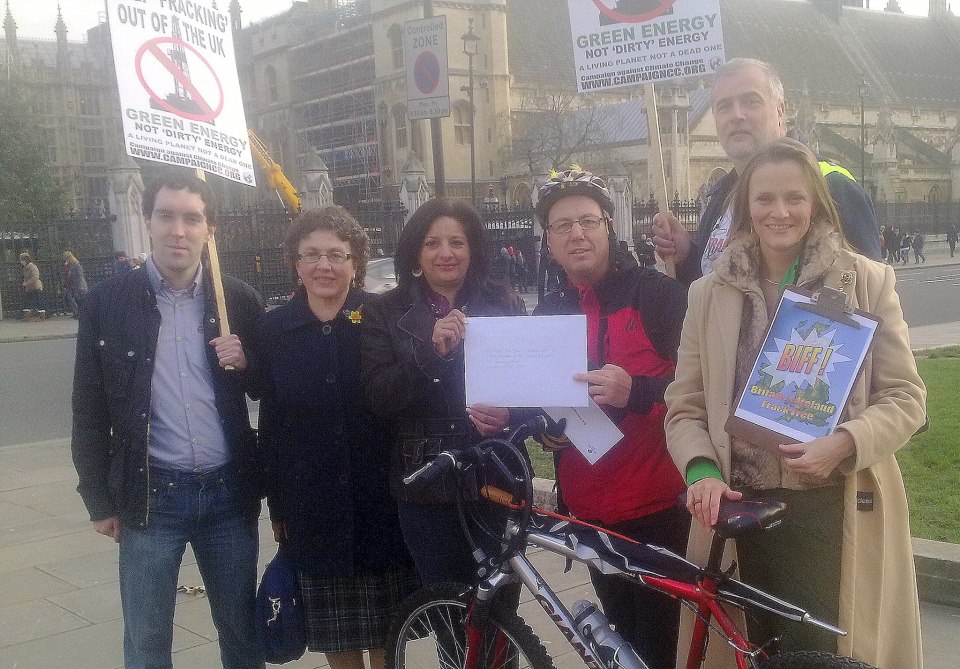
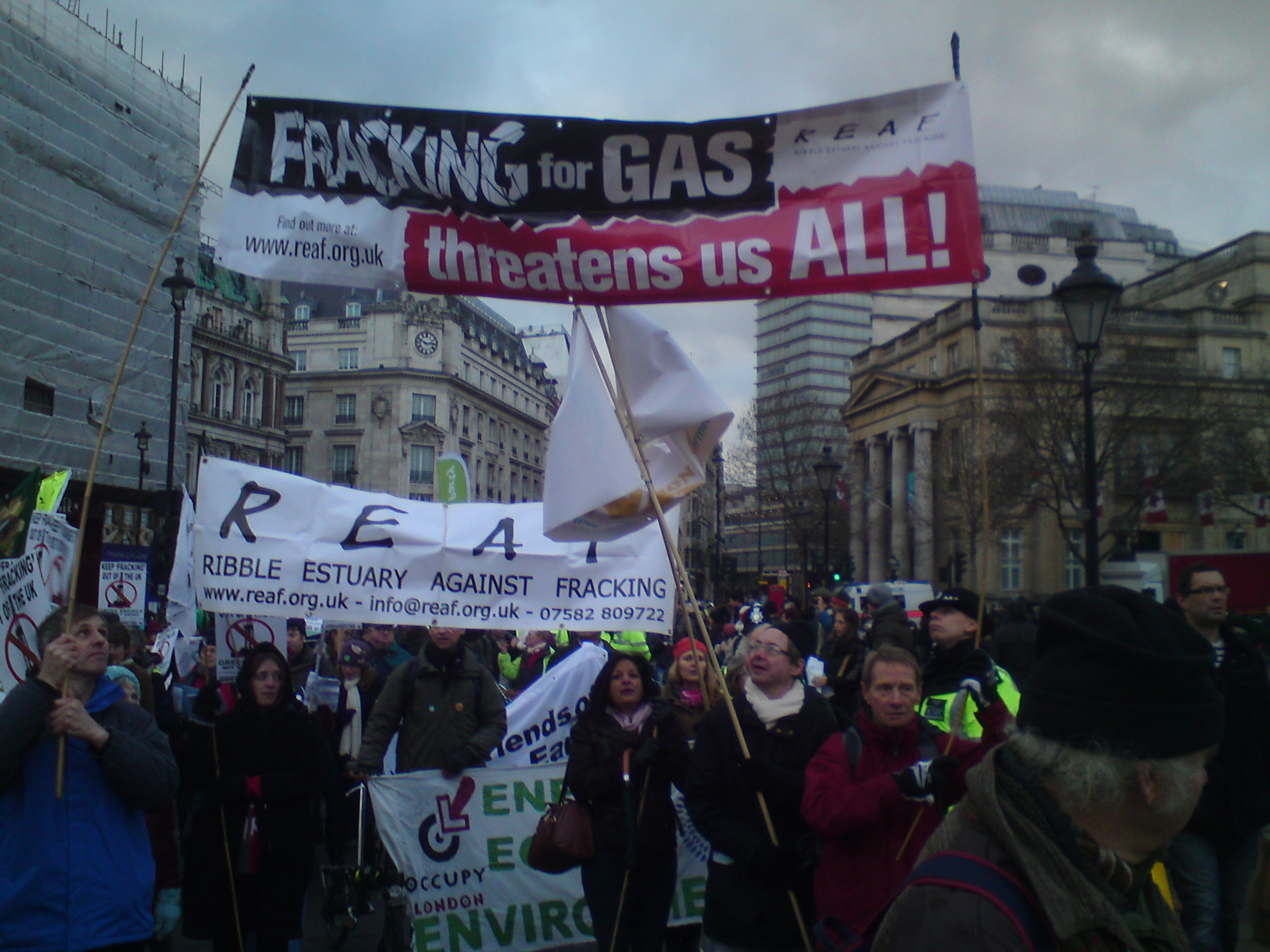
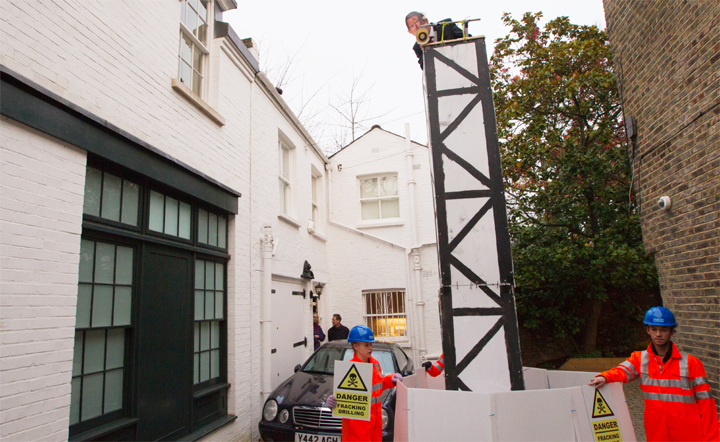
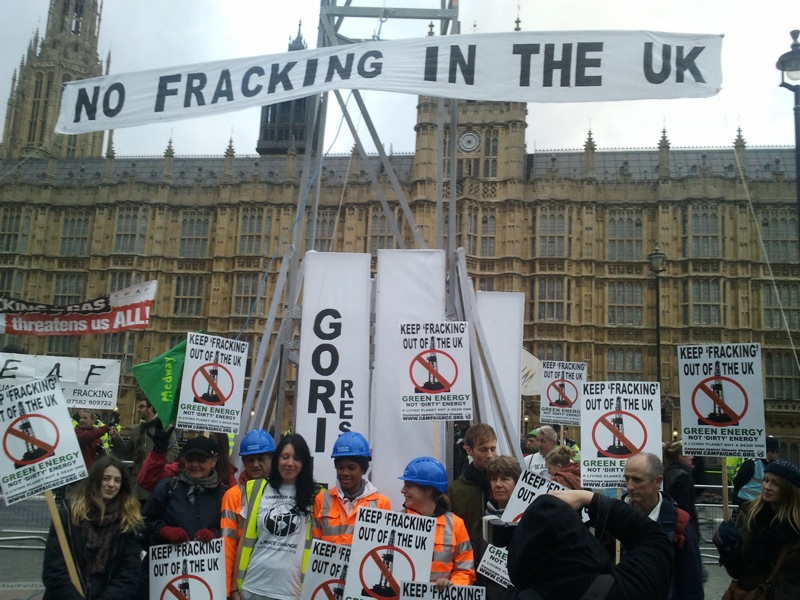
(This was outside the US Embassy, with the Canadian Embassy on the far side of the Square, in the background) 12.30 Leave Grosvenor Square with Gayzer (Frack Free Fylde) and Eve McNamara (REAF – Ribble Estuary Against Fracking), to meet up with the rest of the delegation going into Downing Street. This meant we missed the pipe laying caper across the Square – so here it is in 17 secs of video – courtesy of Frack Off (London): 13.00 Meet in the Red Lion in Parliament Street with Vanessa Vine (Frack Free Sussex and Biff – Britain & Ireland Frack Free), Maria Montinaro (Falkirk Community Councils) and Adam McGibbon (Belfast not for $hale). Also meet up with film crew from the Ecology Film Unit, who are putting together a UK version of their influential film ‘Fracking Hell: The Untold Story’ (available on youtube), and a variety of other freelance journalists and photographers. From left to right, outside Houses of Parliament: 14.00 Go through the rigmarole of security into Downing Street. Minor panic as half the delegation had no photo I.D. (no names mentioned) Sad to say, Dave wasn’t in and, disappointingly, had left no instructions to invite us in and offer us tea and cake; which would have been nice considering we had come from far and wide to see him – but times are hard for everyone I guess! 15.00 On coming out of Downing Street, Eve and I went off to track down and join the marchers on route from the US Embassy to Parliament. We found them approaching Trafalgar Square – and what a fine sight they were: (Eve rejoining her fellow fractivists from REAF) (Lord Browne getting a visit from Frack Off (London)) 15.30 The march ends outside the Houses of Parliament and the gathering crowds erect an impressive mock rig to rousing cheers, caught by the BBC cameras: (Fully erect – Frack Off crew in orange – Tisha in middle) Phil (CACC), Eve (REAF), MP John McDonnell (Lab Hayes and Harlington) , and Natalie Bennett (Green Party Leader) made rousing speeches to end the formalities of the day. Natalie’s speech at the end of the day: 16.30 Help with the clear up before heading off for a warming meal and a couple of drinks. 19.15 Train back to Bridgend, with usual delays and detours to try and piss you off – but it has been a very satisfying day, as I reflected on how far this campaign has come in the two years since I stood on that hill top near Llangeinor and realised what was at stake. https://bridgendgreens.wordpress.com/2011/01/22/fracking-close-to-llangeinor-lewistown-ogmore-vale-blackmill-bettws/ 22.20 Home in time for MotD and a large whisky! All this was happening in London, but during the day many other events were happening all over the country, including: SWANSEA / KEYNSHAM / BRIGHTON / HUDDERSFIELD / LYTHAM ST.ANNES For an excellent round up of all the day’s news and highlights from around the country, check this out: |
Letter to David Cameron Re Fracking Ban 1.12.12.pdf
Letter to PM David Cameron calling for a fracking ban
| Being delivered by hand on Saturday 1st December 2012 by 6 strong delegation:
Dear Mr Cameron, UK-wide call for an immediate ban on shale gas and coal bed methane exploration and development on our islands. Through your seemingly imminent adoption of a hazardous, unregulatable and largely foreign-owned hydrocarbon extraction industry in Britain, your ‘greenest government ever’ is in fact sanctioning nothing short of potential ecocide. We have had detailed correspondence with the DECC over the past year, the vast majority of which has been obfuscatory and contradictory. Gayzer Taryanyi, whose house was cracked by fracking activities in Lancashire last year, recently walked from Blackpool to Westminster to deliver a letter to you, to which your office gave a cursory response that was tantamount to disregard. As a result, we are today delivering this letter as a formal UK-wide deputation, requesting straight answers from you personally as the man who is ultimately responsible. Fracking for shale gas and coal bed methane is not an intelligent response to Britain’s energy needs. It would provide gas and ‘keep the lights on’ in the next fifteen to twenty years, after which Britain would be in exactly the same energy predicament it is in now, except that our landscape would be spoiled, water courses irreparably contaminated and we would have poured countless tons of methane and CO2 into the atmosphere. ‘Safe fracking’, Mr Cameron, is the oxymoron of the decade. It is simply not possible to regulate a technology which is prey to the vagaries of subterranean geology. Hydraulic fracturing compromises seismic security and risks leakage of fugitive toxic gases and other carcinogenic contaminants through faulty well-casings and along fault lines into our groundwater, aquifers, reservoirs, soil, air and thereby our bloodstreams and those of our children – for untold generations. 1. In the only attempt so far at high volume hydraulic fracturing in the UK, almost everything that could go wrong did so. Earthquakes were caused and well casings have repeatedly failed. Will you place upon the fracking industry the responsibility for the risks it is taking with our ecology and seismic security and to observe the internationally agreed ‘precautionary principle’? 2. Fracking in our rural communities would significantly and detrimentally alter the character and appearance of our communities and deny citizens their right to enjoyment of their homes and local environment. Your parliamentary constituency of Witney lies in an area with fracking shale gas potential. What steps will you take to to ensure that your constituents’ quality of life is not spoiled by industrialising the area with shale gas wells, condensate tanks, waste fluid pits, pipelines, compressor stations and frequent heavy road tanker traffic? 3. When fracking damages businesses, communities, homes, health and the environment, it is not clear where to go for redress. When damage or loss occurs, the injured parties are left to fend for themselves against the closed ranks of an unresponsive industry. Will your government implement legislation compelling the fracking industry to discharge its liabilities promptly and fairly and to establish an autonomous, industry-financed liability levy that is rigorously regulated? 4. There has been no Environmental Impact Assessment of the proposed shale gas fracking sites In the Fylde and the agencies responsible have not explained why. Will you ensure that the Fracking industry and regulatory agencies disclose all relevant information and conduct All necessary assessments, and that all exploration in the Fylde is halted until this has been done? 5. The fracking industry is secretive or silent about how spent fracking fluid effluent (‘produced water’) is transported, treated, evaporated, injected into wells and disposed of. Four million litres of radioactive waste water from Cuadrillas Preese Hall Farm site was moved without a permit, diluted and dumped in the Manchester Ship Canal. Some waste frack fluid has been moved more recently, but there is no information about where it was moved to, by whom and by what permitting process, if any. In the US and Australia, toxic waste effluent is illegally being sprayed on roads as ‘dust suppressant’ or ‘de-icer’. Will you compel the fracking industry to make full disclosure of how it will store, transport, treat and dispose of its toxic waste? 6. Fracking for shale gas involves building up enormous hydraulic pressure to fracture shale rock. When the rock splits and the pressure finally is released, a huge plume of methane, hydrocarbons, benzene and other carcinogenic volatile organic compounds (VOC) escapes into the air. If your Government gives the green light to further hydraulic fracturing in the UK, will you do anything to prevent this routine air pollution? 7. US data shows that 30% of well casings fail within 10 years. Failed well casings are a route for contamination to groundwater aquifers and to the air. What rate of well casing failure would be acceptable to you? 8. Damage caused by oil and gas exploration is impossible to prove without pre-fracking baseline testing of air and water. Will you introduce statutory independent baseline testing, funded by an industry levy, to be undertaken before each planning permission is granted for fracking? 9. In the Fylde, over 800 shale gas well are planned by Cuadrilla. A similar intensity of industrial development is planned for all areas of the UK that can be fracked, because there are no ‘gas fields’ but only small pockets of gas distributed evenly throughout the shale rock. This supply declines sharply once each well has been fracked. Do you acknowledge that exploiting a short-term, finite supply of shale gas will spoil and contaminate large areas of the British countryside? 10. Like shale gas fracking, unconventional coal bed methane extraction presents a threat to the countryside of the UK for the short-term benefit of a dirty industry. Will you closely examine the implications of the coal bed methane wells already approved at Keynsham near Bristol and at Airth in Scotland? Hydraulic fracturing for methane is an ecocidal, inept, uneconomical and irresponsible attempt to address our critical energy needs that would be hugely damaging and inappropriate for Britain and it is unnecessary. The number of jobs that the fracking industry would create is small compared to those which would be created by clean renewable energy technologies were the government to back them. The CO2 reduction target for the UK could easily be met by renewables and by a concerted reduction in energy consumption with the retrofitting of existing building stock and more efficient transport systems. The energy solution offered by the fracking industry by comparison is nasty, brutish and short. When will you stand by your claim of leading the ‘greenest government ever’, call an immediate moratorium on this cynical insanity and invest instead in safe and truly renewable energy procurement technologies? Please stop patronising and attempting to placate the people of the UK with nonsense about safe regulation of an unpredictable, unregulatable process that threatens irreversibly to poison our ecology, our farmland, our livestock and our children. We are not as credulous as you imagine. Do you want a legacy as the Prime Minister who despoiled both the countryside and the health of Britain by sanctioning ecocide? Or would you prefer to be remembered as the first Prime Minister to lead a truly green government? Yours sincerely, (the six undersigned) Vanessa Vine – BIFF! (Britain & Ireland Frack Free) / Frack Free Sussex Gayzer Tarjanyi – Frack Free Fylde Eve McNamara – REAF (Ribble Estuary Against Fracking) Andrew Chyba – The Vale Says NO! Maria Montinaro – Falkirk Community Councils Adam McGibbon – No Fracking Northern Ireland/Belfast not for $hale |

Uganda’s Anti-Homosexuality Bill – action required
|
The fight against fracking being taken to Downing Street
| The fight against fracking is being taken to Downing Street on 1st December, by a delegation representing every part of the UK, with South Wales being represented by Andy Chyba of “The Vale Says No!” campaign group and Bridgend Green Party. He will be part of a 6 strong delegation that also has representatives from Scotland, Northern Ireland, the South East of England and two from Lancashire, where the only fracking in the UK, to date, has occurred – and run into immediate problems.
Fracking is one of the techniques used in so called “extreme energy” exploitation, that seeks to extract the the last remaining drops of fossils fuels from the ground in ever more extreme and risky ways. Fracking involves pumping water, sand and a cocktail of chemicals into the ground under extraordinary pressure in order to shatter shale rocks and release gas trapped in the shales. South Wales also faces the threat of other types of extreme energy production – such as Underground Coal Gasification (threatened in Swansea Bay and the Lougher Estuary) and Coal Bed Methane (across the South Wales Coalfield). Among the many problems experienced by the frackers in countries like the USA and Australia are: the complexity of fractures allowing gas and chemicals to migrate into groundwater and water supplies; serious health issues related to the water contamination and also air contamination associated with gas treatment at the surface; triggering of seismic activity such as the two earthquakes shown to be linked with the fracking near Blackpool; implications for agriculture, especially organic farmers, of contaminants in water, soil and air; impacts on property prices; difficulties of disposing with water returned to the surface, full of additional contaminants flushed from the rocks (including radioactive isotopes); the impacts of associated heavy vehicle traffic in rural areas; explosive blow-outs. What is also now clear is that even if no major problems are created straight away, the problems can be stored up to strike years/decades/centuries after the frackers have done their dirty deeds. Given this catalogue of horror and the genuine difficulties in predicting, regulating and remedying most of these problems, rational and prudent governments in many parts of the world have seen fit to impose moratoria and bans. These include: France, Bulgaria, Romania, the Czech Republic, Canada (Quebec), Germany (North Rhine Westphalia), USA (Vermont, New Jersey, New York). Given the dire economic mess created by successive governments, it is perhaps not surprising that this particular government is being wooed by its friends in big business into contemplating the ‘quick fix’ represented by ‘extreme energy’, such as fracking for shale gas. But even the most optimistic of projections suggest that fracked shale gas can make no more than a small dent in our energy needs, for no more than 30 years. These optimistic projections bear little relation to the reality found in most areas subjected to fracking to date. These have found it difficult to get much more than 10% of the expected gas out of the rocks and have found wells becoming uneconomic after little more than 3 or 4 years. Our concerns resonate with every community directly threatened by the frackers – such as Llandow in the Vale of Glamorgan – as they then sit up and take notice of what is truly at stake. Groups across the UK have now come together to form an Anti Fracking Network to try to ensure these crowded islands of ours remain a safe, clean and habitable place for future generations to live. When you look at the state of the world around us today, do we really want to leave yet another toxic legacy for our children and grandchildren to have to contend with? This is the message being taken to Downing Street, along with petitions and letters of concern, and as part of a whole day of action in London and around the country – such as in Swansea – called Get Fracktious – which will also involve building mock rigs and pipelines. LONDON NATIONAL EVENT DETAILS: http://www.campaigncc.org/getfracktious SWANSEA REGIONAL EVENT DETAILS: https://www.facebook.com/FrackedSwansea?ref=ts&fref=ts For more information: Contact Andy Chyba |
Bridgend Green Party Meeting Agenda – Thursday 29th November
| Bridgend Green Party Meeting 7.00pm Thursday 29th November 2012 at the The Railway PH at the bottom of Station Hill (upstairs meeting room). ALL WELCOME (Especially new members!) AGENDA:
NOTE – Venue is 1 minute’s walk from both the Bus and Train stations in Bridgend. REMINDER – If anyone needs a lift to any of our meetings, let Andy know and we will organise it for you. |
Sustainable Wales Debate: Is Catastrophic Climate Change Inevitable?
| Please support this Sustainable Wales event on Friday, December 7th, at 8pm at the Green Room
[above SUSSED, 4-5 James Street, Porthcawl, CF36 3BG ].With guest speaker: Nick Jepson For two decades, the only thing that successive failed conferences and declarations on climate change have been able to agree on is a number: 2 degrees Celsius. If global temperatures rise by more than this, they say, we run a risk of passing a tipping point from which there will be no return. A runaway spiral of warming would be the result, at which point reducing emissions will have no effect as the world turns to desert and 80% of human beings die. This debate is about why we will almost certainly exceed a 2 degree target and why we never really had a chance of doing better. We have collectively failed in the fight against climate change. This isnt really anyones fault as individuals, but the fault of a system. I aim to show why the internal logic of capitalism means that it is not only spectacularly incapable of halting climate change, but in fact makes it inevitable, sooner or later. Whether we like it or not, we are bound to a system whose rules of operation, its ceaseless need for expansion, mean there was never a real chance of doing so. So, what can we do? Do we focus on mitigation and adaptation? Should we be thinking about controversial geoengineering schemes? Should we pump water Vapour into the air to create artificial reflective clouds? Seed the oceans with iron fillings to grow carbon eating algae? Put giant mirrors in space? These are drastic solutions and each time humans have interfered in their environment there have been unintended consequences, but how do we weigh these against the existential threat of climate change? Nick Jepson is a PhD researcher and teacher in global political economy at the University of Bristol. His doctoral research is on the transformation of the world-system which is taking place as a consequence of the rise of China, particularly focusing on the implications of this for development and extractive industries in the Global South. |
20mph limits across an entire County? If Lancashire can do it, Bridgend surely can.
| It is not yet widely known but, thanks to the Green Party, Lancashire is the first county in the country to make nearly every residential road 20mph. Robert Lindsay reports (from Green World 78).
In a series of secret town hall meetings, John Whitelegg, a Lancaster Green, was able to turn the countys Tory transport chief to implement Green Party policy on speed limits. The fact that John is also Professor of Sustainable Transport at Liverpool John Moores University helped make him more palatable to the Conservative Tim Ashton. Ashton took the transport cabinet post in 2009 after a blue tide ousted Labour from power in Lancashire. In that same election, the Greens Sam Riches won a county council seat and she spearheaded the public side of the 20mph campaign, holding public meetings, garnering support with door- to-door surveys during election times and highlighting the risk to school children in her division. John had found the previous Labour regime obnoxiously unhelpful when he first began trying to persuade Lancashire to adopt countywide 20mph limits 11 years ago. They hated the fact I was Green Party. Greens were taking their votes. But Ashton was more receptive. Eventually, the Tory road supremo was calling John Whitelegg for advice on overcoming the hurdles placed by his officers. He also had to battle his own backbenchers who believed 20mph would slow journey time. John got all the directors of public health in the North West to write personally to Tim Ashton at his home urging him that cutting the speed limit to 20mph would be the single biggest improvement he could make to health in Lancashire. The biggest boost came in August 2010 when national and local newspapers cited a report revealing the Lancashire districts of Preston, Burnley and Morecombe as the worst in the country for road injury to children. It seemed to act as a wake-up call to Tim Ashton, who has direct responsibility for bringing down road injuries in Lancashire. It was a perfect storm of events, said Riches. Things came to a head when Riches resisted a council plan to put a short 20mph limit on a stretch of road in her division, near a dangerous school crossing, saying it would make matters worse. Summoned to a meeting with Tim Ashton, he asked her to explain why she was blocking the move. Then he said: Would you support an area-wide 20mph limit? Shortly afterwards, the policy initiative was announced. Now half-way through the three-year, £9.4 million programme, average speeds are down in some areas but are unchanged in others and the perception is that more enforcement and publicity is needed. A series of high-profile police speed gun checks is imminent, followed by a countywide poster, radio and new media publicity campaign. Paul Binks, Lancashires Road and Transport Safety Manager said: We are hoping that it will become socially unacceptable to drive at more than 20mph. Its about changing the culture, said Whitelegg. For Riches, the campaign illustrates an uncomfortable and often forgotten truth: Green councillors can only change policy if they persuade the opposition as well. Robert Lindsay is a Green Party member in Suffolk. Some facts about Total 20, or area wide 20mph limits Total 20 avoids the use of expensive humps or other physical calming measures. The idea is that by imposing 20 limits over a wide area such as a town, city, borough or county, drivers get the message that it is unacceptable to drive at more than 20mph in a residential area. Total 20 areas cost just £333 per road and are very cost effective. The Government calculates the cost of a road death to the economy at £1.8 million. Portsmouths Total 20 scheme cut serious injuries and deaths by 22%. If you are driving at 30mph and someone runs out three cars lengths in front of you, you will hit them at 27mph. The impact on that person is equivalent to falling from the third floor of a building. At 20mph you will stop just in time. 20mph areas lengthen the average car journey by just 30 seconds. Britains Department for Transport sets national targets to reduce road deaths and casualties by a certain percentage over a certain time, implying it finds a certain level of road death acceptable. Sweden has a zero tolerance for road death policy which has energised road safety professionals and led to widespread 20mph limits. |