Category Archives: Uncategorized

The rise and rise of corrupt government in the UK

As we enter the final few days of the 2015 General Election campaign, the only real sense of the establishment parties getting a well-deserved kicking is with the SNP assault on Labour in Scotland. The fact of the matter is that the neoliberal establishment parties will still be forming the basis of our next government and nothing much will change. However appallingly they act, the British public seem reluctant to seek out radical change.

Sleaze has become the accepted norm it seems. We have had ‘cash-for-questions’ and we have had the MP’s expenses scandal. Plenty of those involved are still on the scene and there even MPs forced out by expenses scandals in 2009/10 that have the audacity to seek election again this time.

The big scandal in recent years (2013) came to light when a Tory MP and a bunch of peers were caught on camera taking cash from journalists posing as representatives of foreign companies. The Right Honourable Lord (Jack) Cunningham of Felling (pic>), Blair’s cabinet ‘enforcer’, was caught asking for a mere £12,000 per month  – which I am sure he only wanted to support the food banks in his former constituency in Whitehaven, being a good Labour socialist!!

Cameron and Clegg were suitably horrified (by the indiscretion at least) and pledged to stamp out such corrupt parliamentary influence-peddling. And their first, and so far as I know only, target was? …….. Why, of course, the Trade Unions! They hastily created a register of lobbyists, allowing the policing of union membership lists, and also curbs on union spending on election campaigns . I somehow doubt Lord Fucking’em of Cunning has his Union membership paid up these days.

Cameron’s and Clegg’s cynicism has been breath-taking. The register has done absolutely nothing to to prevent most of the high level lobbying carrying on as before, as it only applies to lobbying firms (aka influence brokers). Those taken directly onto corporate payrolls remain exempt. So it may be a bit trickier for backbench sleaze balls – but the big guns will continue to lap up the cream.

Cameron, was of course, a former lobbyist himself, so he knows only too well how it all works. His election adviser is that well known “master of the dark political arts”, Lynton Crosby. As a prominent lobbyist for those nice corporations peddling tobacco, alcohol, oil and gas, he has ensured proposals for plain fag packets and minimum prices for alcohol have not got anywhere.

Conservative Party treasurer, former banker Peter Cruddas had to resign when he was exposed for selling access to Cameron in return for a party ‘donation’ of £250,000. Liam Fox quit after it was revealed he had obtained £157,000 from Tory donors purely to allow his chum Adam Werrity to hold his hand on global trips as Defence Secretary. And these are just the ones that we know about – the tip of an iceberg, no doubt.

But even all this doesn’t begin to cover the full extent of corporate influence. We have been rapidly learning (or been taught) about how it works by the masters of it all based in the USA. Read Chomsky’s ‘How the World Works‘ for a readable account. Over half of the Tories’ funds come from bankers and financiers. Six-figure donations routinely buy a government jobs. In fact, there is an ever growing merry-go-round of politicians, lobbyists, civil servants, bankers, corporate advisers all just swapping jobs. Thus business and Government interests become mutual and interchangeable.

A bit of googling and Wikipedia research quickly throws up some interesting examples:

  • David Hartnett – was the head of tax at HMRC who let Starbucks and Vodafone avoid paying billions in tax. Moved to Deloittes accountants in the City, who work for …… Vodafone!
  • Hector Sants – was head of the FSA, and thus in charge of regulating the banks. Left to join ……. Barclays!!
  • Jeremy Heywood – moved from the Treasury to join Tony Blair’s office, from where he moved onto Morgan Stanley investment bakers, and then on to working for David Cameron.
  • Tony Blair – rakes in at least £20m a year from banks and dodgy governments. The ultimate champagne socialist!

All just choice examples of common place practices. There is a constant flow of people between the big auditing firms and government. How else are they to devise new loopholes for the big corporations quicker than we can close them? Government regulators often become the prized assets of the corporations they used to regulate. There are plenty of ex-military and defence ministry people making good money from arms companies. Politicians, civil servants and intelligence officers often have portfolios of lucrative directorships to ease them towards their dotage.

In this context, the inexorable march of privatisation in our public services is assured. Let’s not forget, Labour lambasted John Major for introducing some piffling PFI contracts to the Civil Service, but it was Labour who embraced it and introduced it to the NHS. It has proven to be more expensive, less accountable and have lower standards, yet with 142 (cross-party) peers in the Lords involved with private healthcare companies, the 2012 Health Bill heralded a new round of outsourcing.

As with the US, corporate and financial power have usurped government power. It is patently obvious that things cannot change with any of the Con/Lab/Lib collaborators in government. Radical alternatives are on offer from the Green Party and others.

We can ban ministers and civil servants working for private companies. We can reverse the tide of privatisation. We can implement a redistribution of income that caps executive pay. We can bring manufacturing back to the skilled hands of people in this country, rather have an economy built on the sands of financial wheeling and dealing. We can, but there is, sad to say, negligible chance of it starting next week.

The battles against insanity and inequality are intertwined

One of the unexpected consequences of my recent breakdown has been rediscovering a passion for reading, study and learning. I have now completed the 8-week Mindfulness programme and I am beginning to emerge from the gloom and look to fill my time positively.

To this end, I have enrolled onto the Open University’s Futurelearn programme of free online courses and have just completed the first week of a Mental Health and Well-being 6 week course that I am already getting a lot from. Particularly encouraging and timely has been the fact that much of what I have long-felt to be true – and is reflected in the Green Party’s philosophical basis to an extent – is becoming increasingly accepted as the way forward.

For example, a recent report prepared by the British Psychological Society, entitled A psychological perspective on very serious health problems, has highlighted the following preventative strategies:

  • Equality

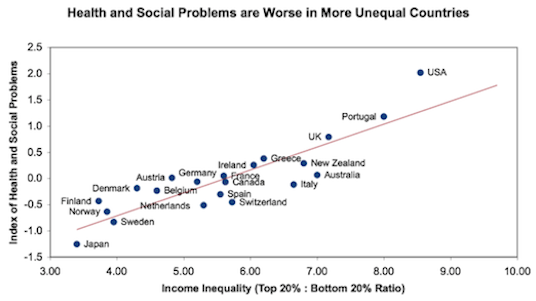
Evidence shows that a major contribution to serious emotional distress is not only poverty but particularly income inequality – the growing gap between the richest and poorest people in society. In their influential book The Spirit Level, sociologists Richard Wilkinson and Kate Pickett demonstrate that mental health problems are highest in those countries with the greatest gaps between rich and poor, and lowest in countries with smaller differences. Equal societies are associated with more trust and less paranoia. This suggests that rather than primarily targeting our efforts at individuals, the most effective way to reduce rates of ‘mental illness’ might well be to reduce inequality in society.

(Source: http://inequality.org/)

  • Reducing discrimination and oppression

A classic paper on this was published in 1994, entitled Environmental failure – Oppression is the only cause of psychopathology. Whilst some might think that goes too far, there is no doubt that people who have been subject to oppression, and particularly discrimination (racism, homophobia, discrimination on grounds or gender, disability or ‘mental health’) are put at risk by these experiences. We can all work to combat discrimination and promote a more tolerant and accepting society, the paper suggests. Tell that to ukippers!

  • Reducing harmful drug use and addressing its causes

Alcohol and tobacco are unquestionably the most serious substance-related public health issues, but cannabis and other drugs have been associated with mental health problems in general and psychosis in particular. Over-use of recreational drugs appears to make it more likely that someone will experience a psychotic crisis.
This does not necessarily mean that we need a stronger clamp-down on drugs and many people (including most Greens) argue that de-criminalising the possession and use of drugs would be an important positive step towards protecting people’s health. It is also important to address the social problems that lead people to turn to taking drugs, including poverty, inequality, unemployment, hopelessness and feeling disenfranchised from society. The supposed ‘war on drugs’ we hear so much about is, according to commentators such as Noam Chomsky, merely a cover for international interventions and, domestically, a distraction that allows repression in the inner cities and an excuse for attacks on civil liberties.

(various online sources)

The Spirit Level was a book I first read back in 2010, when it was first published. I read a review of it around the time I joined the Green Party and it resonated with the geographer in me and helped confirm my view that the income inequality was quite possibly the most important issue facing the country, the world and our role as guardians of the planet. It is an essential read for any ecosocialist. It has, of course not been anywhere near universally acclaimed, but the solid research underpinning it makes its assertions as irrefutable as, say, the evidence for global warming – i.e. it is only not clear to fuckwits and/or vested interests.

Of course, some of those vested interests control our media, so don’t expect rational coverage of such ideas. After all, 98% of scientists are in agreement on global warming, yet the media feel ‘obliged’ to offer both sides of the non-existent debate! The public therefore often form an opinion that there is a lot more controversy than there really is. These attempts to overthrow large bodies of scientific evidence that may have important political implications are a well-established practice, and the subject of another interesting read, Merchants of doubt: How a Handful of Scientists Obscured the Truth on Issues from Tobacco Smoke to Global Warming.

It may be beginning to sound as if I have been seduced by conspiracy theories and paranoia. Why would vested interests want to deceive us about global warming and work against drives for a more equal society? Well, don’t take it from me – take it from Noam Chomsky – arguably the most important intellectual alive today. I have been revisiting some of his views on ‘How the World Works’. It has re-affirmed my confidence in ecosocialism as the way forward – and re-inforced my loathing of the USA.

Chomsky explains how, ever since the Second World War, successive US governments have been committed to maintaining a right-wing status quo. For Republican, read Conservative (Tory); for Democrat, read Labour (Tory-lite). (Similarly, for Tea Party, read UKIP (ultra-Tory)) This means, in practice, business interests are always allowed to prevail, workers are divided and weakened, and the burden of reconstruction after wars/economic recessions/environmental disasters etc. is placed squarely on the shoulders of the working classes and the poor. Sound at all familiar?

Antifascists, socialists of any sort, and any campaigners for a fairer society, be they charitable organisations, religious orders, or intellectuals, were and are an obvious and unacceptable threat to this now-traditional order of things. The US became adept at installing fascists and Nazi collaborators in places where social revolution raised its ‘ugly’ head. If it required extreme violence (or even if it didn’t), that was never a problem. Sometimes softer measures sufficed – such as subverting elections or withholding/obstructing aid. Chomsky points out that the threat of a good example was considered such a danger to the status quo that no country would be exempt from being dealt with – no matter how weak or poor it was. He cites these examples:

“Take Laos in the 1960s, probably the poorest country in the world. Most of the people who lived there didn’t even know there was such a thing as Laos; they just knew they had a little village and there was another little village nearby. But as soon as a very low-level social revolution began to develop there, Washington subjected Laos to a murderous ‘secret bombing’, virtually wiping out large settled areas in operations, it was conceded, had nothing to do with the war the US was waging in South Vietnam.”

“Grenada has a hundred thousand people who produce a little nutmeg, and you could hardly find it on a map. But when Grenada began to undergo a mild social revolution, Washington quickly moved to destroy the threat.”
(Being a Commonwealth country, this was a rare occasion of British dissent against US intervention. The UK Government had no such problems with most of the following litany – Grenada did not break the ‘Special Relationship’)

Chomsky goes on to write the following, explaining and condemning the US responsibility for these devastating interventions (I have added some cultural references in brackets which prove we weren’t all blind to what was going on):

This is just a sample of the large scale war crimes the US and its friends (Thatcher and Blair to the fore) have been up to and getting away with. See a fuller selection here (and this is just up to 1999).

This makes every US President (and most UK Prime Ministers), since World War Two, war criminals – certainly by the standards they themselves set at the Nuremberg Tribunals. This is up to and including Obama and Cameron.

Looking forward, the question needs to be asked as to just how long left-wing progress, in places like Greece (Syriza) and Spain (Podemos), will be allowed before the ‘right’ attempts to orchestrate its catastrophic demise.

In the meantime, Syriza in particular has offered us a shining beacon of hope that change via parliamentary democracy may yet be just about possible. There have been rumblings of change around the globe. The Arab Spring and Occupy have been effectively nipped in the bud, but what of rumblings in these isles? There is a very tangible wave of anti-Westminster sentiment sweeping the land from an eclectic range of sources; be it UKIP, the Scottish YES campaign, the anti-austerity alliance (potentially) of the SNP, Plaid Cymru and the Greens, or Russel Brand’s no-vote ‘Revolution’.

Has anyone noticed the media spin on all this? Years of apathy and, by inference, tolerance of the status quo, was portrayed as stability. Now that people are finally beginning to get off their backsides and organise, we are in a crisis of democracy! The Economist recently portrayed it thus:
“Between 1980 and 2000 democracy experienced a few setbacks, but since 2000 there have been many”   Really?
This is a classic example of right wing propaganda. It is targeting the politically literate (maybe 20%) who may have some role in decision making. Their acceptance of the underlying doctrine is crucial. They are constantly drip fed it through the broadsheets and the BBC. The vast majority, however, are sometimes characterised as ‘the bewildered herd‘.They are supposed to just do as they are told and put their trust in the ‘responsible’ people. They are the target audience for the less subtle mass media – the tabloids, the sitcoms, Premier League football etc.

The undermining paradox of tory doctrine (be it the full-fat, lite or ultra variety) is that creating greater inequalities actually increases the need for big government – more police, more prisons, more health and social services. These services are always expensive and never fully effective. The most effective and civilised way to achieve the Tories’ purported dream of a smaller state is reducing inequality. The Scandinavians sussed this out a long time ago. It is not rocket science, so it suggests that Chomsky’s critique is the one prevailing. There will be no ‘good example’ here in a hurry! Corruption and the unbridled greed of the ruling classes will see to that. Thatcher and Blair have embedded a tolerance of this in the UK public, which we see today in the pro-austerity agenda of the Con/Lab/Libs at this General Election.

The Labour Party has to take the greatest responsibility for perpetuating the appalling status quo. We expect nothing else from the Conservatives, but with its history of emerging from the workers movements and trade unions, with proud achievements such as the creation of the NHS, the Labour Party has become a disgusting travesty. Watching Lord (vomit) Kinnock and Saint Blair milk their status to the max must be making Milliband’s mouth water. After all, Kinnock never even managed to win a General Election, losing two even when Thatcher had been rumbled as the Wicked Witch of the West.

To quote from The Spirit Level:
“It is now time egalitarians returned to the public arena. We need to do so confident that our intuitions have been validated and found to be truer than most of us ever imagined. Because the evidence shows that few people are aware of the actual scale of inequality and injustice in our societies, or recognise how it damages the vast majority of the population, the first task is to provide education and information.”

I guess this is what I am hoping to achieve as my contribution to the revolution we need to bring about. We need to address the bewildered masses. We are on the right tracks. We need to keep asking questions, keep demonstrating, keep writing letters, keep voting. It has to be sustained and organised. We need to keep learning from our mistakes and keep working with the right people in a non-sectarian way for the common good.

But we had better watch our backs and beware of the biggest single threat to any possible peaceable revolution, ‘the world’s rent-a-thug’ as Chomsky calls the USA, appropriately enough. History tells us that when they feel the winds of social change gathering momentum, they will stop at nothing. With the British Establishment as longstanding allies, it is almost certain to get ugly at some point.

But to end on a more positive note, I will now go and meditate on this now:

Green Party 2015 General Election Manifesto

A couple of days ago, the Green Party (GPEW) launched its manifesto for the GE in three weeks time. Indeed all the parties have been busy launching their manifestoes in the last few days. They make interesting reading.

A manifesto is a published declaration of the intentions, motives, or views of the political party. A manifesto should usually accept previously published policy but can promote new ideas and prescriptive notions for carrying out changes the author(s) believe(s) should be made.

I can assure everybody that the Green Party does this properly and rigourously (in part because I was responsible for a small part of it – yes, on fracking). I would like to publicly commend the work of Brian Heatley, in particular, and all the many other contributors, for providing such a well written, thorough document that is accessible to all (via the full range of versions available)

Lots of work has gone into costing the pledges within it, which makes it disappointing when we hear Natalie Bennett and Pippa Bartolotti floundering around for a few headline figures in interviews, and even more disappointing and disingenuous of some of the media to exploit these personal weaknesses when the figures are readily enough to hand. Sample pledges:

  • Investment in renewables (£35bn)
  • Increase in NHS budget (£12bn, then 1.2% p.a)
  • Early years education (£8bn p.a.)
  • Class size reductions (£1.5bn p.a)
  • Abolition of tuition fees (£4.5bn)
  • Cancellation of existing student debts (£30bn)
  • Increase in Social Housing budget (£4.5bn p.a.)
  • VAT reduction to 5% on restaurants/tourism and related + home renovation (£7.6bn p.a.)

Sample budget increases:

  • Cancelling Trident and nuclear disarmament (£100bn+ over 30 years)
  • Stopping landlords writing off mortgage interest against tax (£5.8bn)
  • Increasing minimum wage to £10p/h (£2.4bn p.a. saved on tax credits + £1.5bn increase tax/N.I. revenue)
  • Wealth tax of 2% on top 1% (£10bn in 2016 and rising)
  • Robin Hood Tax (£5bn in 2016 and rising)
  • Abolition of upper NI threshold (£14.5bn in 2016 and rising)
  • Increase in Corporation Tax (£12.5bn in 2016)
  • Reducing tax evasion (£12bn in 2016 and rising)
  • VAT & fuel duty on aviation fuel (£16bn in 2016)

Over the course of a 5 year parliament, the manifesto details £672.7bn of revenue increases to set against £136.9bn of revenue decreases. This gives a net increase in revenues to fund our programmes of £535.8bn. Of course, some of these issues, especially regarding health and education, are devolved matters. Which brings us to Wales Green Party. Available in English and Welsh (of course), they have produced a kind of addendum designed to go alongside the GPEW manifesto. Sounds fair enough, but at the time of writing the links to it on the Wales Green Party website are not working – possibly due to an attempt at rectifying a bit of a gaffe (shurely not!) over the ever-sensitive issue of Welsh independence. The manifesto for the Green Party of England and Wales states:

“Greens have long supported the process of devolution in Wales. We believe that the people of Wales should enjoy the degree of autonomy, perhaps including self-government or independence, that they wish to have, as expressed in a referendum. “Up until such referendum, Greens in Wales will focus on improving and maximising the potential of the current settlement.”

Hear, hear! But the Welsh addendum doesn’t mention a referendum. Au contraire, their stated approach to Welsh governance is pretty much identical to the mainstream neoliberal parties with Wales having to settle for a ‘reserved matters’ form of devolution. The Welsh manifesto addendum states:

“We believe that the starting position should be that all powers are devolved from Westminster to the Welsh Government except for those that are best retained at a UK level.”

Not surprisingly, this discrepancy is already being jumped on to illustrate how out of tune WGP continues to be with GPEW. I had better stop here methinks!

P.S. The link to the Wales addendum became functional again a few hours later – unamended as far as I can tell. On reflection, it seems to be more of an early bid for support in the Welsh Assembly elections next year than having much relevance to the General Election this year, but that is fair enough and more realistic I suppose. Achieving some success in those WA elections would be all the more realistic with some form of pact with PC in place – but WGP’s position (at odds with GPEW) on Welsh governance makes it clear that this will not happen.

Votes for Policies – if you dare!

VOTES FOR POLICIES https://voteforpolicies.org.uk/

I thought I better check where I stand theses days, and it looks like I am still a rock solid Green:

And it also looks encouraging for the Greens in Bridgend, if they get their act together to put a candidate up!

If you keep visiting the site, it will update the figures as we approach the election. Despite all this, I still predict a probable lost deposit and 5th or 6th place, if the Greens stand. Finishing ahead of UKIP would represent some sort of worthwhile outcome.
As well as the usual Lab/Con/Dems, we also have Plaid Cymru, TUSC and our friends in the Pirate Party vying for some of our target audience (and UKIP).
With FPTP, it is a lot easier to hang on to votes you shouldn’t have, than to gain votes you should have.

Voting for what you really want is a tactic that too few run with – and the strategy of the left factions standing against each other makes it so.

If there was a SYRIZA-like coalition of the left, between Greens/PC/TUSC/Pirates, Labour MP Madeleine Moon would be out on her ear and have to start paying for her own jolly trips all over the world, instead of having another 5 years serving Porthcawl (I doubt she even knows where Wildmill is) handed to her on a plate.

Hey ho!

P.S. Just to bang on about the same point a little more – here are the current scores for Ogmore constituency. The potential for a joint Green/PC assault on this safe Labour seat is clear enough. Instead, we have two people I have the utmost respect for going head-to-head and getting nowhere (I suspect).

Screen Shot 2015-03-24 at 14.25.35

Andy’s PV solar panels’ performance – 32% saving

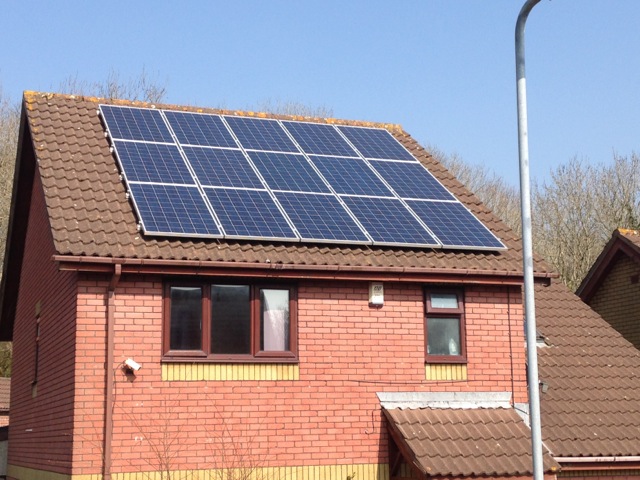
We had this installed in late November 2013 by A Shade Greener at absolutely no cost to us whatsoever, and have found the company as good as their word at every stage. They get the ‘Feed In Tariff’ for all the electricity generated. We get to use as much of the electricity generated that we can for free, with the rest feeding into the grid. The onus is on us to organise our household and activities to gain the optimum benefit, but the bottom line is that we gain some benefit every time the panels produce anything (there are always appliances such as fridges/freezers, and things on standby, using some electricity). We will always have an electricity bill for what we use over and above what the panels produce at a given time – and through the night of course!

A few things need to be taken account of before looking at the figures.

  • This is a maximum size installation of 4kWp, using slightly bigger than usual panels.
  • Our house faces a bearing of 210 degrees, which is 30 degrees off the due South which gives optimum performance.
  • The company will consider installations up to 45 degrees either side of due south i.e. anywhere between bearings of 135 (SE) and 225 (SW) degrees.

SO, WHAT SAVINGS HAVE WE MADE?

The data comes from our eco-eye monitor, which cost us £60. This is the only outlay we have made, as A Shade Greener don’t supply one (it makes no odds to them whether we use the electricity produced or not), but I would say it is very worthwhile as it flags up when there is surplus electricity available for us to use – time to put the washing machine or dishwasher on – and also provides the data below (and masses more):

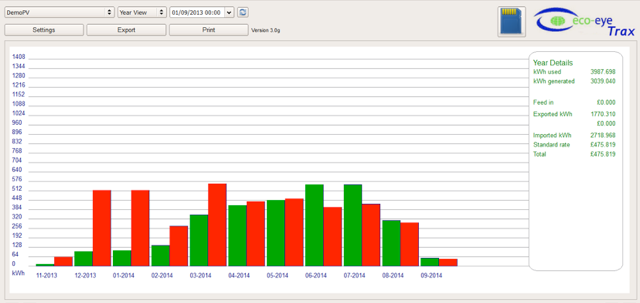
(I had hoped to show the whole of 2014, but the memory card became full in early September, so ignore the incomplete months of Nov “13 and Sep “14)

The graph indicates the electricity we used in red and the electricity generated by the panels in green.
I am puzzled why we used so little in February last year, but otherwise the pattern is much as may be expected. We find:

  • Peak consumption in Dec/Jan/March; lowest consumption in (bar odd data for Feb) in Jun/Jul/Aug
  • Peak production was in Jul/Jun/May; with lowest production in Dec/Jan/Feb
  • Production actually exceeded consumption in Ju/Jul/Aug

However, there is always a mismatch between times of production and times of consumption, so how does this pan out?

Of the 3039kWh generated by the panels, we exported 1770kWh, so we used 1269kwh of it (42%). Had we managed to use all 3039kWh, this would not have covered all of our consumption – but would have covered 76% of it.

Over the period, the house used 3988kWh, importing 2710kWh of it (68%), so we have a headline figure of 32% saving – just below the 37% average saving cited by A Shade Greener:

In monetary terms, it depends what unit rate you are paying. We currently pay 14.04p per unit to Ecotricity.
The 1269kWh we got from the panels was therefore worth about £178, but this excluded Sep/Oct/Nov. If we assume these would have been average months, the annual saving would be around the £235 mark.

There is plenty more we could do to optimise our use of the panels’ production, but we are getting worthwhile savings and also passing our surplus into the grid, reducing the need for non-renewable production.

It really is a no-brainer!

P.S. If you call A Shade Greener in, don’t forget to mention my name!

There’s a black dog on my shoulder again

‘Black dog’ as a metaphor for depression: a brief history

Apologies for my rather sudden disappearance from social media (feel free to share this page if you see fit) and withdrawal from my usual activities. I suffered something like a perfect storm of work, political and personal setbacks that, over a considerable period brought me crashing down a few weeks ago.

I am just about beginning to function again, but it may take a while before normal service is resumed – if it ever is.

I am, however, beginning to become hopeful of taming the black dog and managing its behaviour to avoid another meltdown on this scale again (this is my third major episode), and this is the reason I am writing this post – to share the source of this hope.

Depression is the scourge of modern living and the facts and figures speak for themselves: Mental Health Statistics

Screen Shot 2015-03-16 at 21.12.52

So, a quarter of you probably have some sort of idea what it is like to be a sufferer, which means three quarters of you haven’t a clue, because you really cannot know what it is like if you haven’t been there.

Because it effects people everywhere and of any background, it does mean great intellectuals and artists suffer at least their fair share (there is some evidence that rationalists may suffer more). Some have attempted to share and explain the experience.

The Manic Street Preachers ‘Black Dog’ song above comes from their ‘This is my truth, tell me yours‘ album that contains some other insights such as:

Another perhaps unlikely source of insight into depression is Ruby Wax. She has suffered a lot more severely than I have and describes it well here: 

Screen Shot 2015-03-16 at 21.15.27

“I remember why depression is so awful now that I’m back in that land; there is no specific sharp, jabbing or throbbing pain, there is no feeling. This is the sensation people are after when they take certain drugs to forget but even then they know it’ll wear off. This isn’t recreational it’s terrifying. There is no one in your body to even register pain. There is nothing, empty space, whoever you were who lived in your skin has left the building, vanished. I can recall back in a fog that I had a fast mind, a quick wit, insight into others; it feels like I’m talking about a distant relative. People remind you that you’ve accomplished things I’m sure it’s true but then I was someone else not this thing. That what it feels like in reality I know it’s not true but this again is a symptom of the disease.”

However, she goes on to explain that, although she has not got a cure, she has found a way of managing and taming it – a way that has connected with me too:

“This time I’m not fearful about having the actual depression. Having studied it, I know this is what it is. I’m not fearful that I’m making this up and I can ‘snap’ out of it. That said, fear is a symptom of the disease; I feel I’m in full emergency mode because my chemicals are in full emergency mode, not dependent on any outside stimuli but because they have started to flood my brain and cause havoc.”

Screen Shot 2015-03-16 at 21.17.45This starts to give a clue as to how to handle the ‘black dog’ of depression. There is something physiological going on in terms of chemicals at work in the brain. This is why medication can and does help. What medication cannot do, however, is help you manage the thought processes that can trigger, accentuate and perpetuate the downward spiral into a depressive state. This is where counselling and talking (cognitive behaviour) therapies have been developed, along with all manner of ‘alternative’ therapies. But there are a couple of major problems with most of these. Firstly, you only get a referral to such services once the depression has taken hold and is relatively severe. Secondly, they are often built around stuff that is easy to dismiss as wooly and/or mumbo jumbo. If you buy into it, like a good placebo, it is likely to have a positive impact, but for rationalists like myself and Ruby Wax, if we don’t understand it, we won’t buy into it and it will never work. This is perhaps why rationalists end up suffering more.

What we need is something that we can see having a scientific basis and underpinning, alongside something we can build into our daily lives to help avert and manage our depressions. Ruby Wax has done the due diligence and found something that is (all too) slowly becoming a recognised way forward. It is called MINDFULNESS-BASED COGNITIVE THERAPY (MBCT) – I’ll simply call it ‘mindfulness’.

Ruby Wax went to the extreme lengths of studying it for a Masters degree from Oxford University, where the whole concept has been developed (with others) by a guy who has become one of my gurus, Professor Mark Williams. I use the term guru quite deliberately as the the whole programme, as the Prof fully acknowledges, owes a lot to the ancient wisdom of Buddhist traditions in terms of mindful meditations. I have long acknowledged the Buddhist world view and traditions as vastly superior to other (religious) traditions, and I am happy to advocate MBCT as a bit like Buddhism minus the paraphernalia but bolstered by science.

I was first introduced to mindfulness and Prof Williams’ work by my GP quite a while ago. However, he threw me straight into undertaking the meditations and I quickly dismissed it all as more wooly nonsense and refused to buy into it. It wasn’t until I recently heard Ruby Wax advocating it, and joining up a few dots for me, that I finally bought into it properly and started to do my own diligent research.

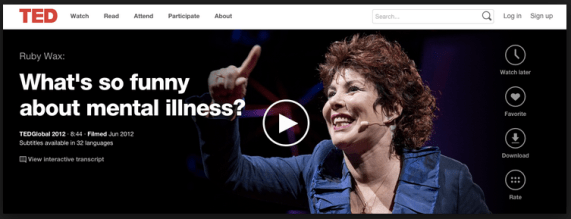
Here’s Ruby’s TED  talk.

Screen Shot 2015-03-16 at 21.19.57
Here’s her (a) book  Screen Shot 2015-03-16 at 21.23.09

(b) audiobook and

(c) tour.

Here is Prof Mark Williams’ introducing the concept in a reasonably accessible way: Science Live lecture 2012. His calm, engaging voice helps inspire confidence and I recommend sticking to his publications and recordings.

Screen Shot 2015-03-16 at 21.27.13        Screen Shot 2015-03-16 at 21.28.52

The beauty of the 8-week programme is that it is easy enough to self-administer with the aid of one book and its accompanying CD     (Audiobook format)

I am currently into week three of the eight week programme. Although it is impossible to say whether the small improvements in my condition are down to increased medication, or being signed off work, or the mindfulness guided meditations, or the love and support received from family and friends, or any possible combination of these factors – I can say quite categorically that the meditations are something I look forward to doing for the peace they give me for a few minutes at least (nothing offered me proper peace of mind before). I can also say categorically that I now understand the principles (if not the detail) of the science behind the whole approach, and thereby buy in to the whole strategy. It offers real hope of being able to cope much better with the mad world we live in.

What it all means for me returning to campaigning and politics remains to be seen. Being in the Green Party is swimming against the tide (the green surge has slowed the tide, not reversed it). Being an ecosocialist within Wales Green Party is battling against a further rip current. I became exhausted and drowned. I will not be rushing back to that environment. I have other more pressing priorities for when I am in good enough shape to take them on – namely sorting out my employment situation and properly attending to the wonderful people in my life that I may have taken for granted and neglected for too long. They have been my lifesavers and I owe them everything.

I fully acknowledge that part of the great depression that envelops many people is not having the support of other people around them. But at the end of the day, sufferers of depression, and indeed everyone living the rat race of a life we have created for ourselves, have everything to gain and nothing to lose from allowing mindfulness to give you that little bit extra control of your mind and the life your mind creates for you.

As Ruby Wax explains in her TED talk, we are simply not designed for the lifestyles we have created for ourselves. Material wealth and all the opportunity to ‘progress’ in the world does not create happy, well-adjusted people. Coming to terms with this truism and learning to enjoy the here and now has to be (at least part of) the way forward.

I have exhausted myself now. I will leave you with Ruby’s words, as she expresses it better than I can:

“It’s hard for me to write this and come up with words and sentences because it feels like no one is at the wheel of the ship – so who’s writing this? I’m pushing myself to keep going so I can remember what it looks like when it’s written down and for everyone else who suffers with this to say this is not your imagination, you are not being self indulgent (I’m fighting my mind on that one). It’s exactly what it says on the bottle, it’s poison, terrifying and a complete mummification in nothingness. This is physical and some part of your brain is trying, as it always does, to find a reason. For other illnesses when you feel sick there’s an explanation – you might say to yourself, “Of course I feel terrible I have an infection, a virus, cancer” (pick one). With dementia at least you might be the last to know that something is wrong, but with depression you’re completely aware and cognisant that you’re gone and what’s left of you is on auto pilot that tries to steer you into the bathroom and find food and that’s about it. I feel I’m on a sinking ship and this writing is an SOS signal.”

There is no need to send me a lifeboat, but a little patience while I get my shit together would be appreciated. Thanks.

PS – I just stumbled across this video from another of my idols: Rational and Rambling 

Screen Shot 2015-03-16 at 20.59.10

Tell your energy supplier to frack off!

Switch to Ecotricity

9 February 2015

Switch to Ecotricity today  

Dear Andy

We all know that fracking is bad; so why not switch your energy supplier to one that cares about the planet and generate a donation for us at the same time?

Ecotricity is the only energy company in the UK to guarantee that the gas it sources for its customers will be free of shale gas from fracking.

In an industry first, Ecotricity’s ‘Frack Free Gas’ promise means that it’ll never buy fracked gas for supplying to households and businesses in Britain – so customers will avoid supporting the fracking industry with their energy bills.

For every supporter who switches to Ecotricity, we’ll receive a donation of up to £60. Find out more at ecotricity.co.uk/foe.

It’s a win-win situation – switch to a green energy supplier and support our vital work at the same time. There’s no better time to switch.

Thanks,

Kat

Time for me to move on

As of this week, I am no longer a member of Bridgend Green Party (although I remain a member of GPEW for the time being). This saddens me more than most people will credit. I have devoted a huge part of my life over the last four and a half years to getting the local party off the ground and established. A small but dedicated group of activists have helped us become a respected player in the local political scene and we have achieved a few things of note.

In 2012 we managed to put up the biggest slate of Green candidates in Wales outside of Cardiff, and Gareth Harris’ 24% was, I believe, the best result of any Green candidate at County Council level in Wales that year. We also saw Kathy Lewis returned as our first ever Community Councillor in Laleston and had a couple of other near misses.

Working closely with Plaid Cymru members in Bridgend, we helped establish Bridgend Against the Bedroom Tax, and when it merged to become part of South Wales Against the Bedroom Tax, Bridgend’s Kay Harris was its chair for a while. We have also played an active role in the anti-fracking movement (including trips to Balcombe, Barton Moss and Borras), the 20’s Plenty campaign, No To NATO and Stand Up to UKIP groups, among many others.

Our Elections Officer, John Evans, was commended by BCBC as one of the best organised and most efficient elections officers in the 2012 local elections. He went on to become the Wales ERO for a while.

We have been far from the ‘one man band’ some have attempted to portray us as. I am proud of the team we have built and what we have achieved. I thank them all for their unstinting support, energy and commitment. It has been fun and satisfying. Thank you.

For much of the last couple of years, however, we have been bemoaning the stagnation of both the local party and the Wales Party. So it is with no little irony that we find ourselves with the Bridgend Party in potential meltdown, just at the point where membership of both Bridgend and Wales Green Parties has sky rocketed in completely unprecedented and unexpected fashion.

So what has gone wrong? Why am I so disillusioned at the very point where I might more reasonably be expected to be full of optimism and joy?

I have had a fractious relationship with Wales Green Party Council for some time, particularly over their refusal to hold Pippa Bartolotti to account for a constant stream of misjudgements and gaffes, but it has only been in the last 12 months or so that things have been stretched to breaking point. The key issue has been our relationship as a party to Plaid Cymru.

This may well surprise many that know me well and/or have read my book, because I have consistently maintained that nationalism is second only to religion as a divisive force on this planet. I don’t want to go into the detail of these views now (I have done so repeatedly elsewhere) but save to say I would not have touched Plaid Cymru with a barge pole for most of the the 20+ years I have lived in Wales. Things started to change in 2011 when I read Leanne Wood’s Greenprint for the Valleys. Here was a new generation of Plaid Cymru politician speaking my language. I began to see the ecosocialist dimensions to the PC agenda, and learn about the Cynog Dafis era as well. When Leanne Wood became Leader of Plaid Cymru, in March 2012, it was immediately clear that PC was now a party we could and should work with, especially given their relative strength and electoral success.

It was around this time that I also started to take more note of Plaid Cymru in Bridgend and I was a delighted to accept an invitation to work with them on the Bedroom Tax campaign mentioned above. It confirmed that we have a huge amount in common and that they were actually pretty nice people. By the local elections later in 2012 we were talking informally about, for want of a better phrase, ‘keeping out of each other’s way’ as much as possible, and this contributed to us having a better and more successful campaign than we might otherwise have managed, with it being at our first attempt and all.

I started to try and feed some of this back into Wales Green Party, but was met with something close to hostility for even suggesting such a thing. Too many of the then Council members seemed to want to hark back to the somewhat acrimonious end to the previous attempt at an electoral pact in Ceredigion in the early 90s – rather than focussing on the fact that it had successfully led to the election of the UK’s first Green MP – sort of – with Cynog Dafis’ election on a joint Green / PC ticket. The ‘truth’ behind the demise of that successful relationship depends on who you talk to, which in itself points to likely fact that there was blame on both sides. But hey, this is a different era.

Despite this attitude from WGPC, I was beginning to hear other voices sharing my view that PC should be seen as our allies rather than our adversaries. This was coming from all directions – in no small part because of the obvious achievements of Greens and PC working together in Brussels and Westminster. I was getting encouragement for my standpoint from senior members of GPEW in England, even if it wasn’t forthcoming in Wales. I was getting encouragement from friends in PC as well. Far from all in PC have been kindly disposed to the Green Party, but the majority by far have been and continue to be so.

With no sign of WGPC changing personnel or opinions, I was encouraged to try and bring about change by challenging for the leadership of Wales Green Party at the end of 2013, especially after coming out on top in the Euro list poll. There were personal family reasons for not pursuing the leadership at that time, to which could be added political reasons for deciding to withdraw from the Euro list. It wasn’t until sometime after we had the Euro list poll that it emerged that Jill Evans was in serious danger of losing her MEP seat, primarily due to UKIP’s continued surge (ours was a pipe dream at this time). Given that, despite Bartolotti’s shameless spin (for which she was forced into public apologies), the Greens were never going to get remotely close to making a breakthrough, it seemed clear to me that for the sake of the Green/EFA group in Brussels, and in recognition that Jill Evans voting record on key issues was actually better than our own MEPs, we should withdraw. But with Bartolotti being number two on the list, that was never going to happen. I had to take a unilateral stance.

Again utterly shamelessly, not only did Bartolotti (legitimately) usurp the lead candidate position, but within 24 hrs of doing so she was attempting (with less legitimacy) to create a whole campaign team that was never on the table for me. WGPC and I had agreed, after my election, that it should be a low key campaign, to be used to simply engage with target wards for 2017. Despite Bartolotti’s best efforts, the Green Vote went down a bit (in line with nationwide trends) and Jill Evans scraped back in. There was widespread relief at this, as GPEW disappointingly only managed to add one more MEP, so losing Jill would have represented a zero net gain to the UK contingent in the Green/EFA group in Brussels.

We will never know how significant my move and the resultant publicity was in saving Jill’s seat in Brussels, but it was a close run thing and PC’s leading lights were duly appreciative of what I had done and were hoping it would signal a new era of closer links between PC and the Green Party. However, it was patently obvious to all concerned that this would not be likely with Bartolotti at the helm of WGP. I openly declared my intention to run against her at the end of 2014, in the absence of any other candidate, with plenty of encouragement from senior members of GPEW again. I was impressed with the mutual respect shown by Leanne Wood and Natalie Bennett, and the clear desire of both to build on the constructive relationships witnessed in Brussels and Westminster.

However the campaigning period for the Wales leadership coincided with the Green Surge, precipitated, somewhat ironically, by David Cameron’s advocacy of the Greens going the TV debates and the independence referendum in Scotland, whereby the public showed a clear appetite for a new sort of politics. What should have been a source of joy became a source of consternation for me and the people that supported my ‘Work with PC’ platform.

What the surge did was flood the party with new members who were never likely to be sympathetic to calls for strategic withdrawals from parliamentary seats that PC could win. Given the choice between my rhetoric about the bigger picture and the need to act strategically for the greater good, and Bartolotti’s exaltations that we were on an irresistible roll to world domination, it was not surprising that I came a cropper. Any attempt I made to shine a light on her shortcomings were met by indignation that Greens don’t do ‘negative’ campaigning. I was stuffed.

I had sussed my fate a while before it was sealed and had decided to retreat back, licking my wounds, to focus back on my local party again. But within a matter of a few short days the pictures of Natalie Bennett with Leanne Wood and Nicola Sturgeon were everywhere.

What emerged was a clear message that the three parties, despite their differences, were interested in an anti-austerity alliance, based around trying to optimise their collective strength in Westminster after the General Election. On a purely pragmatic level, if nothing else, this has to mean ensuring as many MPs are elected to this collective block as possible. In Wales, given that the Green Party’s realistic aspirations cannot extend much beyond saving a few deposits, it is therefore incumbent on the Wales Green Party, and its members, to put aside narrow, short-term whims (namely to have a Green candidate in very constituency) for the common good, if it is to be in any way supportive of the concept of an anti-austerity alliance.
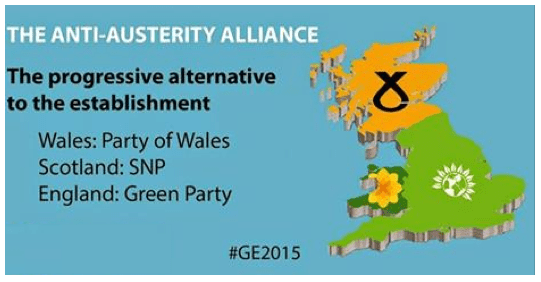
So why hasn’t some leadership in this direction been shown? After all, there is no hiding GPEW’s position on this when you see and read the following on its website:

“The people of Wales face a real choice at the election…….
“If the people of Wales return a strong contingent of Plaid Cymru MPs in May, then Wales will be best placed to secure an outcome to improve the prospects of our people and communities.”

Let us be clear. This is not calling for Wales Green Party to capitulate. There is no reason for not standing in probably 34 out 40 constituencies. It is simply calling for a constructive attitude to alliance building for the common good. It would involve give and take over a longer timescale. However, the constitution of GPEW seems to be inhibiting Natalie Bennett from getting involved in the Wales situation. I have spoken with her recently and sense her great frustration with the situation, but she steadfastly insists (quite rightly no doubt) that it is for the members in Wales to resolve among themselves. Which means, of course, that given the attitudes prevailing in Wales Green Party, there simply is no prospect of an anti-austerity alliance in Wales. This was confirmed and reinforced by Bartolotti this very weekend:
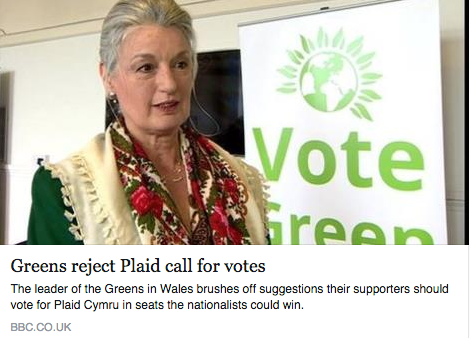
Thus we have the bizarre and unfathomable situation in which the GPEW is very much in favour of working on an anti-austrity alliance with Plaid Cymru, but the party in Wales steadfastly rejects it and obstructs it. And to cap it all, from my perspective, it is me that is now being openly accused of being out of touch and damaging the party.

What these situations desperately need is leadership. If that cannot be applied from the top down, it is reliant on it emerging at the appropriate level. At the risk of being further accused of an unhealthy preoccupation with Bartolotti, it has long been recognised by many that she is driven by a craving for the spotlight and self-aggrandisement. Self-sacrifice does not come easy to the self-serving. Which means the only other hope of leadership on this issue has to come from within local parties.

Therein lies the next problem. It was not so long ago that outside of Cardiff and Bridgend there was barely a properly functioning local party in Wales. Swansea came perilously close to folding completely, Cardiff imploded after the huge disappointment of failing to get Jake Griffiths into the Welsh Assembly in 2011, and Gwent had to resort to attempting telephone conferences in order to stay alive as it activist numbers dwindled to being few and far between. This was pretty much the state of play 12 months ago, with barely 400 members to our name.

The transformation has been little short of astonishing. I am unsure of the current numbers, but I believe there are now something like 2000 members and maybe 10-12 constituted branches. Awesome! However, with the best will in the world, these people are ‘green’ in all sorts of ways. They are keen and enthusiastic and keen to do things right – I have helped some find their way with organising their party and negotiating the way the party does things like policy making. They have come from an impressive range of backgrounds, from political ‘virgins’ to serial party hoppers. Some are well briefed, others have little real idea, beyond the obvious, what the party stands for. We have passionate ecosocialists I have taken a shine to, and brash green capitalists that I have taken a dislike to. That is all fine and dandy.

What is not fine and dandy though, from my perspective, is the fact that all the enthusiasm they have brought in with them is being inappropriately channeled into thinking they can go out and sweep all before them. Yes, I understand they have joined the Green Party and not Plaid Cymru or any other party – but they need to be told that they are also joining what should be seen as one of the leading elements in an anti-austerity alliance that may require some self-sacrifice for the common good. Yes, I understand they want to put their cross next to a green candidate on a ballot paper wherever possible – but they need to be told that in an alliance situation, that sometimes means understanding that another party logo represents their choice occasionally. With the right leadership people understand this. It is hard to disagree with journalist and PC member Vicky Moller when she says:
“The [welsh] greens have been adamant about having candidates in every constituency. They are full of hubris at this point, seeing a heroic role for themselves and less worried about the immediate outcome than their glorious horizon. I feel it’s a maturity issue, like adolescents behind the steering wheel for the first time.”

The potential for alliances has been demonstrated in spectacular fashion by SYRIZA, which for those that don’t realise it, is a acronym of Greek words that translate as “the coalition of the radical left”. The situation in Greece is not the same as the situation here, but with continued austerity it will soon be much similar. The rise of SYRIZA was driven by utter despair. Would it not be wise for us to learn what is possible before we get to that desperation?

Let me share a history lesson from which we have much to learn. The parties that originally formed the Coalition of the Radical Left in January 2004 were:

In the election of that year, the coalition gathered 241,539 votes (3.3% of the total) but still managed to gain six members of parliament. All six were members of Synaspismós, the largest of the coalition parties. This led to much tension within the coalition.There followed some fairly turbulent years, with parties coming and going. In 2007, the ‘green’ party, Ecological Intervention, joined. The coalition held together and started to make real progress in the polls. But it was not until 2013 that it achieved sufficient strength and cohesion to become a unitary party, with the formal merger of the following disparate elements, who finally recognised that sectarianism had to be completely discarded for the sake of the people of Greece.
So in the summer of 2013, the following groups came together (along with their philosophies):

  • Active Citizens (Ενεργοί Πολίτες): democratic socialism, patriotism
  • Anticapitalist Political Group (ΑΠΟ): communism, trotskyism
  • Citizens’ Association of Riga (Velestinli): patriotism, internationalism, ecology, social justice
  • Communist Organization of Greece (KOE): maoism, communism
  • Communist Platform of Syriza: Greek section of the International Marxist Tendency, communism, trotskyism
  • Democratic Social Movement (DIKKI): left-wing nationalism, socialism, euroscepticism
  • Ecosocialists of Greece: eco-socialism, Green politics
  • Internationalist Workers’ Left (DEA): revolutionary socialism, communism, trotskyism
  • Movement for the United in Action Left (KEDA): communism
  • New Fighter: democratic socialism, social democracy
  • Radical Left Group Roza: Luxemburgism Radicals (Ριζοσπάστες): democratic socialism, patriotism
  • Red (Κόκκινο): communism, trotskyism
  • Renewing Communist Ecological Left (AKOA): democratic socialism, eurocommunism, green politics
  • Synaspismós (SYN): democratic socialism, eco-socialism, eurocommunism, environmentalism, feminism
  • Union of the Democratic Centre (EDIK): radicalism, social liberalism
  • Unitary Movement: democratic socialism, social democracy
  • And a number of independent leftist activists

After nine hard years achieving this, it was rewarded with immediate success, coming first in the Euro elections of 2014, and being swept to government in the snap election of last month.

What we are witnessing here in the UK is the early stages of trying to build a similar coalition of the radical left in the UK. None of the constituent parties in SYRIZA would have come close to participating in Government without the hard work of Tsipras and others to make the coalition work. That work had to include: diffusing sectarianism, focussing on the common ground, putting personalities and egos to one side, realising that making compromises is always a necessary ‘evil’ in getting to achieve anything.

It is vision I want to work towards with anyone who wants to listen. That currently appears to preclude working with the Green Party within Wales. I have failed to convince anyone of influence to my position and am now characterised as a disruptive and damaging influence. The membership has had its opportunity to choose a path and have chosen the one they are now well and truly on.

My options are limited. As willing as I am to work with and embrace Plaid Cymru as allies and partners, they are not the ideological fit that the Green Party is for me still. I do not intend to join PC. I feel as if I have done all I can in Wales for the time being. Remaining involved can only fuel division and acrimony. What is clear to me, though, is that I cannot be party to the possible ruination of historic possibilities in the General Election. If my battle to talk sense into Green Party members in Wales is lost, along with possibly a couple of PC seats, then the best I can do is to try to contribute to securing a gain for the anti-austerity block across the border in Bristol West, and maybe try to get down to Brighton Pavilion to help re-elect the person that inspired me to join the Green Party in the first place.

I have therefore taken the unusual step of asking for my membership to be reassigned to Bristol Green Party/South West Region. This is the only compromise I feel comfortable with at the moment.

It means I will be withdrawing all my involvement with Bridgend Green Party as of the AGM this Thursday. I sincerely hope some of the new influx feel able to take it on and will hopefully nurture it to future success. If and when the issues with the anti-austerity parties in Wales resolve themselves, then I may return.

But in the meantime I simply need a break from it all for a while – certainly until after the GE – to reflect on what do next. As I am facing redundancy shortly, this applies to my work life as well as politics. I am in no frame of mind to get embroiled in political wrangling anymore and I apologise, to those I respect, that I may have offended by being even more blunt than usual at times recently. That, more than anything else, tells me it is time to step back and move on.

Good luck everybody!!

Andy Chyba

TTIP response from Madeleine Moon, Bridgend MP

Dear Mr Chyba

Thank you for your email regarding the Transatlantic Trade and Investment Partnership (TTIP) currently being negotiated between the European Union and the United States and the motion that was considered in Parliament on Thursday 15 January. Unfortunately I was not able to attend the sitting that day due to a long-standing obligation in my constituency. However, I can assure you that I was kept well-informed of the issues around the debate, and I have attached a link to the debate below for your attention.

http://www.publications.parliament.uk/pa/cm201415/cmhansrd/cm150115/debtext/150115-0003.htm#15011570000001

I agree that greater Parliamentary scrutiny over TTIP should be a priority. We have seen in the past that UK public services are a particular priority for US investors. In 2009, for example, our higher education market was subject to several acquisitions by US companies; the for-profit company Apollo took over BPP in 2009.

The situation could potentially be worse than you have suggested, as for-profit companies who acquire certain public services can be eligible for public subsidies. To take higher education as an example, for-profit companies will be able to access public subsidies through the form of student support. This would be occurring at the same time as the Department for Business, Innovation and Skills removing even more of the funding from our universities.

The negotiations have been criticised by a wide array of organisations and unions, mostly on the grounds that the move poses a threat to our public services. It is also disheartening to see that the deal is being negotiated entirely behind closed doors. The Government was recently asked about the TTIP in Parliament; I have attached a link below for you to see their response in full, but I would draw your attention to several quotes from the Minister that may be of interest to you:

“The Transatlantic Trade and Investment Partnership is a top priority for the Government. It has the potential to be the largest bilateral trade agreement in history and to bring significant economic benefits…it demonstrates clear EU-US leadership on the trade agenda and a firm commitment to liberalisation and open markets…negotiations will be tough but we hope that a deal can be reached by early 2015.”

http://www.publications.parliament.uk/pa/cm201314/cmhansrd/cm131218/text/131218w0002.htm#1312196000137

The Minister was also pressed on what implications the deal would have for national sovereignty, and whether it would hamper the ability of the Government to act in the public interest with respect to our public services. The Minister replied:

“Negotiations for TTIP are at an early stage. As with any trade or investment agreement, the UK aims to promote the UK’s interests while ensuring that the UK Government is not prevented from acting in the public interest.”

http://www.publications.parliament.uk/pa/cm201314/cmhansrd/cm131218/text/131218w0002.htm#1312196000137

There was also a Backbench Business Debate on the subject of TTIP in Parliament recently, and I have attached a link to the debate for you to see in full, which I think may be of interest to you.

http://www.publications.parliament.uk/pa/cm201314/cmhansrd/cm140225/debtext/140225-0002.htm#14022593000001

You will be able to see that the Minister partly blames the media for the lack of publicity TTIP had attracted up to that point. You will also be able to see that the Opposition broadly accepts the proposals that the Government has put forward around TTIP, but has said that more action is required in order to guarantee that small businesses will not lose out, and that there must be exceptions in place to ensure services such as health and education are not affected by loopholes like the example I gave above.

Unfortunately, the comment made by the Minister regarding negotiations between the EU and the US being at an early stage are the closest we have come to finding out anything about the negotiations, as no information about them is being publicly distributed. The Government have maintained that they will not reveal any further information about the negotiations they are holding while they are at that stage.

Thank you once again for your email. If you feel there is anything further I can do, please do not hesitate to contact me again.

Yours sincerely

Madeleine

Madeleine Moon MP
Bridgend

House of Commons
London SW1A 0AA
02072194417

47 Nolton Street
Bridgend
South Wales
CF31 3AA
01656 750002

The Green / Labour Feud – Bilgewatch

From the BILGEWATCH blog:

The run up to the General Election risks being truly horrid. The standard of mainstream “debate” will likely continue a frenzied downward plunge, founded on premises which are provably false.

Perhaps 2015 will be a key year in breaking the hold of the ceaseless, skewed and ill-informed nonsense so often presented as “news” and “debate”. But for now, stand by for a deluge of bile, which social media and broader campaigning will not escape, by any stretch. I want to address a growing build up of nasty and prolonged spats between supporters of the Green and Labour parties. They’re badly spilling over into groups normally united on issues such as public services, anti racism etc. and can be a dispiriting time-sink.

Likely to alienate most who are sympathetic to both parties, these odysseys often spawn several hundred posts. They disproportionately revolve around such themes as “Yeah, but Brighton bins…yeah, but Iraq”. They keep strong adherence to the great imagined internet law of “Last Post Wins”. People aiming to calm things down risk a dose of “But s/he started it” from both sides.

How much purpose does it all serve? With everything else going on, do we really need 4 more months of it?

As a Green, I’ve had many battles, close up and personal, with the Labour party. Most of it probably a bit petty and long ago in the scheme of things, but still…

I also have many valued friends and comrades in the party, which doesn’t mean I have to think much of the modern organisation as a whole. I can be a tribalist, but am not aiming for that here. My default setting is left-pluralist.

I’d like to create a sense of circumspection, if not harmony (which would probably be unrealistic). I’m certainly not after rancour, and I hope Labour supporters will take this piece in the constructive spirit with which it is offered.

The Greens have had a pretty good time of late. Polling numbers are healthily up, membership has shot past that of UKIP and the LibDems.

Labour supporters are increasingly concerned, attack pieces have started to emerge. Sadiq Khan has been tasked with addressing the issue on an official basis. None of this has had much effect so far.

I hope Greens keep a cool head about our progress, pride comes before a fall. We spent a generation in the electoral basement after the high of the 1989 Euro elections, where we still won no seats, (Euros were First Past The Post in those days). None of our recent fortune adds up to much till we win more seats under FPTP. Let the UKIP zealots be alone in giddy delusions about “earthquakes” and sweeping into power.

I’d also ask Greens to remember that, no matter how shallow, stupid or nasty they consider Labour attacks, Greens have been attacking Labour for a long time. We’ve often revelled in it, so it would be a bit daft to act all affronted at some return fire.

So, here are some things I’d ask Labour supporters to consider:

1) Respect the intelligence of Green/Labour considerers.

They understand the system. aware that most votes don’t really count toward the final outcome. We all know Labour had 13 years to change this, and failed to. Is it wise to now go round using emotional blackmail and erroneous slogans, such as “Vote green, get blue” on the back of that failure? Such soundbites are not valid in the vast majority of constituencies. As for the marginals, have faith in people voting according to their judgement, taste and circumstance, and perhaps splitting their national and local votes. Polling in marginals shows Labour doing sufficiently better than on average, this backs up my case.

2) Don’t assume that Green votes would automatically be yours as a second preference.

Taking votes for granted, as if by some divine right, is arrogant, complacent and alienating. Such characteristics could be a big cause of Labour’s current difficulties. Where Labour have taken support for granted in the past, votes have drifted to the LibDems, even the BNP. Now some of them have gone to UKIP. In other cases, people just stopped voting, but turnout in May will probably be high.

This isn’t all about left or “social justice” territory, but quite a lot of it probably is. Labour have no monopoly on that territory, and there’s no reason why they should assume it. In fact, a lot of votes they lost to the Libdems in 2010 were on that territory.

3) If Labour lose, it wont be The Green’s fault.

For all the “Green Surge” hype, a nationwide vote of even 5% on the day will be quite impressive.

What % of that in marginals might have been Labours? How much energy might go into wringing that % out with negativity and spin? would that energy yield justifiable return or be better spent elsewhere?

Two or three seats for The Greens will be astonishing. Even one will be a score draw. Increase in support can be ephemeral. There is a lot of work to do to build on our increase in membership. The first actual victories are more likely to be seen in 2016 locals.

To really blame a Labour defeat on a short period of progress for a much smaller party would be a dismal admission of failure in itself.

People may invoke the 2000 USA Presidential election, but that’s a far more cronky system than even ours. The comparison is fatally flawed by the fact that Gore won anyway! Bush got in on a courthouse coup, possibly the most horrific piece of electoral dodginess in modern western history. Is that Ralph Nader’s fault? Blaming him is letting a rampantly criminal regime off the hook. Gore’s personal cowardice was key in not letting so many voters in Florida have their voice heard. Murdoch’s Fox and a host of other nasties played parts too. The start of Michael Moore’s Farenheit 911 covers all this excellently, if you want to go revisit the sorry episode.

https://www.youtube.com/watch?v=Rf5iyZ6A-eI

There are a host of things more likely to prevent Miliband getting into number 10 than The Green Party. Hideous and patronising right-wing propaganda is near the top of the list, but perhaps people need to look nearer to home as well.

4) Ask yourself why Labour are struggling.

By this I mean “struggling to be consistently in a position likely to bring around an overall majority”.

With 5 years of opposition, 100s of MPs and MEPs, thousands of councillors and scores of thousands of activists, there should be considerably more to offer the public than “The Tories are awful. You have to vote for us. It’s the system”.

What’s the point in fighting on right-wing territory now occupied by 3 other parties? Labour not only look indistinct in this neo liberal mush, it’s insincere as far as most of their activists are concerned. Between the 2 main contenders, if Labour are seen as too similar to Tories, especially on economics, the risk is that people will go with the devil they know.

Instead, Labour can persuade many potential Green, LibDem and even UKIP voters with a program that re-engages their centre-left core. Miliband has looked best, and rattled the right most, when taking on the likes of the energy cartel. Don’t lose sleep about being attacked as “too left wing” by Murdoch rags, The Mail et al. It will happen anyway, so you may as well make it worthwhile.

Also ask yourself if it’s strategically wise to argue on 2 fronts by opening a left flank on Greens, who will counter with skill and energy. Labour have a longer, more powerful past, with more clangers to draw on in arguments. I’ll spare the detail, you can fill in the blanks.

By contrast, why should Greens single out Labour as the huge problem? We should (and do) attack the general right-wing consensus, based as it is around failed austerity, corruption, corporate rule, growing inequality and blaming those at the bottom for problems caused by those at the top. If Labour are too big a part of that, it’s their problem. They still have a chance to distance themselves from it, and I think they should.

————————————————-

I’m not a lunatic, I don’t want another half decade of festering, psychopathic tory corruption, masquerading as “government”. Yet, most people can vote Green without the slightest risk of brining that about, and it would be disingenuous to pretend otherwise.

To recognise the realities of the system, and that “vote green get blue” can apply no further than outside Lab/Con marginals, is a sensible compromise position. Yes, UKIP mess up the traditional maths somewhat, but probably more to Labour’s favour overall. UKIP will probably do well in a lot of safe Labour seats while putting otherwise safe-ish Tory ones in peril.

A solid vote for firm ecological, anti austerity, social democratic politics outside of the Labour Party will firm up those causes within it.

Some people have talked about “vote swapping” between key and non key constituencies. Heavily relying on trust, maybe it will happen on a moderate scale. But on the whole, it’s unrealistic to even expect non-aggression. Still, many of us campaign together for years without party hats much on, doing the election thing now and again, and returning to generally good relations afterwards. I’ll try to be one of them, even if I don’t always succeed. Thus, we might at least spare non partisan campaigns from our bickering, and to aim for less overall aggression, more respectful attention to nuance, genuine analysis, good humour and an avoidance of crude strawmen, ad hominem attacks and the like.

Thanks for reading.

—————————————————-

Please share this, read my other stuff and follow if you thought it worthwhile. No offence is meant to anyone by this blog not addressing supporters of Left Unity, TUSC, any other left party, Plaid. SNP, etc, anarchists or the non aligned 🙂