
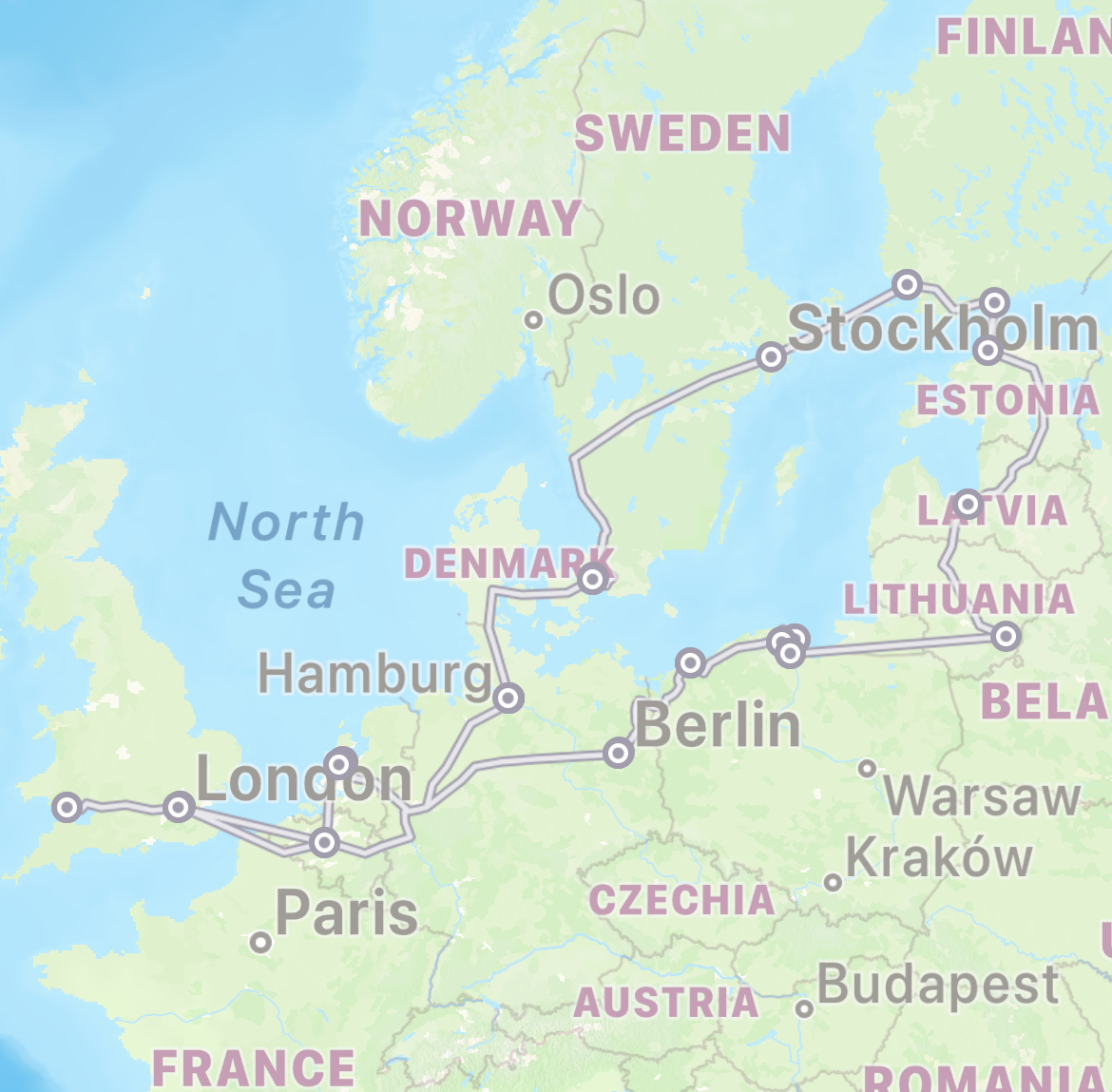
I have recently returned from a lap of the countries surrounding the Baltic Sea; the Scandinavian countries of Denmark, Sweden, Åland Islands and Finland (and Norway recently too), plus the former USSR Baltic States of Estonia, Latvia, and Lithuania (and the Baltic coast of Poland, for good measure).
Perhaps surprisingly, most of these countries I had never visited before, but I had learned quite a bit about them in various contexts over the years. I had developed the impression that these were countries we could, indeed should all learn more from, but was keen to visit and witness life there to challenge my views and see how valid they are.
The lessons to be learned are many and varied, so I am dividing them into 2 blog pieces: this one on socioeconomic lessons, especially those pertinent to the Welsh Independence campaign, and another on the historical and political lessons of small European nations gaining independence.
I am going to divide these nations into two groups:
The Nordic Group = Denmark, Norway, Sweden, Finland (to which can be added Iceland, which I visited not so long ago too)
The Baltic Group = Estonia, Latvia, and Lithuania.
Let me start by presenting some data to give some evidence-based context.

Firstly, let us just acknowledge that these are all small countries in terms of population. The Nordic countries are mostly about twice the size of Wales (Sweden x3, Iceland the size of Cardiff), while the Baltic states are all significantly smaller, with Estonia less than half the size of Wales. The oft heard claims that Wales is too small to thrive as an independent country is patent, nay ridiculous nonsense. (Altogether, there are more than 20 European countries smaller than Wales’ population.)
Right from my earliest days as a geography student, I have always been fascinated by the Nordic countries consistently impressive scores across all sorts of metrics, be it wealth, equality, health, education, happiness etc. Stretching from the same latitudes as Scotland, up into the Arctic Circle and with no major resource advantages over the U.K., I was intrigued as to how they achieved so much. The answer is very straightforward, as it turns out. It is the ‘Nordic Model’.
The Nordic model comprises the economic and social policies as well as typical cultural practices common in the Nordic countries (Denmark, Finland, Iceland, Norway, and Sweden). This includes a comprehensive welfare state and multi-level collective bargaining based on the economic foundations of social corporatism, and a commitment to private ownership within a market-based economy.
Norway is a partial exception due to it sharing a huge resource advantage with the U.K. in the shape of North Sea oil and gas. Unlike the U.K. though, it hasn’t allowed capitalists to largely piss it up the wall but has nurtured it by creating the world’s largest sovereign wealth fund that secures the country’s wealth and well-being indefinitely. It underpins the large number of state-owned enterprises and state ownership in publicly listed firms.
Although there are significant differences among the Nordic countries, they all have some common traits. All the Nordic countries are highly democratic and all have single chamber legislature and use proportional representation in their electoral systems. They all support a universalist welfare state aimed specifically at enhancing individual autonomy and promoting social mobility, with a sizable percentage of the population employed by the public sector (roughly 30% of the work force in areas such as healthcare, education, and government), and a corporatist system with a high percentage of the workforce unionised and involving a tripartite arrangement, where representatives of labour and employers negotiate wages and labour market policy is mediated by the government. As of 2020, all of the Nordic countries rank highly on the inequality-adjusted Human Development Index, the Global Peace Index, as well as being ranked in the top 10 on the World Happiness Report.
Doesn’t it sound wonderful? Yet we have suffered and endured 45 years of unremitting neoliberal capitalism selling off our public assets and services, hollowing out remaining public services and non-stop ‘austerity’ for the poor while the rich accumulate obscene wealth. Is it any wonder that the Shetland and Orkney Islands have considered abandoning the U.K. and returning to Norway (they were gifted to Scotland by King Christian of Norway in 1472). An independent Wales could never join Norway, but it could certainly adopt the Nordic Model if it elected the right people.
The Nordic model was originally developed in the 1930s under the leadership of social democrats, although centrist and right-wing political parties, as well as labour unions, also contributed to the Nordic model’s development. The neoliberal zeitgeist across Europe and beyond in the last 45 years has impacted the Nordic countries to an extent, with increased deregulation and expanding privatisation of public services. However, it remains a distinctive approach retaining strong emphasis on public services and social investment.
The Baltic Nations have a very different history, of course. As any Pole knows, the boundaries of countries in central Europe have been fluid throughout much of history, but the underlying nations have survived and, debatably, the current borders match the national identities of the peoples of Europe as well now as ever. (There remain some nations subsumed into larger states, of course, such as Wales and Catalonia.) The Baltic nations achieved independence from tsarist Russia as part of the violent fall-out of the Russian Revolution around 1917-18. They remained independent until the German occupation in 1940, followed by the Soviet occupation up until 1991.

With the dissolution of the Soviet Union in 1991, the Baltic states looked primarily towards their Nordic neighbours for inspiration as to how to set up their legislatures. They also warmly embraced a Scandinavian initiative to create a Council of Baltic Sea States (CBSS) in 1992. This consisted of all the Nordic group countries (once Iceland joined in 1995), all the Baltic group countries, plus Poland, Germany, and Russia (until it was kicked out after its invasion of Ukraine). There is scope for the largely cultural focus of the Celtic League of Celtic nations to evolve similarly with Welsh and Scottish independence.
Integration with the rest of Western Europe became a major strategic goal for the newly-indepndent Baltic states and all three were in NATO and the EU by 2004.
The statistics reveal that the Baltic states have made rapid progress across most metrics, but still have quite a way to go to emulate the Nordic states. But they seem to remain focussed on achieving this, and surely will if Putin doesn’t throw an enormous spanner in the works.
The Baltic countries have built their economies on innovation and trade. Small and highly connected to global markets, they have developed industries that excel in technology, manufacturing, and services. This focus has allowed them to remain competitive in an ever-changing economic landscape.
Investment in education and infrastructure has played a key part in their growth. Skilled workforces and modern transport systems attract businesses and encourage local entrepreneurship. Governments in the region have supported these efforts through policies that promote transparency and efficiency.
Tourism also contributes to the economic success of the Baltics. Visitors are drawn to the region’s cultural heritage, natural beauty, and vibrant cities. This steady flow of international visitors supports local businesses and boosts national revenues, helping to strengthen their economies further.
The Baltic countries are expected to continue their economic growth in the coming years. According to the European Commission, Estonia’s GDP is projected to grow by 3.5% in 2024, while Latvia and Lithuania are forecasted to grow by 3.3% and 3.8%, respectively. These figures are driven by a combination of export growth and domestic consumption.
Renewable energy is a key area of focus for future development. Lithuania aims to generate 50% of its electricity from renewable sources by 2030, compared to 38% in 2022. Estonia is also expanding its wind energy capacity, with plans to install over 1,000 megawatts of new wind farms by 2025. Investments in green energy are expected to attract funding and create jobs, boosting regional economies.
Technology and innovation are also driving forward-looking initiatives. Latvia’s IT sector grew by 10% in 2022, with exports of IT services reaching €2 billion. Estonia’s start-ups are thriving, with over 1,300 start-ups contributing €1.4 billion to the economy in 2022. These sectors are seen as key to maintaining competitiveness and ensuring steady growth in a rapidly changing global market.
There is nothing here that Wales could not emulate, given the freedom to fully capitalise on its natural and human resources. Independence is not a silver bullet that ensures any sort of success in and of itself. But it is a golden opportunity; a golden opportunity to fulfil a people’s potential that is rarely afforded when subservient to a dominant paymaster.
History can provide us with lessons we can learn as to how to best optimise the opportunities that independence can afford.
 Bridgend's Green Leftie