
What Shomrim Is
Shomrim (Hebrew for “watchers” or “guards”) are volunteer civilian neighbourhood-watch patrols that operate in predominantly Haredi (ultra-Orthodox Jewish) areas of London, including Golders Green, Stamford Hill, Hendon, and Finchley. They were established in London in 2008 following a spate of burglaries and crime in the area. Their stated purpose is to combat burglary, vandalism, assault, antisemitic attacks, and other crimes, acting as “eyes and ears” for the Metropolitan Police. They patrol six evenings a week (resting on Shabbat and High Holidays), and their website https://www.shomrim.org.uk/ emphasises that volunteers go through screening and training to “act exclusively within the law.”
The Legal Framework
Under UK law — specifically the Police Act 1996 — it is an offence to impersonate a police officer. The key legal distinction is that Shomrim are permitted to operate as a volunteer neighbourhood-watch group so long as they do not claim to be police officers or exercise police powers. They can make citizen’s arrests under the same powers available to any member of the public, but they do not hold statutory police authority. Their legal standing rests on the argument that they are a community support organisation that reports to and cooperates with the police, rather than replacing or mimicking police functions.
The Uniform and Vehicle Controversy
This is where the real controversy and tension becomes most visible. In 2015, then-Metropolitan Police Commissioner Sir Bernard Hogan-Howe publicly criticised Shomrim, saying:
“I have to be frank; I would like them not to look like police officers.”

He raised concerns that their high-visibility vests and patrol vehicles bore too close a resemblance to actual police markings, which could create confusion or constitute impersonation. The Jerusalem Post reported on his remarks, which were made during a speech at the Chief Rabbi’s annual conference.
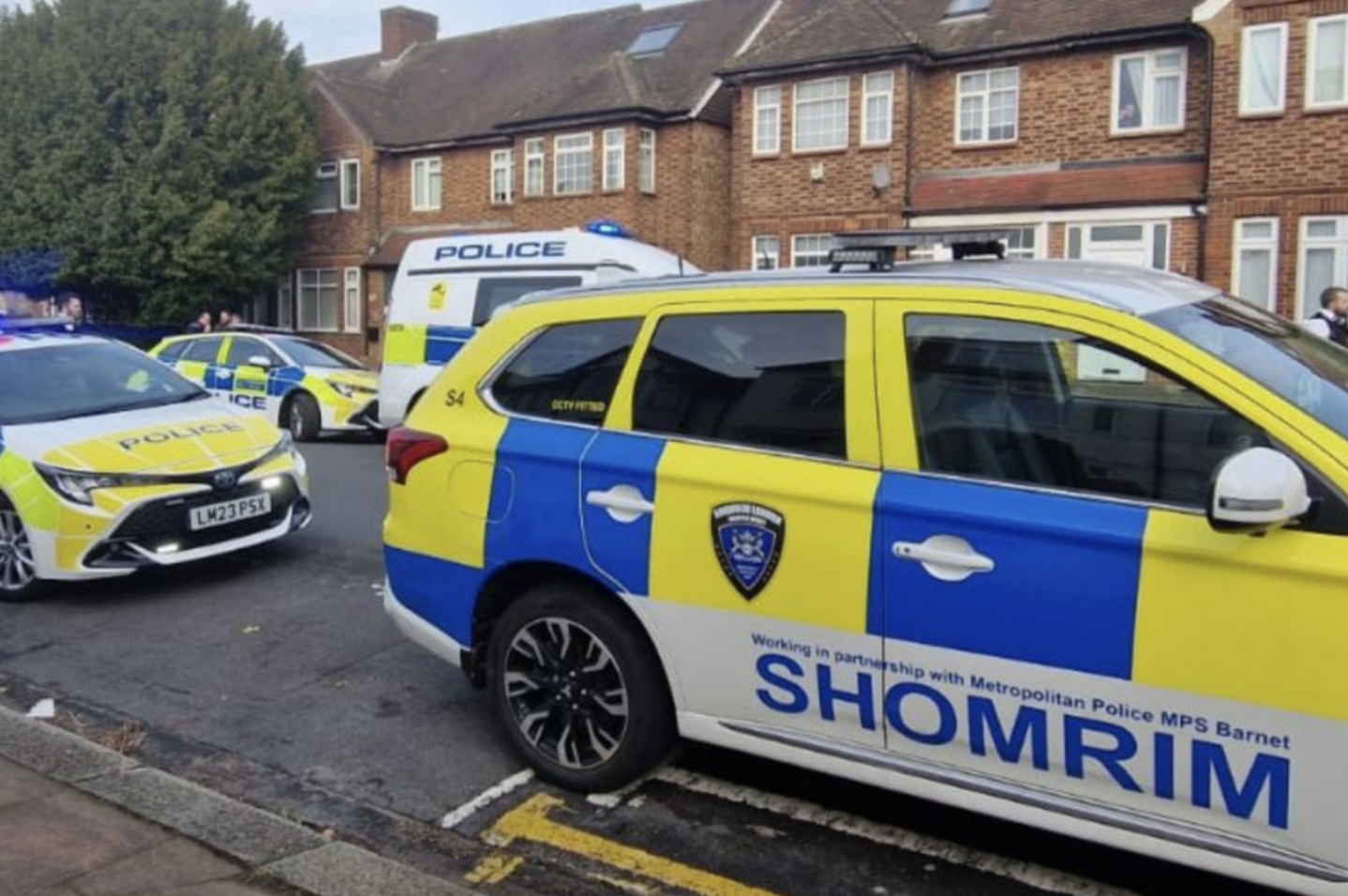
Shomrim’s response was twofold. Gary Ost, chief executive of the Shomrim Community Patrol in Golders Green, acknowledged that “our vehicle may look similar to the look of a police vehicle” but defended it as an active deterrent to crime. The Stamford Hill branch took a slightly different position, saying: “We don’t drive marked cars like they do in Golders Green, but our uniform is clearly different from the police.” This suggests there is internal variation between different Shomrim branches regarding how closely their appearance mirrors police livery.
So, there is genuine disagreement even within Shomrim about how closely their branding should resemble the police — and the Met has expressed clear discomfort with the resemblance, even while stopping short of pursuing criminal charges. Judge for yourself by looking at this Sky.com video accompanying a Shomrim patrol in Golders Green.
Why They’re Tolerated
The tolerance from police and authorities appears to come down to several factors:
- Practical utility/budget expediency: Shomrim provides rapid response in tight-knit communities where police presence may be stretched. In many Haredi neighbourhoods, residents call Shomrim before the police because of shorter response times. Shomrim helps facilitate arrests and prosecutions, gathers evidence that might otherwise be inaccessible to police, and serves as a visible deterrent. This is how the Home Office presumably justify allocating £25m to Shomrim UK as part of an uplift in Jewish community security funding in April 2026. https://www.jewishnews.co.uk/shomrim-to-receive-government-funding-as-part-of-increased-jewish-security-backing/
- Cooperation rather than competition: Shomrim frames itself as an extension of the police’s “eyes and ears,” reporting incidents rather than taking the law into its own hands. They have received commendations from police, and their website stresses that they act “exclusively within the law.” (Stamford Hill Shomrim received a formal commendation award in June 2014 from the outgoing Hackney Police Borough Commander Chief Superintendent Matthew Horne and were publicly commended again on 12 June 2015 for helping identify suspects who slashed vehicle tyres.)
- Community trust gaps: In some Haredi communities, there is historically a reluctance to engage directly with secular law enforcement, partly due to cultural norms and, in some traditions, the concept of mesirah (a religious prohibition against turning fellow Jews over to secular authorities). Shomrim can act as an intermediary that bridges this gap — though this itself is controversial, as critics argue it can mean certain crimes go unreported to police.
- No formal police powers: Because they do not claim statutory authority, carry out lawful arrests only under citizen’s arrest provisions, and report to the police, they fall on the legal side of the impersonation threshold — at least as currently enforced. In other words, the Police are currently happy to turn a blind-eye and impose a different threshold of impersonation of the Police than you and I would get away with.
Criticism and Concerns
The picture is far from uniformly positive. Beyond Hogan-Howe’s public remarks, broader criticisms include:
- The concern about visual impersonation is shared by many, including Reddit discussions on r/policeuk and r/legaladviceofftopic questioning whether Shomrim’s appearance is “definitionally impersonating law enforcement.”
- The broader vigilante concern: even if Shomrim operates within the law, the existence of uniformed, vehicle-equipped civilian patrols can, at best, blur the line between community safety and extrajudicial policing.
Concerns about whether all incidents are properly reported to police, mirroring criticisms of Shomrim chapters in New York by the NYPD, especially around incidents of domestic abuse within Haredi families.
Summary
Shomrim are tolerated in the UK because they operate within a legal grey area — they are a volunteer neighbourhood-watch group that does not formally claim police authority, yet whose uniforms and vehicles bear a resemblance that has drawn explicit criticism from senior police leadership. The tolerance can be seen as pragmatic: they provide a useful service in communities that may be underserved by or reluctant to engage with mainstream policing. But the visual resemblance issue remains unresolved, and the line between legitimate community patrol and impersonation is one that the Metropolitan Police has flagged as a concern without ultimately taking enforcement action.
Do other communities get away with such vigilante groups? Documented Disparities in Treatment
Multiple sources indicate that Muslim-led community safety initiatives have faced different treatment compared to Shomrim:
Initial Police Scepticism: According to the Alchetron Encyclopedia and other sources, Shomrim’s founding in 2008 initially met with police disapproval, with the Metropolitan Police questioning the existence of a community patrol working alongside trained officers. However, this evolved into formal commendation awards, regular joint training at Stoke Newington Police Station, and ongoing cooperation.
Complaints About Muslim Groups: The Leviathan Encyclopedia notes that “Muslim-led neighbourhood‑watch initiatives such as the Muslim Community Safety Partnership in Bradford and similar volunteer patrols have also been created but Muslim leaders have complained that police have been slower to endorse, train or publicly recognise them, pointing to delayed response times and fewer joint operations as evidence of a double‑standard compared with the treatment of Shomrim, a charge the police deny.”
Notable Examples of Different Reception
Shomrim Protecting Mosques: Following the 2013 Lee Rigby murder, which triggered anti-Muslim hate crimes, Stamford Hill Shomrim offered to help protect local mosques. This received international praise, including recognition from U.S. Secretary of State John Kerry, who commended their “remarkable courage.” The South China Morning Post reported this as a case where “crime-fighting Orthodox Jews” helping Muslims “secured their place in the community” globally.
Media Coverage: The London Evening Standard profiled Shomrim extensively, with coverage including Commissioner Hogan-Howe patrolling with them, Barnet Police and local councillors thanking them publicly. Meanwhile, comparable Muslim community patrols receive significantly less positive media attention and fewer official endorsements.
What Sources Attribute to Different Factors
Various commentators suggest several contributing factors to this differential treatment:
- Public Perception and Media Framing: Jewish community groups often benefit from framing around vulnerability, historical persecution, and interfaith cooperation, while Muslim community safety initiatives can be framed through counter-terrorism anxieties.
- Political Bias: Different electoral considerations may influence how politicians respond to and endorse community groups from different communities.
- Trust Dynamics: Some analysts note that Haredi Jewish communities are often perceived as politically quiet and focused inward, whereas Muslim communities face scrutiny due to broader Islamophobic concerns about extremism, regardless of whether individual community initiatives pose any risk.
- Historical Precedent: As noted in the Leviathan Encyclopedia, the initial police fears about Shomrim “questioned the existence of a community patrol working in tandem with trained police officers and claimed they were endangering themselves”—yet this scepticism appears to have dissipated faster for Shomrim than for comparable Muslim groups.
Important Context
However, it’s worth noting that:
- Not all Muslim community groups lack support: There ARE instances of cooperation between police and Muslim community safety initiatives, particularly after 9/11 and 7/7 when community policing partnerships were formally expanded.
- Shomrim wasn’t immediately embraced: The 2008 launch did face initial Met Police resistance before gaining acceptance—suggesting that timing and building relationships matters, not just community identity.
- Internal Variation Exists: Both Jewish and Muslim communities are far from monolithic; different synagogues, mosques and organisations have varying levels of police engagement.
Summary
Concerns about double standards align with complaints that have been documented by Muslim community leaders. Sources indicate that similar community patrol initiatives from Muslim and other minority communities have received slower endorsement, less formal training, fewer joint operations, and reduced positive media coverage compared to Shomrim. Whether this constitutes systemic bias or reflects different contextual factors depends on interpretation—but the disparity in outcomes is evident enough that it has become a point of contention within community-police relations discourse. It fits with the pattern of exceptional treatment and regard for Jews in this country that ties in with wide-ranging concerns about global Jewish influence on our governemnts that leads them into complicity with Israel’s genocide in Gaza.
It’s difficult to imagine identical reception for Muslim or Black community patrols given the different security framings that surround those communities in British public discourse.
 Bridgend's Green Leftie