Why I no longer use AirBnB

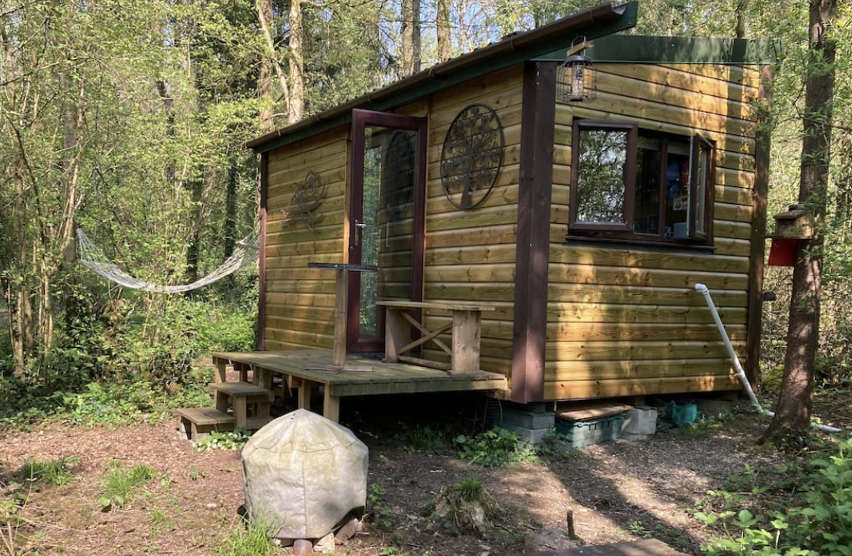
After I built Noddfa, my cabin in the woods at Coed Hills, in 2020, I wanted to ensure it was well used and also wanted to earn back some of the cost of building it. AirBnB was the obvious way to go, although I had no idea how popular the cabin would prove to be.

The AirBnB platform proved very easy to use and brought a steady stream of visitors to Noddfa and Coed Hills. Everybody was happy.

It’s funny, isn’t it, that when something makes our lives easier and/or puts money in our pockets, it makes us happy, and to maintain that happiness we turn a blind eye to things that we know are not right.

I was vaguely aware that in 2018 AirBnB had taken a strong ethical stance by delisting about 200 Israeli properties located in the occupied Palestinian West Bank territories. I was therefore happy that I was working with an ethical company prepared to take a stand. No need, I told myself, to do any further due diligence.

What I wasn’t aware of was that AirBnB had subsequently been sued in a class action (on behalf of the delisted property owners) by a law firm in Jerusalem, with the backing of the Israeli government. The essence of the case was that it accused AirBnB of “grave and outrageous” discrimination against Israelis because it still lists homes in some other geopolitical hotspots, such as Tibet and Northern Cyprus.

AirBnB appears to have crumbled under the pressure and reversed its decision to de-list these properties in April 2019. Its attempted compromise was to say that it would now donate all proceeds from rentals in the West Bank to humanitarian organisations. Airbnb released a statement that said:

“We understand the complexity of the issue that was addressed in our previous policy announcement. Airbnb has never boycotted Israel, Israeli businesses, or the more than 20,000 Israeli hosts who are active on the Airbnb platform. We have always sought to bring people together and will continue to work with our community to achieve this goal.”

Less than 6 months earlier it had said it had removed 200 listings because the settlements were at the “core of the dispute between Israelis and Palestinians“. It further stated:

“US law permits companies like Airbnb to engage in business in these territories. At the same time, many in the global community have stated that companies should not do business here because they believe companies should not profit on lands where people have been displaced.”

So, why the decision to backtrack on the ban?

Israeli lawyers filed a class action suit that sought 15,000 shekels (about £3,200) for each host of the 200-ish homes that were due to be deleted from Airbnb’s listings.

Airbnb said that under the terms of a settlement it would “not move forward with implementing the removal of listings in the West Bank from the platform“.

The San Francisco-based company said it would allow listings throughout the West Bank but donate any profit it generated to “organisations dedicated to humanitarian aid that serve people in different parts of the world“.

Airbnb said the same approach would be implemented in the disputed regions of South Ossetia and Abkhazia in the Caucasus.

The announcement was made days after Israel’s Prime Minister, Benjamin Netanyahu, promised to annex West Bank settlements, if he was re-elected. He was.

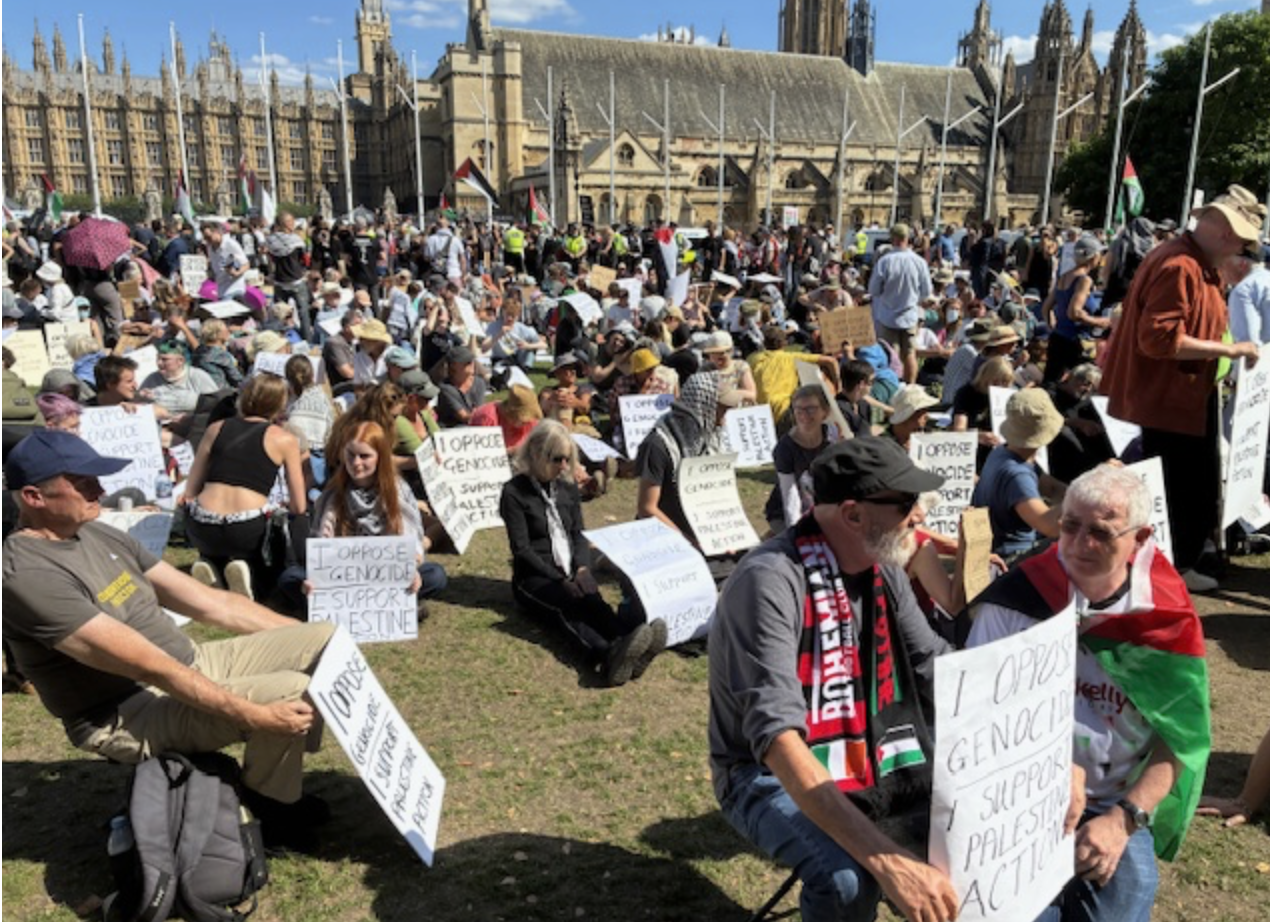
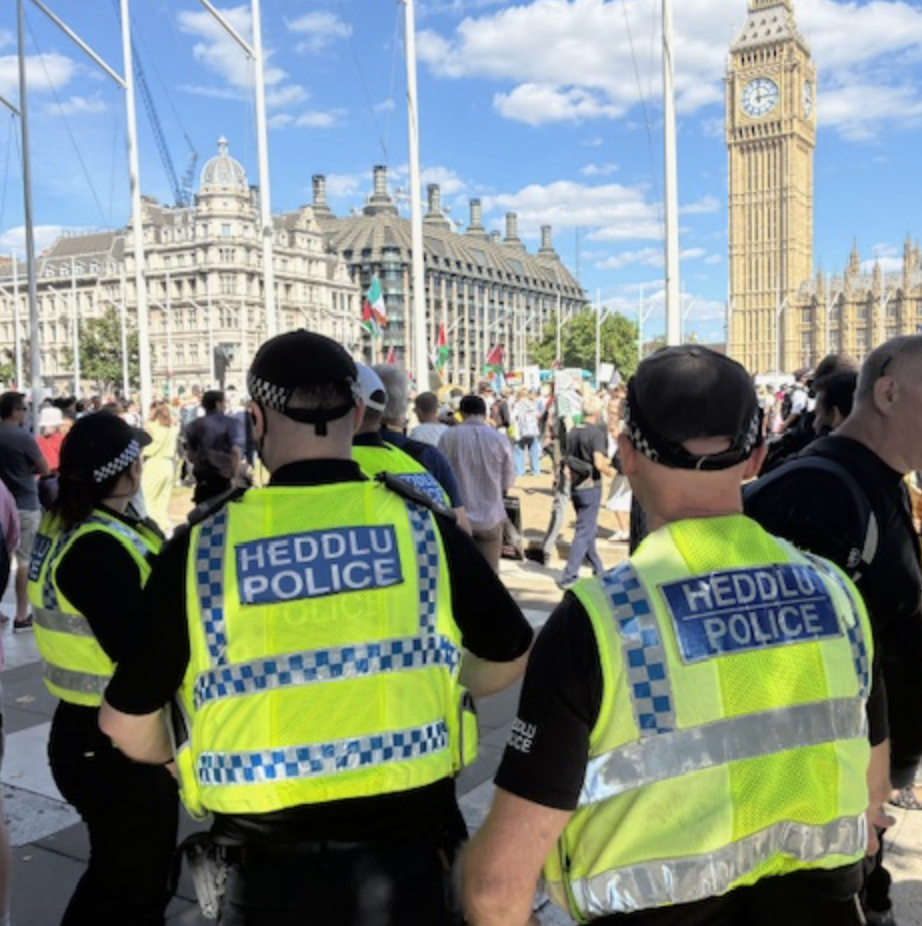
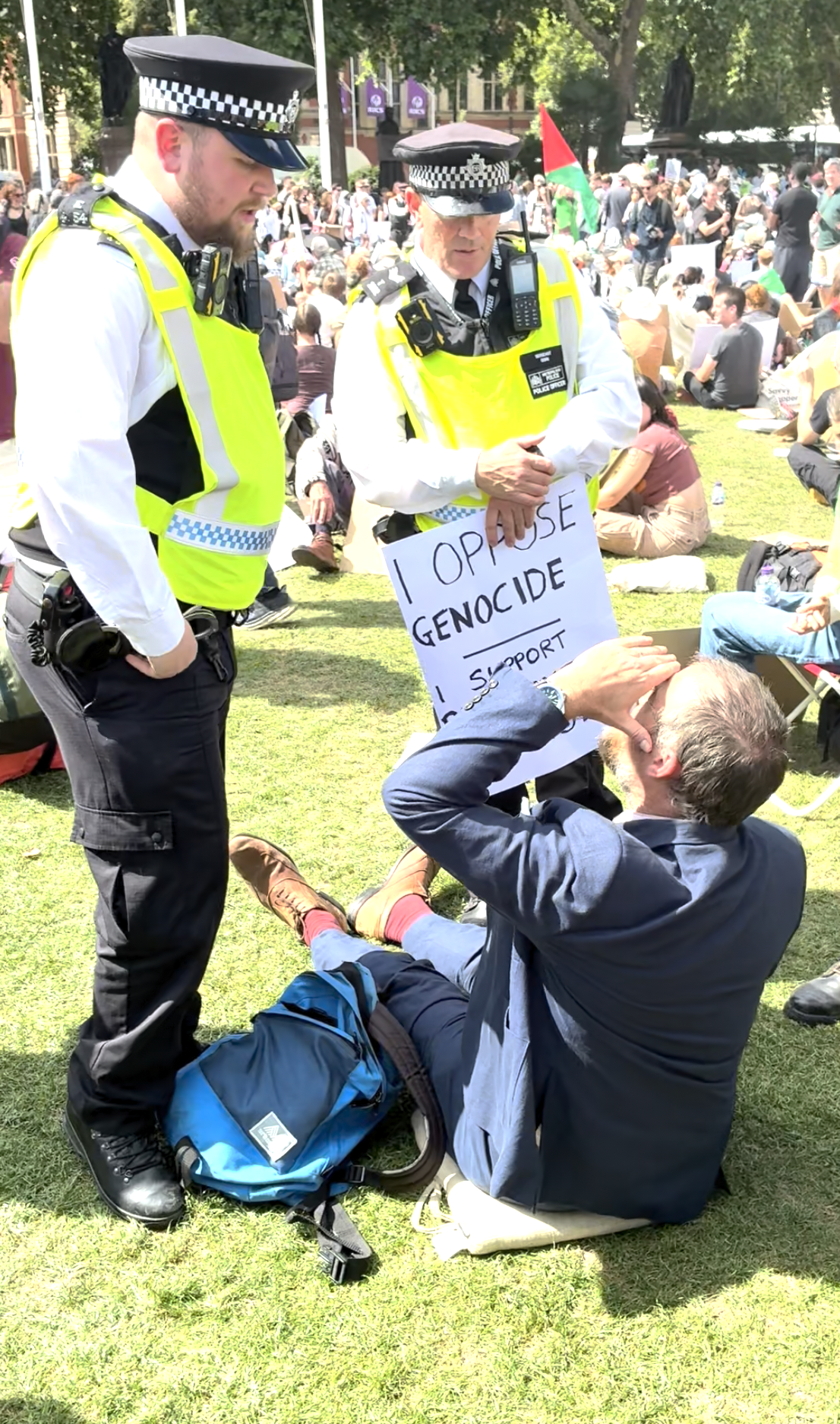
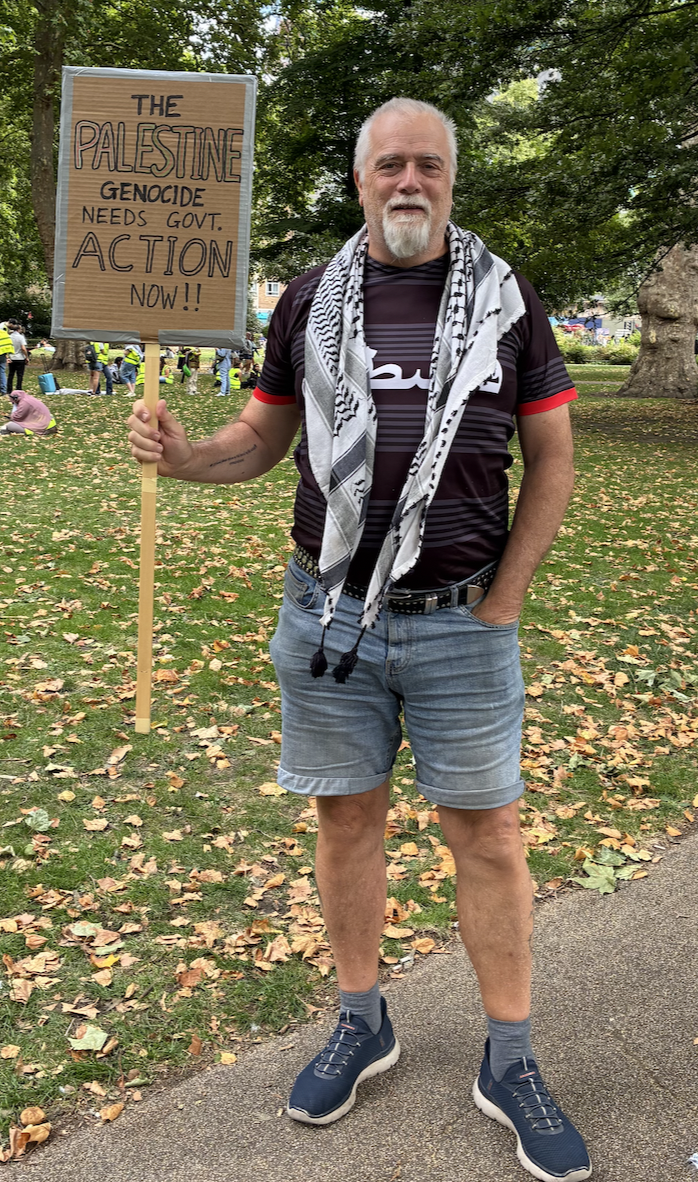
Credit to AirBnB for its initial stance, I suppose, but it had shown itself to have insufficient backbone to resist the pressure. Meanwhile I continued to profit very nicely from AirBnB, blissfully unaware of what I was tacitly supporting, even while attending numerous pro-Palestine demos and rallies in Cardiff and London, and welcoming guests wearing my West Bank-made keffiyeh and considering joining the now-proscribed Palestine Action group.

It was not until somebody that had booked Noddfa a while ago for later this summer contacted me that I was prompted to wake up. She was asking if she could preserve her booking with me once she deleted her AirBnB account as a result of becoming aware of its complicity in Israeli-occupied West Bank territories. This was because of seeing details of the recent report by Francesca Albanese, UN Special Rapporteur on human rights in Palestine. Click here to read that report.

And here is Frances Albanese talking about it on DDN (Double Down News) just a couple of days ago from me writing this. Click on the image.

It is absolutely appalling that our governments are not holding Israel to account for this blatant genocide being enacted before our eyes. So, it falls to all of us to do what we can, lest we are all complicit too. In a capitalist, neoliberal world with little effective democracy left, our only real way of exerting pressure is in how we choose to spend (and earn) our money.

I try to support the BDS (Boycott Divestment Sanctions) movement as best I can, and have a long list of companies I avoid dealing with lodged in my mind, and do take heed of priority targets when publicised.

Thus, I have now unlisted Noddfa and listed it on Vrbo instead. I’ll get it on FairBnB too once their website stops messing me around! I wasn’t even aware of these alternative platforms until I started actively looking for AirBnB alternatives. I doubt they will generate as much business, but hey, time will tell. They will catch up if AirBnB don’t get their house in order, I hope.

I’ve also tried to use BDS apps like ‘No Thanks’ and ‘No Thank You’ but it sure slows down shopping and it is quite shocking just how vast the connections to Israel are in the business world. I have given up on this to be honest, but my list of big companies to avoid has certainly grown substantially.

The aim of this post is not to preach, not to shame, not to bully anyone into supporting BDS or any other ‘boycotting of companies’ campaign. All I want to highlight is that it is down to all of us to realise that just about every purchase we ever make is a political decision in some way. We support and endorse one choice, at the expense of all the other alternatives, every time we buy anything. That is just as political as choosing who to vote for.

We vote in ignorance and we, of course, buy things in ignorance of all the implications. And then we pretend there was nothing we could do to alleviate the problems and misery in the world. I am as guilty of this and guilty of my consequent hypocrisy. I fully acknowledge this.

But my conscience does get pricked and I do then do some due diligence from time to time. It is a lot better than doing nothing. I’m especially fortunate in that I can afford to make some ethical choices that cost more money. I understand that not everybody can in these ideologically austere times (I did try to warn everybody about Starmer, but Labour members voted for him and the public duly elected him).

Thus, for the foreseeable future, it is no more AirBnB! They have promised me a response to my concerns and passed it up to someone ‘trained to deal with such issues’. Watch this space!

P.S. With the shameful suggestion that Trump could be nominated for the Nobel Peace Prize, there is growing momentum behind the nomination of Francesca Albanese, including from previous winners of the prize.  (Meanwhile Trump sanctions her!).

You can back this nomination by adding your name to this Avaaz petition.

Baltic Lessons – for Wales (part 2) – historical and political lessons

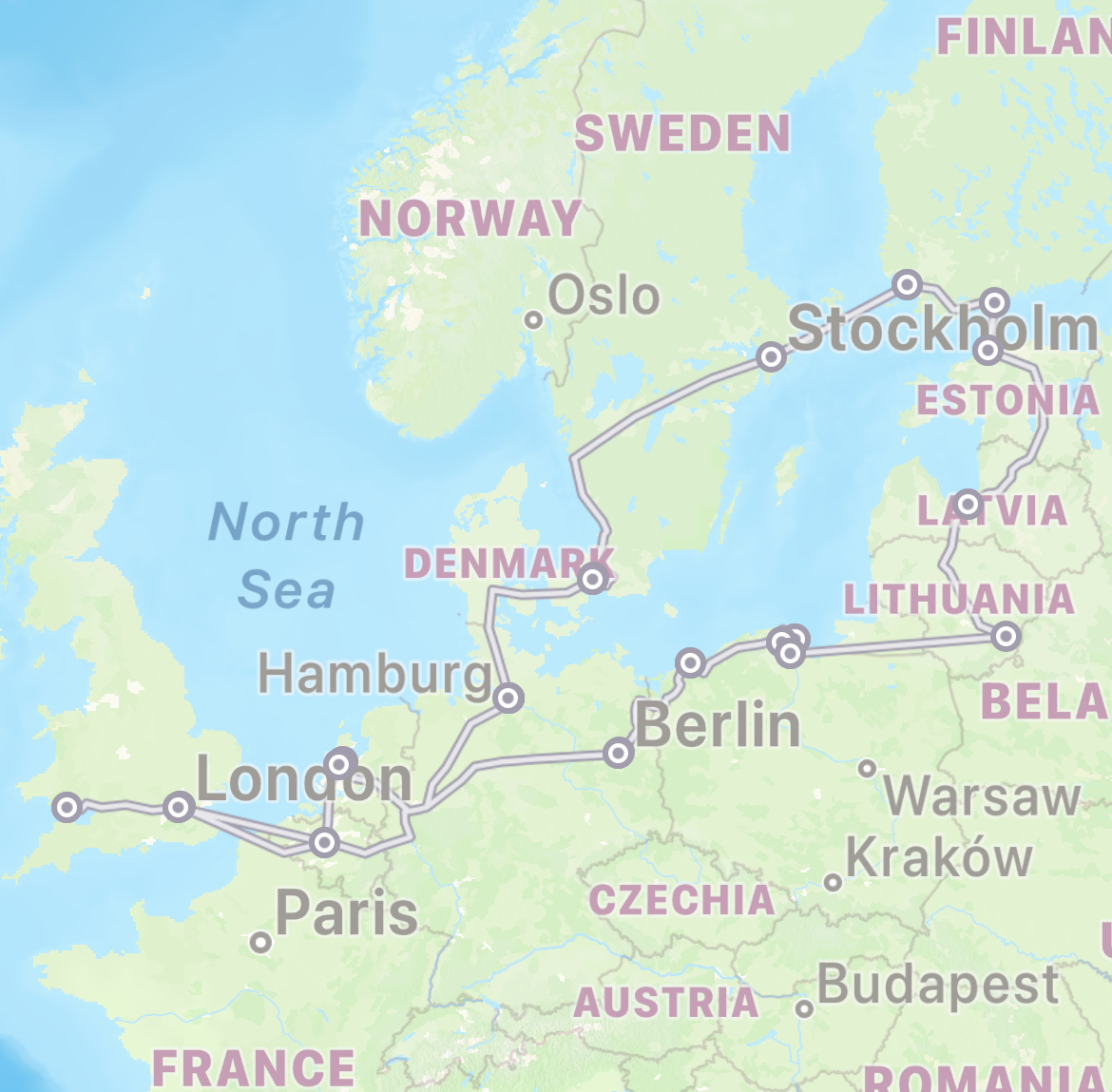
I have recently returned from a lap of the countries surrounding the Baltic Sea; the Scandinavian countries of Denmark, Sweden, Åland Islands and Finland, plus the former USSR Baltic States of Estonia, Latvia and Lithuania (and the Baltic coast of Poland, for good measure).

Perhaps surprisingly, most of these countries I had never visited before, but I had learned quite a bit about them in various contexts over the years. I had developed the impression that these were countries we could, indeed should all learn more from, but was keen to visit and witness life there to challenge my views and see how valid they are.

The lessons to be learned are many and varied, so I am dividing them into 2 blog pieces; the first one was on socioeconomic lessons, especially those pertinent to the Welsh Independence campaign, and this one is on the historical and political lessons especially pertinent to the political situation we are all living in right now.

I will focus this one primarily on the Baltic States of Estonia, Latvia and Lithuania, although their stories are intertwined with those of their Scandinavian/Nordic neighbours.

A BRIEF HISTORICAL SYNOPSIS

As with most nations today, the emergence of their identity goes back to the Middle Ages when tribal groups began to coalesce and settle down in recognisable territories. Thus, the Finno-Ugrians settled in what would become Finland and Estonia; The Livs settled in what is now northern Latvia; and the Samogitians and Aukstaiciai settled in what is most of present-day Lithuania.

 They all shared a collection of Pagan beliefs, worshipping the forces of nature personified as divinities. Their religious and cultural life centred on a large body of folk song, known as the dainos, many of which have survived. They encompass the whole of human life’s connectedness with nature and incorporate a strong sense of ethics.

From the 9th century, the area saw a series of Scandinavian Viking incursions, along with Slavic incursions from the south and east that saw the first attempts to bring Roman Christianity into the region. Around the turn of the 13th Century, the Danes conquered much of Estonia while Germans took the rest along with Latvia and Lithuanian.

Lithuania re-asserted itself successfully in the latter-13th and 14th centuries and became something of an imperial power itself, rejecting Christianity in the process, and taking land that is now Belarus and north-western Ukraine, and reached east as far as Moscow, under Great Prince Algirdas (whose name is prominent around Vilnius and beyond to this day).

One of the consequences of this expansion was the strategic intermarrying with neighbouring nobility that led to the reassertion of Christianity across the region. It led eventually to political union between Lithuania and Poland in the 16th century. Meanwhile Latvia and southern Estonia succumbed to Russian tsar Ivan IV (‘the Terrible’ one) and Sweden took northern Estonia and Finland.

The 17th century saw the region succumb to Russian expansionism, taking Estonia, Finland, Latvia and eating into the Polish-Lithuanian commonwealth, which saw itself partitioned between Russia and Germany and disappearing off the map completely as the result of three partitions in the 18th century.

This situation persisted throughout the 19th century, with attempted Polish and Lithuanian uprisings quashed and met with the intense russification of all the Baltic lands.

The Russian Revolution of 1905 and the arrival of Marxist values led to the peoples of the Baltics regaining confidence to reassert themselves. The three nations started by demanding national autonomy and Lithuania went so far as to demanding an autonomous Lithuanian state based on ethnic boundaries. Russia conceded that Baltic peoples could elect their representatives to the imperial parliament (the Duma) and allowed the consolidation of the national societies and use of the indigenous language in public life and schools again.

The collapse of the German and Russian empires during WWI allowed the Baltic peoples to finally establish independent states in 1918. It was far from plain sailing though. There was a power vacuum that led to fractured politics, the rise of extremism and political violence. Within 10 years all three countries had developed authoritarian systems. Lithuania saw a violently repressive nationalist regime, led by Smetona, eliminate all opposition to become a one-party state. Estonia and Latvia meanwhile were destabilised by exactly the opposite; a multiplicity of parties forming a ceaselessly changing series of weak coalitions.

Thus, when the Russian occupation arrived in 1940, the countries were in no shape to resist at all. There was probably some initial relief in Lithuania when Smetona fled to Germany. But any such relief would soon disappear as the region found itself in the violent grip of Stalin’s sovietisation of the three countries. The Soviet regime imposed manipulated elections that ensured the countries ‘voted’ to join the U.S.S.R.

By the 1970s the Baltic area had emerged as a hotbed of anti-Soviet dissent, with demonstrations and riots beginning to occur. The writing was on the wall (literally at times) and Mikhail Gorbachev understood the zeitgeist. He allowed increasing autonomy, which was especially relished in the Baltic states as they had never reconciled themselves to the loss of their independence, even though it had been politically difficult. It was driven by the strong sense of cultural identity among the indigenous populations. Diplomatic pressure was strong too, as virtually no country in ‘the West’ had ever recognised the incorporation of Estonia, Latvia and Lithuania into the U.S.S.R.

Elections in early 1990 clearly established pro-independence majorities in all three countries. Lithuania declared U.D.I. in March, followed by Estonia in April and Latvia in May. Moscow declared these illegal and asserted pressure in terms of economic sanctions designed to weaken the resolve of the people. There were sporadic outbreaks of violence where Soviet military tried to interfere with or control infrastructure. However, tensions within the corridors of power in Moscow culminated in the disintegration of the U.S.S.R in August 1991, facilitating the acknowledged implementation of the independence of the three Baltic States. By November, the Russians acknowledged the illegality of Stalin’s incorporation of the Baltic states in 1940.

Thus, we enter the short history of these proud nation’s growth as independent nations in the modern world. The 1990s saw the development of new constitutions, new currencies, and new foreign markets for each of the Baltic states. The immediate post-Soviet period, however, was marked by economic instability, and in 1998 a financial crisis in Russia had repercussions throughout the region. Nevertheless, at the beginning of the 21st century, the Baltic states experienced sustained economic growth and closer integration with the nations of the European Union and the North Atlantic Treaty Organization—two groups that all three countries joined in 2004. Their socio-economic success in this period is examined in Part 1 of this two-part blog.

The success of these newly independent nations

Compared to the chaotic nations that had independence in the 1920s and 30s, the Baltic states of today have been shining examples of what can be achieved by small nations gaining freedom and complete independence from much bigger oppressive neighbours. They should inspire and give confidence to nations like Wales, Scotland, Catalonia etc.

One of the keys to their current and ongoing success has been them learning lessons from their Nordic neighbours from the outset of gaining their independence. They set up their constitutions and legislatures along similar lines to them to try and ensure a strong and stable democracy and an economy that could develop mutually beneficial trade links with them and the rest of Western Europe, facilitating entry into the EU and the Eurozone.

There was therefore a strong desire to foster and build upon strategic links between the Nordic and Baltic states, both economically and politically. It has become known as the NB8 and is, in effect, a pact of co-operation between the Baltic Council, that was created by the three Baltic countries in the immediate aftermath of gaining independence on 1990, and the Nordic Council that has existed since 1952. A similar confederation was proposed in the 1920s during the previous period of independence for the three Baltic states, but political instability prevented it happening then. Lithuania was a prime mover for this new pact in the 1990s, recognising the importance of strength in numbers before securing membership of the EU and NATO.

As tensions within the EU (the U.K. has left and others may well follow) and NATO (with Trumpian USA not committed and many others, including me, unhappy with its destabilising expansionism and interventionist approach), it makes sense for nations to foster even greater co-operation, trade and sharing of resources and expertise elsewhere and closer to home.

Thus, the NB8 has developed and become a stronger entity since its inception in 1992. Indeed, a meeting of all the Ministers of Foreign Affairs met in Middelfart in 2000 to reassert the strength of the co-operation programmes (as well as formally adopting the NB8 moniker). A programme of regular conferences for a range of ministers was put in place:

This is backed up with a comprehensive and cohesive network of cooperation activities in political, military, economic, environmental, cultural, and other aspects. Landmark achievements include the 2004 establishment of the ‘NB8 Task Force Against Trafficking in Human Beings’, the 2010 ‘Cross-border Financial Stability Agreement’, and the 2012 ‘NB8 Wise Men Report’ that strengthened co-operation in foreign policy, cyber security, joint energy ventures, and defence.

Were it not for the spectre of Putin’s growing imperialism, the future would look secure and bright for all these countries. But however this pans out, there is a lot of inspiration to be had for other small nations aspiring to independence.

WHAT CAN WALES LEARN?

  • First and foremost, small nations can and do thrive when achieving independence.
  • Once achieved, independence becomes precious and worth fighting to retain. Indeed, countries that achieve independence very rarely ever want to reverse it.
  • On gaining independence, ensure you set up your constitution and legislature properly in order to preserve democracy and maintain stability.
  • It is important to have good friends and neighbours, preferably that you have things in common with.

The dissolution of the U.K. should not be acrimonious and there should be no reason for friendship and co-operation with England to not continue in most things. The Baltic States didn’t have this; it was gaining independence from a violently oppressive entity. It should therefore be easier for Wales and Scotland to make a success of independence.

Even if relations with England were to deteriorate, there is plenty of scope for other alliances, akin to the Nordic Council and Baltic Assembly.

The Celtic League already exists (founded in 1961) to promote and foster a modern Celtic identity and culture across the 6 Celtic Nations of Wales, Ireland, Scotland, Isle of Man, Cornwall, and Brittany. It is primarily focussed on promoting the Celtic languages, buy does also advocate for further self-governance in these nations and ultimately for each to become an independent state it its own right.

The common design features of the Orkney and Shetland flags serves to illustrate the overlapping histories they share with the Nordic countries. Given the fact that Orcadians and Shetlanders are fully aware of this history and have even been agitating about seeing a brighter future in realigning themselves with their Nordic neighbours (Lerwick is much nearer Oslo (@425 miles) than London (@600 miles) after all), it is entirely possible that we could see further overlaps develop in the diagram above.

The overwhelmingly strong message that I have received from both studying and visiting these nations is that there is so much potential to improve our lives in Wales by pursuing independence than from sticking with the status quo. Nothing ventured, nothing gained. Doing the same thing repeatedly and expecting a different outcome is madness (are you still voting Labour in the Assembly elections?).

I may have only spent a very short time in each country on my recent trip, but the places and the people all presented a sense of calm assurance and self-confidence that, despite the challenges of the modern world, they are on the right track.

I saw nobody homeless on the streets, no mindless vandalism, very little litter (other than that created by seagulls), no fly-tipping. You can’t say any of that around our cities, especially Cardiff. I spoke to people paying high taxes but not moaning about it because they feel they are getting good services for their money. Paying a lot doesn’t guarantee quality, but you can’t get quality in the bargain basement.

I spoke to polite, articulate, confident, multi-lingual young people everywhere I went. They are few and far between in Bridgend.

The people of these nations are proudly independent people in proudly independent nations, working together for a better future for everyone.

We can be the same, can’t we?

Baltic Lessons – for Wales (part 1) – Socio-economic lessons

I have recently returned from a lap of the countries surrounding the Baltic Sea; the Scandinavian countries of Denmark, Sweden, Åland Islands and Finland (and Norway recently too), plus the former USSR Baltic States of Estonia, Latvia, and Lithuania (and the Baltic coast of Poland, for good measure).

Perhaps surprisingly, most of these countries I had never visited before, but I had learned quite a bit about them in various contexts over the years. I had developed the impression that these were countries we could, indeed should all learn more from, but was keen to visit and witness life there to challenge my views and see how valid they are.

The lessons to be learned are many and varied, so I am dividing them into 2 blog pieces: this one on socioeconomic lessons, especially those pertinent to the Welsh Independence campaign, and another on the historical and political lessons of small European nations gaining independence.

I am going to divide these nations into two groups:

The Nordic Group = Denmark, Norway, Sweden, Finland (to which can be added Iceland, which I visited not so long ago too)

The Baltic Group = Estonia, Latvia, and Lithuania.

Let me start by presenting some data to give some evidence-based context.

Firstly, let us just acknowledge that these are all small countries in terms of population. The Nordic countries are mostly about twice the size of Wales (Sweden x3, Iceland the size of Cardiff), while the Baltic states are all significantly smaller, with Estonia less than half the size of Wales. The oft heard claims that Wales is too small to thrive as an independent country is patent, nay ridiculous nonsense. (Altogether, there are more than 20 European countries smaller than Wales’ population.)

Right from my earliest days as a geography student, I have always been fascinated by the Nordic countries consistently impressive scores across all sorts of metrics, be it wealth, equality, health, education, happiness etc. Stretching from the same latitudes as Scotland, up into the Arctic Circle and with no major resource advantages over the U.K., I was intrigued as to how they achieved so much. The answer is very straightforward, as it turns out. It is the ‘Nordic Model’.

The Nordic model comprises the  economic and social policies as well as typical cultural practices common in the Nordic countries (Denmark, Finland, Iceland, Norway, and Sweden). This includes a comprehensive welfare state and multi-level collective bargaining based on the economic foundations of social corporatism, and a commitment to private ownership within a market-based economy.

Norway is a partial exception due to it sharing a huge resource advantage with the U.K. in the shape of North Sea oil and gas. Unlike the U.K. though, it hasn’t allowed capitalists to largely piss it up the wall but has nurtured it by creating the world’s largest sovereign wealth fund that secures the country’s wealth and well-being indefinitely. It underpins the large number of state-owned enterprises and state ownership in publicly listed firms.

Although there are significant differences among the Nordic countries, they all have some common traits. All the Nordic countries are highly democratic and all have single chamber legislature and use proportional representation in their electoral systems. They all support a universalist welfare state aimed specifically at enhancing individual autonomy and promoting social mobility, with a sizable percentage of the population employed by the public sector (roughly 30% of the work force in areas such as healthcare, education, and government), and a corporatist system with a high percentage of the workforce unionised and involving a tripartite arrangement, where representatives of labour and employers negotiate wages and labour market policy is mediated by the government. As of 2020, all of the Nordic countries rank highly on the inequality-adjusted Human Development Index, the Global Peace Index, as well as being ranked in the top 10 on the World Happiness Report

Doesn’t it sound wonderful? Yet we have suffered and endured 45 years of unremitting neoliberal capitalism selling off our public assets and services, hollowing out remaining public services and non-stop ‘austerity’ for the poor while the rich accumulate obscene wealth. Is it any wonder that the Shetland and Orkney Islands  have considered abandoning the U.K. and returning to Norway (they were gifted to Scotland by King Christian of Norway in 1472).  An independent Wales could never join Norway, but it could certainly adopt the Nordic Model if it elected the right people.

The Nordic model was originally developed in the 1930s under the leadership of social democrats, although centrist and right-wing political parties, as well as labour unions, also contributed to the Nordic model’s development. The neoliberal zeitgeist across Europe and beyond in the last 45 years has impacted the Nordic countries to an extent, with increased deregulation and expanding privatisation of public services. However, it remains a distinctive approach retaining strong emphasis on public services and social investment.

The Baltic Nations have a very different history, of course.  As any Pole knows, the boundaries of countries in central Europe have been fluid throughout much of history, but the underlying nations have survived and, debatably, the current borders match the national identities of the peoples of Europe as well now as ever. (There remain some nations subsumed into larger states, of course, such as Wales and Catalonia.) The Baltic nations achieved independence from tsarist Russia as part of the violent fall-out of the Russian Revolution around 1917-18. They remained independent until the German occupation in 1940, followed by the Soviet occupation up until 1991.

With the dissolution of the Soviet Union in 1991, the Baltic states looked primarily towards their Nordic neighbours for inspiration as to how to set up their legislatures. They also warmly embraced a Scandinavian initiative to create a Council of Baltic Sea States (CBSS) in 1992. This consisted of all the Nordic group countries (once Iceland joined in 1995), all the Baltic group countries, plus Poland, Germany, and Russia (until it was kicked out after its invasion of Ukraine). There is scope for the largely cultural focus of the Celtic League of Celtic nations to evolve similarly with Welsh and Scottish independence.

Integration with the rest of Western Europe became a major strategic goal for the newly-indepndent Baltic states and all three were in NATO and the EU by 2004.

The statistics reveal that the Baltic states have made rapid progress across most metrics, but still have quite a way to go to emulate the Nordic states. But they seem to remain focussed on achieving this, and surely will if Putin doesn’t throw an enormous spanner in the works.

The Baltic countries have built their economies on innovation and trade. Small and highly connected to global markets, they have developed industries that excel in technology, manufacturing, and services. This focus has allowed them to remain competitive in an ever-changing economic landscape.

Investment in education and infrastructure has played a key part in their growth. Skilled workforces and modern transport systems attract businesses and encourage local entrepreneurship. Governments in the region have supported these efforts through policies that promote transparency and efficiency.

Tourism also contributes to the economic success of the Baltics. Visitors are drawn to the region’s cultural heritage, natural beauty, and vibrant cities. This steady flow of international visitors supports local businesses and boosts national revenues, helping to strengthen their economies further.

The Baltic countries are expected to continue their economic growth in the coming years. According to the European Commission, Estonia’s GDP is projected to grow by 3.5% in 2024, while Latvia and Lithuania are forecasted to grow by 3.3% and 3.8%, respectively. These figures are driven by a combination of export growth and domestic consumption.

Renewable energy is a key area of focus for future development. Lithuania aims to generate 50% of its electricity from renewable sources by 2030, compared to 38% in 2022. Estonia is also expanding its wind energy capacity, with plans to install over 1,000 megawatts of new wind farms by 2025. Investments in green energy are expected to attract funding and create jobs, boosting regional economies.

Technology and innovation are also driving forward-looking initiatives. Latvia’s IT sector grew by 10% in 2022, with exports of IT services reaching €2 billion. Estonia’s start-ups are thriving, with over 1,300 start-ups contributing €1.4 billion to the economy in 2022. These sectors are seen as key to maintaining competitiveness and ensuring steady growth in a rapidly changing global market.

There is nothing here that Wales could not emulate, given the freedom to fully capitalise on its natural and human resources. Independence is not a silver bullet that ensures any sort of success in and of itself. But it is a golden opportunity; a golden opportunity to fulfil a people’s potential that is rarely afforded when subservient to a dominant paymaster.

History can provide us with lessons we can learn as to how to best optimise the opportunities that independence can afford.

URGENT: Ban Israel from Eurovision

This petition is being organised by AVAAZ, and organisation I have long supported. I’ve mixed feelings about petitioning, but it is better than doing nothing and. Avaaz have a decent record of influencing things.

Eurovision banned Russia from taking part in the contest when they attacked Ukraine, but Israel is still participating!

Eurovision starts in just a few days – join me calling on organisers to ban Israel now – sign this urgent petition and share widely: https://secure.avaaz.org/campaign/en/eurovision_no_stage_for_war_crimes_loc/?&utm_source=email&utm_medium=social_share&utm_campaign=54118&share_location=post_action

Children in Gaza are dying of hunger. Now, Israeli officials want to take over all of Gaza, displacing millions. Yet Eurovision is getting ready to give Israel a global stage.

Russia was banned from Eurovision one day after invading Ukraine, but Israel’s participation continues despite the war crimes in Gaza. Now countries like Spain, Iceland and Slovenia are challenging this hypocrisy – and they are not alone. Artists, broadcasters and thousands of people worldwide are speaking out.

We only have days to make our voices impossible to ignore. Join the call to ban Israel from Eurovision while its attacks continue. Add your name now and spread the word!
Over 50,000 people have been killed in Gaza, mostly women and children. The remaining population of Gaza is facing starvation and daily bombardment.

Eurovision officially changed its slogan to “United by Music” and must show that this slogan is more than words. It must mean unity against all forms of violence and oppression against anyone, anywhere.

How many Palestinians will die either from bombing or starvation before Israel’s song airs? That’s why we must make sure Eurovision sends a message to Israel that they cannot commit war crimes and then be welcomed on stage as if nothing happened. Eurovision should be a joyful celebration where countries come together, connected by our shared values to uphold human rights. That’s why countries that do not abide by these basic principles should receive the same treatment: to be banned from the contest while they are committing war crimes. 

Carl Sagan’s ‘Baloney Detection Kit’

Carl Sagan, in The Demon-Haunted World, presents a set of tools for sceptical thinking that he calls the “baloney detection kit”. Sceptical thinking consists both of constructing a reasoned argument and recognizing a fallacious or fraudulent one. In order to identify a fallacious argument, Sagan suggests employing such tools as independent confirmation of facts, debate, development of different hypotheses, quantification, the use of Occam’s razor, and the possibility of falsification. Sagan’s “baloney detection kit” also provides tools for detecting “the most common fallacies of logic and rhetoric”, such as argument from authority and statistics of small numbers. Through these tools, Sagan argues the benefits of a critical mind and the self-correcting nature of science can take place.

Sagan provides nine tools as the first part of this kit.

  1. There must be independent confirmation of the facts given when possible.
  2. Encourage debate on the evidence from all points of view.
  3. Realize that an argument from authority is not always reliable. Sagan supports this by telling us that “authorities” have made mistakes in the past and they will again in the future.
  4. Consider more than one hypothesis. Sagan adds to this by telling us that we must think of the argument from all angles and think all the ways it can be explained or disproved. The hypothesis that then still hasn’t been disproved has a much higher chance of being correct.
  5. Try to avoid clinging obdurately to your own hypothesis and so become biased. Sagan tells us to compare our own hypothesis with others to see if we can find reasons to reject our own hypothesis.
  6. Quantify. Sagan tells us that if whatever we are trying to explain has numerical value or quantitative data related to it, then we’ll be much more able to compete against other hypotheses.
  7. If there is a chain of argument, every link in that chain must be correct.
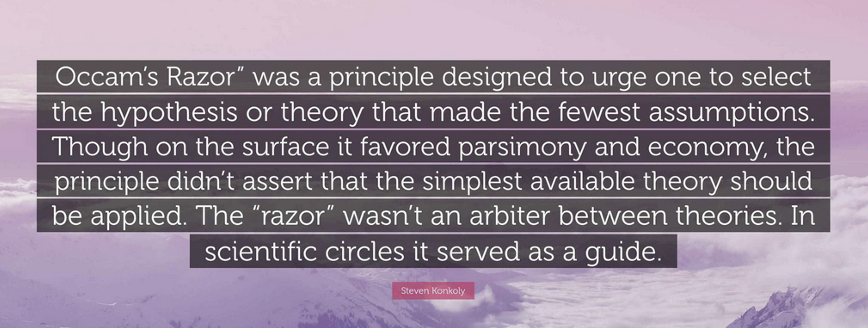
  8. The use of Occam’s razor, which says to choose the hypothesis that is simpler and requires the fewest assumptions.
  9. Ask if a given hypothesis can be falsified. Sagan tells us that if a hypothesis cannot be tested or falsified then it is not worth considering.

Sagan suggests that with the use of this “baloney detection kit” it is easier to critically think and find the truth

Logical fallacies

There is a second part to the kit. This consists of twenty logical fallacies that one must not commit when offering up a new claim.

  1. Ad hominem. An arguer attacks the opposing arguer and not the actual argument.
  2. Argument from authority. Someone expects another to immediately believe that a person of authority or higher knowledge is correct.
  3. Argument from adverse consequences. Someone says that something must be done a certain way or else there will be adverse consequences.
  4. Appeal to ignorance. One argues a claim in that whatever has not been proved false must be true, and vice versa.
  5. Special pleading. An arguer responds to a deeply complex or rhetorical question or statement by, usually, saying “oh you don’t understand how so and so works.”
  6. Begging the question. An arguer assumes the answer and makes a claim such as, this happened because of that, or, this needs to happen in order for that to happen.
  7. Observational selection. Someone talks about how great something is by explaining all of the positive aspects of it while purposely not mentioning any of the negative aspects.
  8. Statistics of small numbers. Someone argues something by giving the statistics in small numbers, which isn’t very reliable.
  9. Misunderstanding of the nature of statistics. Someone misinterprets statistics given to them.
  10. Fallacy of inconsistency. An arguer is very inconsistent in their claims.
  11. Non sequitur. This is Latin for “it doesn’t follow”. A claim is made that doesn’t make much sense, such as “Our nation will prevail because God is great.”
  12. Post hoc ergo propter hoc. Latin for “it happened after, so it was caused by”. An arguer claims that something happened because of a past event when really it probably didn’t.
  13. Meaningless question. Someone asks a question that has no real meaning or doesn’t add to the argument at all.
  14. The excluded middle. An arguer only considers or mentions the two opposite extremes of the conversation and excludes the aspects in between the two extremes.
  15. Short-term vs. long-term. A subset of the excluded middle, but so important it was pulled it out for special attention.
  16. Slippery slope, related to excluded middle (e.g., If we allow abortion in the first weeks of pregnancy, it will be impossible to prevent the killing of a full-term infant. Or, conversely: If the state prohibits…).
  17. Confusion of correlation and causation. The latter causes the former.
  18. Straw man. Caricaturing a position to make it easier to attack. This is also a short-term/long-term fallacy.
  19. Suppressed evidence, or half-truth.
  20. Weasel word. Talleyrand said: “An important art of politicians is to find new names for institutions which under old names have become odious to the public.” 

Sagan provides a skeptical analysis of several examples of what he refers to as superstition, fraud, and pseudoscience such as witches, UFOs, ESP,  faith healing and organised religion.

An alternative to The Demon-Haunted World is the equally accessible Nonsense on Stilts: How to Tell Science from Bunk, by Massimo Pigliucci (2008). One reviewer sums it it up well:

“No one—not the public intellectuals in the culture wars between defenders and detractors of science nor the believers of pseudoscience themselves—is spared Pigliucci’s incisive analysis. In the end, Nonsense on Stilts is a timely reminder of the need to maintain a line between expertise and assumption. Broad in scope and implication, it is also ultimately a captivating guide for the intelligent citizen who wishes to make up her own mind while navigating the perilous debates that will affect the future of our planet.”

Reading and absorbing these two books is possibly the best bit of education you can deliver to yourself. It is sad, but no accident methinks, that every child leaving school is not imbued with this understanding.

Carl Sagan – possibly the greatest influence on my understanding of this world and its place in the universe.

Yesterday (18/04/25), a new article was published that focussed on the last ever television interview of Carl Sagan, back in 1996.

I am always heartened to see anything that brings attention to this great man, given that he has been gone approaching 30 years now. It dawned on me yesterday that he died at the same age that I am now, and this has given me further reason to reflect on the influence that he had on me in my formative years. More on this shortly.

But first, let us look at this article on the Open Culture website yesterday.

It has the link to the interview video at the top:

The Open Culture Foundation is a nonpartisan, nonprofit organisation founded in 2014 to promote open technology as the core to securing digital rights and internet freedom. “Open technology” includes three dimensions: (1) open source software & hardware that can freely used, developed and redistributed by anyone; (2) open data that can similarly be freely used, reused and redistributed by anyone; and (3) open government that promotes transparent, participatory, inclusive and accountable governance.

Hopefully you can see why Carl Sagan’s interview (and work) resonates with them so much. Sagan was a pioneering scientist, focussing on astronomy and astro-physics during the immensely progressive period of scientific advance during and beyond the 1960s; the era of the Apollo missions to the moon and deep-space probes. In this interview and in his seminal, sadly final book, The Demon-Haunted World, he identifies a problem that continues to grow and blight the futures of us all; namely people losing respect and understanding for science and scientists.

At the end of his life, Sagan cared deeply about where science stood in the public imagination. Sagan sensed that scientific thinking was losing ground in America, and especially worryingly in Congress. During his final interview, aired on May 27, 1996, Sagan issued a strong warning:

We’ve arranged a society on science and technology in which nobody understands anything about science and technology, and this combustible mixture of ignorance and power sooner or later is going to blow up in our faces. I mean, who is running the science and technology in a democracy if the people don’t know anything about it.

And he also went on to add:

And the second reason that I’m worried about this is that science is more than a body of knowledge. It’s a way of thinking. A way of skeptically interrogating the universe with a fine understanding of human fallibility. If we are not able to ask skeptical questions, to interrogate those who tell us that something is true, to be skeptical of those in authority, then we’re up for grabs for the next charlatan political or religious who comes ambling along.

This brings to my mind one of favourite Carl Sagan quotes:

The Open Culture article concludes:

“Nearly 30 years later, we have reached this point. Under the second Trump administration, DOGE has rushed to dismantle the scientific infrastructure of the US government, haphazardly cutting the National Science Foundation, the National Institutes of Health, and NASA. Next, they’re going after leading research universities, intentionally weakening the research engine that has fueled the growth of American corporations—and the overall American economy—since World War II. And they’re replacing scientific leaders with charlatans like RFK Jr. who dabble in the very pseudoscience that Sagan warned us about. Needless to say, our competitors aren’t making the same mistakes. Few serious governments are stupid enough to cut off their nose to spite their face.”

Carl Sagan was not just a brilliant scientist and a thoroughly decent human being, he was a prophet!

First and foremost, for me, he was a brilliant, inspirational communicator of difficult concepts. I first encountered him in my first year at University, when the BBC screened his exquisite series “Cosmos: A Personal Voyage (with Carl Sagan)” (13 episodes, 1980/81).

Thankfully, the whole series is still available to us all. https://archive.org/details/CosmosAPersonalVoyage/1980+Cosmos+(A+Personal+Voyage)+-+Ep+01+The+Shores+of+the+Cosmic+Ocean.mp4

If you are not inclined to watch it all, at least watch the first 10 minutes or so. I wager many of you will be drawn in by his voice and words and end up watching more. But whatever; you will get the feel for what drew me in.

At the very least, spare three and a half minutes to watch this video that presents the essence of my worldview so beautifully.

I find it even more powerful when I read it slowly to myself:

From this distant vantage point [that of ‘an alien scientist newly arrived at the

outskirts of our solar system’ where Voyager 1 took the photograph], the Earth

might not seem of any particular interest.

But for us, it’s different. Look again at that dot. That’s here. That’s home. That’s

us. On it everyone you love, everyone you know, everyone you ever heard of, every

human being who ever was, lived out their lives. The aggregate of our joy and

suffering, thousands of confident religions, ideologies, and economic doctrines,

every hunter and forager, every hero and coward, every creator and destroyer of

civilization, every king and peasant, every young couple in love, every mother and

father, hopeful child, inventor and explorer, every teacher of morals, every

corrupt politician, every ‘superstar,’ every ‘supreme leader,’ every saint and

sinner in the history of our species lived there — on a mote of dust suspended in a

sunbeam.

The Earth is a very small stage in a vast cosmic arena. Think of the rivers of

blood spilled by all those generals and emperors so that, in glory and triumph,

they could become the momentary masters of a fraction of a dot. Think of the

endless cruelties visited by the inhabitants of one corner of this pixel on the

scarcely distinguishable inhabitants of some other corner, how frequent their

misunderstandings, how eager they are to kill one another, how fervent their

hatreds.

Our posturings, our imagined self-importance, the delusion that we have some

privileged position in the Universe, are challenged by this point of pale light. Our

planet is a lonely speck in the great enveloping cosmic dark. In our obscurity, in

all this vastness, there is no hint that help will come from elsewhere to save us

from ourselves.

The Earth is the only world known so far to harbour life. There is nowhere else, at

least in the near future, to which our species could migrate. Visit, yes. Settle, not

yet. Like it or not, for the moment the Earth is where we make our stand.

It has been said that astronomy is a humbling and character-building experience.

There is perhaps no better demonstration of the folly of human conceits than this

distant image of our tiny world. To me, it underscores our responsibility to deal

more kindly with one another, and to preserve and cherish the pale blue dot, the

only home we’ve ever known.

If he were still around today, he would be appalled, but sadly not shocked. As I am. As many of you, no doubt, are too. The question is, what are we going to do about it? The very least that we can all do is take on board the last sentence of ‘The Pale Blue Dot’:

To me, it underscores our responsibility to deal more kindly with one another, and to preserve and cherish the pale blue dot, the only home we’ve ever known.

Amen.

Letter to Trump from Lech Wałęsa

As a student in the early 1980s, I remember being hugely impressed by the astonishing bravery of Lech Wałęsa, who headed up the Solidarity Union that led the Gdansk ship workers out on strike against the then communist regime in Poland. He became an icon and a hero. He, of course, went on to be President of the country.

Last week Lech Wałęsa wrote an open letter to Donald Trump. In case you didn’t see it, the full text of that letter is below.

There is so much I could say about the contempt I hold Donald Trump in, but I hope that all reading this would share that contempt so let me just share Lech Wałęsa’s words and be done, rather than risk my blood pressure.


“Your Excellency, Mr. President,

We watched your conversation with President Volodymyr Zelensky with fear and distaste. It is insulting that you expect Ukraine to show gratitude for U.S. material aid in its fight against Russia. Gratitude is owed to the heroic Ukrainian soldiers who have been shedding their blood for over 11 years to defend the free world’s values and their homeland, attacked by Putin’s Russia.

How can the leader of a country symbolizing the free world fail to recognize this?

The Oval Office atmosphere during this conversation reminded us of interrogations by the Security Services and Communist court debates. Back then, prosecutors and judges, acting on behalf of the communist political police, told us they held all the power while we had none. They demanded we stop our activities, arguing that innocent people suffered because of us. They stripped us of our freedoms for refusing to cooperate or express gratitude for our oppression. We are shocked that President Zelensky was treated similarly.

History shows that when the U.S. distanced itself from democratic values and its European allies, it ultimately endangered itself. President Wilson understood this in 1917 when the U.S. joined World War I. President Roosevelt knew it after Pearl Harbour in 1941, realizing that defending America meant fighting in both the Pacific and Europe alongside nations attacked by the Third Reich.

Without President Reagan and U.S. financial support, the Soviet empire’s collapse would not have been possible. Reagan recognized the suffering of millions in Soviet Russia and its conquered nations, including thousands of political prisoners. His greatness lay in his unwavering stance, calling the USSR an “Empire of Evil” and confronting it decisively. We won, and today, his statue stands in Warsaw, facing the U.S. Embassy.

Mr. President, military and financial aid cannot be equated with the blood shed for Ukraine’s independence and the freedom of Europe and the world. Human life is priceless. Gratitude is due to those who sacrifice their blood and freedom—something self-evident to us, former political prisoners of the communist regime under Soviet Russia.

We urge the U.S. to uphold the 1994 Budapest Memorandum, which established a direct obligation to defend Ukraine’s borders in exchange for giving up nuclear weapons. These guarantees are unconditional—nowhere do they suggest such aid is a mere economic transaction.

Signed,
Lech Wałęsa, former political prisoner, President of Poland “

From: politicalarena.org/2012/01/14/lech-walesa-unveils-reagan-statue-in-warsaw/

ARGENTINA and the BRITISH – a complicated relationship, especially if you are Welsh!

I’ve recently returned from a trip to Argentina that saw me visit Buenos Aires, coastal Patagonia and Ushuaia, Terra del Fuego. I quickly felt more comfortable identifying as Welsh rather than British, not because I was in any way intimidated or threatened (quite the contrary), but simply because of historical evidence and propaganda everywhere I went.

Before I delve into this further, let me present some historical context.

Argentina was, of course, initially part of the Spanish Empire, but parts of Argentina, such as Rio de la Plata (including Buenos Aires) and Islas Malvinas (a.k.a. Falklands Islands), were squabbled over between the Spanish and British in the late 18th and early 19th centuries.

Argentina’s current borders were settled after its War of Independence that saw it declare independence from Spain on 15 December 1823. Britain stayed neutral in the war but was quick to recognise the newly established republic. Argentina effectively shelved its claims of sovereignty over the Falklands in return for British economic investment that played a major role in the Argentine economic boom that lasted from the mid 1800s through the Great Depression of the 1930s.

Things changed after WW2 (during which over 4000 Argentine volunteers served with British armed services). The British policy of ‘Imperial Preference’ directed most of its overseas investment to its colonies. The Perón regime then nationalised many British-owned industries, further diminishing British influence.  

By the mid-1960s, the military were calling the shots and there was a military coup in 1966. The military junta soon saw value in resurrecting claims of sovereignty over the Malvinas/Falklands.

Initially, and under pressure from the UN, the British government, or the Foreign and Commonwealth Office (FCO) at least, saw the islands as more of a nuisance and obstacle to trade in South America and were inclined to cede the islands to Argentina in 1968. Parliamentarians sympathetic to the plight of ‘British’ islanders, frustrated these plans.

Thus, throughout the 1970s (and both Labour and Conservative governments) the Argentine government were kind of teased about British willingness to cede the islands once political issues in the UK were resolved. The FCO even tried to make the islanders more amenable by allowing Argentina to increasingly supply the islands with things like oil and food, hoping they would feel increasingly dependent on Argentina and less dependent on the UK.

In 1980, a year into Thatcher’s first term, her foreign secretary, Nicholas Ridley was despatched to the Falklands to try and persuade the islanders of the benefits of a ‘leaseback’ scheme. It failed, despite Ridley conceding in private that he knew that the Argentines were running out of patience and could decide to invade and take the islands.

For the Argentine junta, things came to a head in 1981, They had been in charge for 5 years and the economy had stagnated and was crumbling. Large-scale civil unrest was erupting all over the country. The new junta head, General Galtieri, needed a PR boost and hoped to divert public attention from the floundering economy and human rights issues by mobilising the long-standing patriotic sentiments of Argentinians towards Las Malvinas. He and his advisers were convinced that the British would never respond militarily. They had miscalculated.

By 1982, Thatcher’s popularity was plummeting, and the Falklands looked a no-win situation that could sink her completely. Quietly ceding the islands was one thing, seeing them invaded and snatched away was quite another. But going to war over them, given the logistical challenges involved and the lack of a certain outcome seemed crazy. However, ten weeks later, the Falklands were retaken, and Thatcher could do no wrong for most Brits.

But the Argentinians have never lost the conviction, so successfully embedded in them ever since the 1970s, that Las Islas Malvinas belong to them. The British, meanwhile have become ever more aware to the potential riches in the relatively shallow waters of the seas around the Falklands, and potentially in Antarctic territory beyond. Positions have become re-entrenched. However, we see or hear very little about the Falklands back in the UK these days. It is very different in Argentina, as I saw with my own eyes while travelling around. I became increasingly gob-smacked. Here are just some of my photos, firstly from Buenos Aires:

Just 100m from my Buenos Aires AirBnB. 8ft tall 4-sided memorial. The other three sides list the Argentinian ‘heroes’ who gave their lives.  Why 2009? I don’t know. There are countless other memorials dotted all over the city.

At least half the buses in Buenos Aires had this stuck on the side. A law passed in 2014 by the Argentine Congress says public transport must have signs saying “Las Islas Malvinas son Argentinas” (‘the Falkland Islands are Argentine’).

I went to a Boca Juniors game in January 2025. An essentially left-wing club in the dock area of the city still has banners at home games asserting the Malvinas are Argentinian.

Moving on to Welsh Patagonia, I wondered if the strong Welsh affiliations and affections altered the attitudes towards the Malvinas/Falklands. Nope, not at all.

This adorns the Town Hall in Trelew. It was the only conspicuous memorial I stumbled across in this town, but some buses in the town had the same poster as those in Buenos Aires. Why 2024? Again, I don’t know.

The county town of Rawson, nearer the coast, ramped things up a bit more. Near the County Hall is an extensive collection of Malvinas memorials:

Translating the plaque beneath one of them:

Worker stopping with one hand raised

The advance of the internal and external enemy

That oppresses the people

And with one hand pointing

A barbed wire fence

Symbol of invading capitalism

Towards South American territories.

That’s the working classes of South America resisting the capitalist colonialists of Europe, Britain specifically in this case. Which is an interesting perspective for people largely descended from capitalist colonialists of centuries gone by, Spain in that case, but hey!

Rawson is also home to a museum dedicated to the Falklands War; the ‘Museum of the Malvinas Soldiers’:

It appears to have been put together and curated by local families of soldiers who lost their lives there. It is, however, free to enter and I guess is financially supported by government at some level. It was staffed by a man in his 30s; quite an intense guy who recognised my Welsh soccer shirt. He got a bit emotional when I shook his hand and said ‘muchas gracias’ as I left.

Soldier of my country…

Boy of my people…

What unfathomable nights

your dreams sheltered!

I cry for you at night and…

At dawn I still remember…

Emotional stuff. But looking at the visitor book, I don’t think this museum sees many visitors. It is the public displays in the town centres that (a) keeps the emotion alive for the locals, but also (b) smacks the visitor in the face, especially British visitors. And thus, onto Ushuaia!!

There is a special context to Ushuaia’s obsession with Las Islas Malvinas. This map, cut into thick sheet steel, is down by the port entrance:

Ushuaia is on Tierra Del Fuego in the top left of these maps. The Argentinian Government regards it as the capital city of all the territories on this map, thereby including the following territories that the map on the right identifies as UK territories: Islas Malvinas a.k.a. Falkland Islands, Islas Georgias del Sur a.k.a. South Georgia, Islas Sandwich a.k.a. South Sandwich Islands, Islas Orcadas a.k.a. South Orkney Islands and Antartida Argentina a.k.a. British Antarctic Territory.

Ushuaia doesn’t even attempt to perform any governmental functions outside of Tierra del Fuego as it regards these other territories as under illegal occupation by the British. But this doesn’t stop it attempting to maintain communications, if only via radio:

This is Nacional FM broadcasting from Ushuaia across Tierra del Fuego and, it would seem, to the Islas Malvinas. It would be interesting to know the listening figures from there!

But there are ‘in-your-face’ messages all over town:

Clockwise from top left: Memorial plaques from all manner of organisations / Entrance to large memorial plaza / Eternal flame in memory of the dead built at the 30th anniversary of the war / 40th anniversary war memorial / one of about twenty poster size photos displayed around the plaza.

And it is not just war memorials. In an attempt to assert that the Malvinas are theirs, there are also big diplays about the wildlife, ecology and need for ‘proper’ conservation on the islands:

There are a lot of references to “Argentinas y Fueguinas” to emphasise that the islands are not just Argentinian, but more specifically of the Tierra del Fuego administartive area, of which Ushuaia is the capital.

This was on the back of business premises overlooking the port.

Next to the port entrance, and elsewhere, there are lots of things stressing that the Islands are relatively close to Ushuaia (but that is still about 500 miles), compared to Buenos Aires, and also that the UK is ridiculously far away; 12,700km or 7,900 miles.

Also next to the port entrance, and quite pointedly in both Spanish and English, given the large number of English-speaking tourists passing through, are these two unequivocal statements on large noticeboards:

I would love to know what has been deleted from the bottom!

So, the message is loud and clear and unequivocal; Argentina has not given up on being able to assert sovereignty over the Falkland Islands, at the very least, and over other UK held territories in the South Atlantic/Southern Oceans.

However the language used by the current President (at the time of writing), Javier Milei, has been tempered compared to some of his predecessors. https://www.bbc.co.uk/news/articles/ce43zv3qln9o

There clearly is no desire to physically fight over the islands again. But it is also clear that a diplomatic resolution is nowhere near even being on the horizon again. https://www.bbc.co.uk/news/articles/ce43zv3qln9o

In the meantime, a two prong PR campaign that has been going strong since the 1970s continues. First is all the messaging on public transport and public buildings aimed at keeping the idea firmly implanted in the mind of the Argentinian public. Second is the uncompromising messaging to visitors to Argentina, especially conspicuous around ports and airports used by tourists, presented extensively in English so that British and American visitors, in particular, cannot miss the message.

Here is the main tourist information online portal for Ushuaia:

The map link at the bottom goes to the map below that shows the whole array of public installations to do with Las Malvinas, but which is far from inclusive of all mentions of Las Malvinas around the town.

So, what do I conclude about the Las Malvinas/Falklands situation now, in 2025, well over 40 years since the war?

British tourists, as far as I can see, and in my experience, suffer no discrimination from the Argentinian hospitality sector, nor from the vast majority of the Argentinian people. There seems to be an understanding about the capitalist interests driving the current determination of the UK establishment to hold onto the Falklands and other territories in the region. But it is this feeling that they are being robbed of potential resources that belong to them that will not let them give up on the aspiration to have sovereignty over the islands recognised and achieved.

There is no hint of any desire to go to war over the islands again right now, but in this age of Trumpian powder-keg diplomacy, that could change if the conditions were right, and some sort of trigger event occurred. There are possible trigger events on the horizon such as the uncertain future of the Antarctic Treaty’s Environmental Protocol when I it comes up for review in 2048.

Perhaps even more imminent is the “Blue Hole” issue of the fishing free-for-all going on around the Falklands due to the waters being caught in the middle of the territorial dispute between the UK and Argentina. One of the consequences of this is the lack of any agreements on fishing in these waters; it is one of the only areas of sea not covered by any regional fishing agreement. The consequences of the resultant over-fishing are dire for Falkland Islanders (the fishing industry makes up two-thirds of the Falkland Island’s economy) but also for the impact on fish stocks in neighbouring waters. https://www.ethicalmarkets.com/falkland-islands-dispute-is-causing-fishing-free-for-all-in-nearby-blue-hole/

This may yet convince the Falkland Islanders that their prosperity and future might actually be more secure under Argentinian jurisdiction. This was, after all, an argument the UK Governments put forward themselves back in the 1960s and ’’70s, remember?

That would be a fascinating turn of events given that the (duplicitous) pretext for fighting the war in 1982 was the Islanders explicit desire to stay ‘British’. If they were to change their minds (and Shetland/Orkney Islanders, for example, are increasingly changing their minds and considering to self-determine themselves as Norwegian instead of British), then how could the UK say ‘no’? The UK is destined to dissolve in any case, sooner or later, with Scottish and Welsh independence and the re-unification of Ireland. Where this would leave British dominions and far-flung overseas territories, such as the Falklands, is an interesting consideration. The UK has only recently (just 6 months ago, in October 2024) given sovereignty of the Chagos Islands back to Mauritius. This is a interesting precedent. https://www.bbc.co.uk/news/articles/c98ynejg4l5o

It is my view that there is natural justice https://en.wikipedia.org/wiki/Natural_justice  that should ultimately settle all such issues, if and when a fair and balanced consideration of material facts and human and environmental impacts can hold sway. I do not wish to prejudge such things, but nonetheless, I am of the opinion that this would lead to not just the dismantling of the UK as described above, but also the recognition of islands that cannot (or want not to) sustain themselves as independent nations belonging to the nearest and/or geologically consistent land mass country.

Thus, I do think that eventually the Falkland Islands should and will become recognised as Las Islas Malvinas of Argentina.

But what of the Islanders desire to remain ‘British’? A major part of this is cultural. They are almost all of British descent; English-speaking, but mostly descended from Scottish and Welsh immigrants who settled from 1833 onwards. More recent immigrants have stemmed the population decline in the islands and have come mostly from the UK, St Helena and Chile. The 2012 census https://web.archive.org/web/20130520184434/http://www.falklands.gov.fk/assets/Headline-Results-from-Census-2012.pdf  showed 59% of residents identifying as Falkland Islanders, 29% as British, 9.8% as Saint Helenian and 5.4% as Chilean (N.B. adds up to more than 100% as some identified as belonging to more than one category). A small number identified as Argentinian and of other nationalities.

I deduce a few things from these figures. Firstly, the Islanders do not see themselves as essentially British; they see themselves as essentially unique and distinct. Secondly, beyond the cultural matters of language, religion (most are protestants), and education, their loyalty to Britain is probably essentially pragmatic – that the UK guarantees its well-being and security to the tune of £60m a year, not counting major infrastructure investment of military significance, such as the recent £7m refurb of the Mount Pleasant military base. That represents more than £30,000 a year for each full-time inhabitant. (For context, that £60m could cover the £20 increase in Universal Credit given during Covid but since removed despite no end to the cost-of-living crisis. Or free school meals for 150,000 kids. But hey, I digress).

The point is that I feel sure that the islanders could easily be convinced that their livelihoods (mostly fishing dependent) and well-being (access to healthcare especially) could easily be matched, if not bettered by being under Argentine jurisdiction, and that assurances and guarantees about preserving their cultural identity and ways of life as English-speaking, tea-drinking, Anglicans would be enough to seal the deal.

After all, there is another part of Argentina that has done just that for another group of settlers of British descent, namely Welsh Patagonia.

Which brings me neatly to my reflections on what I saw and learned in and around Welsh Patagonia.

Welsh Patagonia is generally recognised as coinciding with the Argentinian province of Chubut. Having initially landed at Puerto Madryn, the early settlers were guided to the more fertile land along the lower Chubut valley by the indigenous Tehuelche people, thereby creating the towns of Rawson (named after Guillermo Rawson, the Argentine Minister of the Interior who championed and supported the Welsh settlement in Argentina), Trelew (initially Trelewis, the Welsh for Lewistown – a village just outside Bridgend), Gaiman (the name originating from the Tehuelche place-name meaning “rocky point”), and Dolavon (derived from the Welsh for “river meadow”). These are the five towns I visited.

Sometime later Welsh settlers migrated across the pampas and set up towns in the foothills of the Andes, such as the initially flour-milling town of Trevelin (from the Welsh ‘Trefelin’ = mill town) and Esquel (derived from Tehuelche words for “marsh” and ‘thorny plants”). I didn’t have time to get to these towns.

The story of the Welsh arriving in Puerto Madryn is a sad one.

The onset of the Industrial Revolution saw wealthy English capitalists investing heavily in the South Wales coalfield valleys and saw mass migration into the area. Welsh speakers became a nuisance and began being persecuted not just in the workplaces but by parliament. An 1847 parliamentary report on Welsh education (that became known as the ‘Treachery of the Blue Books’) https://www.library.wales/discover-learn/digital-exhibitions/printed-material/the-blue-books-of-1847 poured scorn on Welsh speakers and advocated punishments like the ‘Welsh Not’; a piece of wood hung around the necks of children caught speaking Welsh.

This persecution saw many join the waves of migration to America, but this didn’t make it easier to maintain the speaking of Welsh (although they did create ‘Welsh’ towns at Utica in New York State and Scranton in Pennsylvania). The idea of creating a remote utopia away from the influence of the English language became an obsession for some.

One such was a Caernarfon publisher and printer, Lewis Jones (honoured in the naming of Trelew), who in 1862 travelled to Patagonia’s Chubut Valley, accompanied by Welsh Liberal politician, Sir Love Parry-Jones (whose home estate, Madryn, would give its name to the port in which the settlers would land). They met with Guillermo Rawson, the Interior Minister, and he was amenable as he saw it as a way of gaining more control over a large tract of land disputed with their Chilean neighbours.

Having obtained Rawson’s agreement, the next step was to round up a group of initial settlers. A Welsh emigration committee met in Liverpool and published a handbook, Llawlyfr y Wladfa (Colony Handbook) to publicise the Patagonian scheme. The handbook was widely distributed throughout Wales and in America.

The first group of settlers, over 150 people, gathered from all over Wales, but mainly north and mid-Wales, sailed from Liverpool in late May 1865 aboard the tea-clipper Mimosa. Passengers had paid £12 per adult, or £6 per child for the journey. Blessed with good weather the journey took approximately eight weeks, and the Mimosa eventually arrived at what is now called Puerto Madryn on 27th July.

Unfortunately, the settlers found that Patagonia was not the friendly and inviting land they had been expecting. They had been told that it was much like the green and fertile lowlands of Wales. In reality it was barren and inhospitable windswept pampas, with no water, very little food and no forests to provide building materials for shelter. Some of the settlers’ first homes were dug out from the soft rock of the cliffs in the bay. I learned most of this from the Museo Del Desembarco:

Those shallow hollows where those first dishevelled migrants landed were the homes for most of them for a quite a few weeks, such that they cut out discernible recesses to act as shelves etc.

The future looked bleak, but the indigenous Teheulche Indians took pity on them and tried to teach the settlers how to survive on the scant resources of the area. This was my view of the area as I flew into Trelew.

They essentially survived by receiving several mercy missions of supplies until, with Tehuelche help, they identified a hopefully viable proposed site for the colony in the Chubut valley, about 40 miles from Puerto Madryn. It was here, where a river the settlers named Camwy cuts a narrow channel through the desert from the nearby Andes, that the first permanent settlements of Rawson and Trelew were established from the end of 1865.

The colony suffered badly in the early years with floods, poor harvests and disagreements over the ownership of land. In addition the lack of a direct route to the ocean made it difficult to bring in new supplies; Puerto Madryn remained the best landing point in the region.

History records that it was a certain Rachel Jenkins who first had the idea that changed the history of the colony and secured its future. Rachel had noticed that on occasion the River Camwy burst its banks; she also considered how such flooding brought life to the arid land that bordered it. It was simple irrigation (although backbreaking work to create) that saved the Chubut valley and its small band of Welsh settlers.

This history is preserved in Trelew’s ‘Pueblo de Luis Museum’ named in tribute to Lewis Jones (‘The people of Lewis’ Museum), based in what was the railway station eventually built for the line up the valley.

Over the next several years new settlers arrived from both Wales and Pennsylvania, and by the end of 1874 the settlement had a population totalling over 270. With the arrival of these keen and fresh hands, new irrigation channels were dug along the length of the Chubut valley, and a patchwork of farms began to emerge along a thin strip on either side of the River Camwy. The plan of the plots is in the museum. It appears that many changed their first names to Spanish equivalents – John Evans becomes Juan Evans, William Thomas becomes Guillermo Thomas, Henry Griffiths becomes Enrique Griffiths.

In 1875 the Argentine government granted the Welsh settlers official title to the land, and this encouraged many more people to join the colony, with more than 500 people arriving from Wales, including many from the south Wales coalfields which were undergoing a severe depression at that time. This fresh influx of immigrants meant that plans for a major new irrigation system in the Lower Chubut valley could finally begin.

There were further substantial migrations from Wales during the periods 1880-87, and 1904-12, again mainly due to depression within the coalfields. The settlers had seemingly achieved their utopia with Welsh speaking schools and chapels; even the language of local government was Welsh.

In the few decades since the settlers had arrived, they had transformed the inhospitable scrub-filled semi-dessert into one of the most fertile and productive agricultural areas in the whole of Argentina and had even expanded their territory into the foothills of the Andes with a settlement known as Cwm Hyfryd. Bridgend boy, John Murray Thomas was prominent in this expansion, with his story told in the museum:

He was born in 1847 in Penybont ar Ogwr, South Wales. He arrived in Chubut on board the Mimosa in 1865. He was married to Harriet Underwood. From 1877 onwards he made several exploratory trips through the interior of Chubut, highlighting the expedition led by Fontana in 1885 which resulted in the discovery of the Andean valleys and the subsequent founding of the Colonia 16 de Octubre, seat of Esquel, Trevelin and the Futaleufu dam. He died on 3 November 1924 at the age of 77 and his remains rest in the Moriah Chapel cemetery.

These now productive and fertile lands started to attract other nationalities to settle in Chubut and the colony’s Welsh identity began to be eroded. By 1915 the population of Chubut had grown to around 20,000, with approximately half of these being foreign immigrants.

The turn of the century also marked a change in attitude by the Argentinian government who stepped in to impose direct rule on the colony. This brought the speaking of Welsh at local government level and in the schools to an abrupt end. The Welsh utopian dream of Lewis Jones et al appeared to be disintegrating.

Welsh however remained the language of the home and of the chapel, and despite the Spanish-only education system, the proud community survives to this day serving bara brith from Welsh tea houses and celebrating their heritage at one of the many eisteddfodau.

Speaking to locals in all of the towns in the area, it is amazing how many proudly claim to be descendants of early Welsh settlers, and especially of those first 150 or so on the Mimosa. They seem proud of the story and declare that they would love to visit Wales one day. Most learned a bit of Welsh in school, but I found nobody claiming to be proficient in the language, although I was told that they do exist.

The future of the language in the area will need some help, as it has back in Wales. In 1997 the British Council instigated the Welsh Language Project (WLP) to promote and develop the Welsh language in the Chubut region of Patagonia. Within the terms of this project, as well as a permanent Teaching Co-ordinator based in the region, every year Language Development Officers from Wales are sent to ensure that the purity of the ‘language of heaven’ is delivered by both formal teaching and via more ‘fun’ social activities, especially eisteddfodau. Whether this will be enough, only time will tell.

So, and in conclusion, what, if anything, does the history of the Welsh in Patagonia have to say of relevance to the future of the British in the Falklands?

I think the essence of it is that anything is possible with a combination of the determination of the players to make things work and a degree of political expediency for the powers that influence things to allow things to work.

The Welsh settlers in Patagonia were political refugees escaping persecution in their homeland and determined enough to make a fresh start that they could find away to overcome the problems they encountered, with a little help. It was politically expedient for descendants of the Spanish colonialists to ‘give’ the land of the indigenous Tehuelche to this ramshackle bunch of refugees. The Tehuelche saw the benefits of the new trading opportunities and the land was not precious to them in any case. Everyone was a winner.

The context in the Falklands is very different of course. The settlers there were sponsored and supported by the British government, and still are to this day. There is no reason why, with the right mindset of the islanders and the Argentinians that the Islanders cannot prosper under Argentinian governance. Finding the political expediency to allow this to happen is likely to be relatively easy in Argentina. I get the impression that allowing the Islanders to remain and allowing them to maintain their language and cultural identity would not be a big issue in finding a settlement. As in Chubut, it might get eroded over time, but that depends on how strongly it is practiced and maintained. Getting British Government support might prove trickier – despite the attitudes it presented back in the 60s and 70s – as it is in the grip of rabid neoliberal capitalists who control the zeitgeist. But this has to change sooner or later.

My experience of Argentina is that Argentinians welcome and value British visitors and have no issue accommodating them as residents either, allowing them to be themselves. The issue between the countries is at Governmental level and focussed on the territorial disputes off the shores of Argentina.

Self-determination is a very important principle. It was denied to Welsh speakers in their homeland. Their determination to create a new homeland far away eventually succeeded because that determination was given self by the Argentinian respect for what they wanted to do in difficult terrain and respect and help offered both ways between those settlers and the indigenous Tehuelche people of the area.

Self-determination was given as the main reason for the military response of the British in 1982. While I may scoff at the notion that this was the primary motivation, it is an honourable enough motivation in most circumstances. We can argue about the legitimacy of self-determination claims of people shipped many thousands of miles to lay claim to uninhabited land, but if we put this aside, the most likely resolution of the dispute over the Falklands/Malvinas, in my opinion, is for the Islanders to come to the decision that they would prefer to be governed and supported by Argentina than the UK.

The Welsh migrants had had enough of British rule harming their way of life. The independence campaigns in Wales and Scotland are focussed on the conviction that living standards and well-being can be better once divorced from British/UK rule. The Northern Irish are coming around to the conclusion that they would be better off being part of a reunited Ireland, divorced from British rule. Shetland and Orkney Islanders https://www.bbc.co.uk/news/uk-scotland-north-east-orkney-shetland-66066448  are actively exploring the benefits of divorcing from the UK and returning to Norway (they were Norwegian for 500+ years from the 10th  to 15th centuries). Being part of the UK is patently less desirable as time goes on, and there is no sign of that changing any time soon. Once the UK crumbles I foresee the Falklanders quickly accepting the inevitable.

Why the U.K. has become a failing state and how Wales can be a successful one

Outline:

  1. The difference between extractive and inclusive institutions of government and the economy.
  2. The significance of the English Civil War as a precursor to England leading the world into the Industrial Revolution.
  3. The impact of colonialism and post-colonial institutions in explaining the global inequalities of today.
  4. How authoritarianism, communism, neoliberalism and capitalism lead to extractive government and institutions and their own inequalities.
  5. Why inequalities have worsened in the UK and USA since Thatcher and Reagan.
  6. Why a market economy promotes inclusivity.
  7. Why social democratic countries, especially those adopting the Nordic model, are amongst the wealthiest, most egalitarian, and happiest countries in the world. 
  8. Why independence offers Wales the opportunity to take a more inclusive path if it is set up right from the outset.
  9. Independence brings the scope to be radical – liquid democracy etc. 

INTRODUCTION

This essay is prompted and informed by ideas developed from reading ‘Why Nations Fail: the origins of power, prosperity and poverty’ by Daron Acemoglu and James A. Robinson.   They are intellectual heavyweights; they were awarded the 2024 Nobel Prize, alongside Simon Johnson, for their work on comparative studies in prosperity between nations. Throughout this essay I will be referring to it as ‘the book’. 

It is a surprisingly accessible and enjoyable read; a romp through about 400 years of history that builds a compelling case that dismantles a lot of the conventional ‘wisdom’ I was indoctrinated with as a geography student in the 70s and 80s. This was refreshing as I had never been totally convinced by some of the geographical hypotheses for inequality I was sold. The book also dismisses the patently crass cultural hypotheses built around racist tropes, such as the ‘lazy black man’ nonsense, that was also far too common in the 70s and 80s but has been revived by the right-wing populists of more recent times. Indeed, I am writing this just a few days after Trump swept back into the (aptly named) White House in no small part by successfully peddling such tropes. 

So, if it is not cultural, nor climate or geography, that determines prosperity and destiny, what does determine it? Why has Botswana become one of the fastest growing countries in the world, while other African nations, such as Zimbabwe, the Congo, and Sierra Leone, are mired in poverty and violence? Can China continue to grow at such high speed and overwhelm the West? Are America’s best days behind it? What is the most effective way to help move billions of people from the rut of poverty to prosperity? The book endeavours to answer all these questions. But I want to focus on two questions implicit in the title of this essay, that are not dealt with directly by the book:

  1. Why has the U.K. begun to look ever more like a failing state given its successes in the past?
  2. Can Wales successfully divorce itself from this failure to become an independent nation that delivers greater prosperity for its people?

The dragging of the Overton window (of public discourse over economics and social policy) to a substantial degree right of centre in the last 45 years (yes, since Thatcher and Reagan) is why this book is important. I believe it is imperative that we all understand what is going on around us and how it will impact our collective prosperity and well-being. Thankfully, it would appear to be simpler (conceptually) than I have tended to believe up until now. If its premise is correct, it should mean it could be much simpler to put right, just requiring that we set things up correctly. Which is also why independence for Wales (and many other such aspiring nations such as Scotland, Catalonia, Zanzibar, Tibet, Texas etc.) provides a unique opportunity to reset the institutions that, as we shall see, are the main determinant of how political power delivers prosperity (or poverty) to the nation. 

  • THE DIFFERENCE BETWEEN EXTRACTIVE AND INCLUSIVE INSTITUTIONS OF GOVERNMENT AND THE ECONOMY

One of the small challenges in reading the book was the way they use a few key terms in an unfamiliar context. To me, with my geography/geology background, ‘extractive’ means extracting raw materials from the environment, which was a key driver of colonialism in supplying raw materials to the burgeoning industrial revolution that started in Europe. Whilst very relevant, this is not the context that the book uses the word ‘extractive’. It uses the word alongside ‘intrusive’, as opposites in the context of political and economic institutions (whereas to me, the opposite of ‘extractive’ is ‘intrusive’, and the opposite of ‘inclusive’ is ‘exclusive’). So let me try and clarify this dichotomy as it is fundamental to what I am talking about.

Inclusive economic institutions support the material aspirations of most of the population. They feature secure property rights, an unbiased system of law, and a provision of public services that provides a level playing field in which people can exchange and contract. These institutions ensure that people realise most of the gains from their own efforts. The knowledge that they will do so encourages them to choose the careers that make the best use of their own skills, to develop those skills through education, and if necessary, to start their own businesses and invest in plant and equipment. 

Extractive economic institutions are the opposite of inclusive ones: their purpose is to steer the economic rewards toward a relatively small elite. Extractive institutions either discourage people from taking economic initiatives (because they know that little of the gain will accrue to themselves) or narrow their opportunities to do so.

Inclusive political institutions are both pluralistic and sufficiently centralised. Pluralism empowers most of the population by distributing power broadly in society and subjects government to constraints. Instead of being vested in a single individual or a narrow group, political power rests with a broad coalition or a plurality of groups. However, pluralism is consistent with sectarianism or tribalism that leads groups to work against each other rather than with each other. Centralised government that clearly works for everybody is therefore required. 

Extractive political institutions violate either or both requirements for inclusiveness; in essence if they seek to serve the interests of only certain favoured elites. (You can probably see where I am coming from already!)

I hope everybody reading this will agree with me that the spectrum from inclusive to extractive government is essentially the same thing as the spectrum from good to bad government. It is the essence of the theory being presented as to why some nations are seen to fail and some can be seen to be successful. 

I also hope we will largely agree that extractive policies are what we would associate with right-wing, neoliberal, capitalist government; whereas inclusive policies are what we might expect from socialist and social democratic government. It is hard to imagine, looking at the sorry state of government in the UK today, that England was a pioneer in the development of both inclusive politics AND inclusive economics at certain points in history. This therefore merits a brief look at that history.

  • THE SIGNIFICANCE OF THE ENGLISH CIVIL WAR AS A PRECURSOR TO ENGLAND LEADING THE WORLD INTO THE INDUSTRIAL REVOLUTION

Have you ever wondered why it was England that made the breakthrough to sustained economic growth in the seventeenth century, ahead of anywhere else? The book posits that it was only made possible by the political revolution that preceded it. These changes didn’t come about through consensus as there was no mechanism in place at the time to even know what consensus would look like. It took intense conflict between different groups competing for power, culminating in the English Civil War of 1642-1651,  and compounded by the Glorious Revolution of 1688. 

These events gave rise to the birth of inclusive government by limiting the power of the monarchy and gave Parliament the power to determine economic institutions. At the same time, the political system started to be not only be opened up to a broader cross-section of society, but to be controlled by them, giving unprecedented influence over the functioning of the nation. In initiating pluralism and democratically controlled centralised government, the Glorious Revolution in England can be seen to have created the world’s first set of inclusive political institutions (although still a long way from fully inclusive). 

Once established, these more inclusive political institutions started to make economic institutions more inclusive too. Feudalism was finally abolished by the Tenures Abolition Act of 1660, for example. After the Glorious Revolution, parliament then set about breaking up monopolies, rationalising the tax system, creating an independent judiciary, protecting law and order and reforming property rights, including intellectual property rights through the patent system. Crucially, and for the first time, English Law applied to all citizens. 

As a direct consequence of these hugely progressive reforms, there came together a huge stimulus to innovation, allied to the removal of barriers to industrial development. The rationalisation of property rights enabled the construction of crucial infrastructure, especially roads, canals and, later, railways, that were crucial to industrial growth and trade. Thus, the Industrial Revolution was facilitated. 

Of course, the booming prosperity created by this ‘revolution’ did not immediately remove the scourge of poverty from the masses, but it was quickly realised that mass production required mass consumption, so enabling disposable income became important for everybody. The inclusivity of the political institutions was slowly improved as suffrage was extended, trade unions were allowed and domestic infrastructure like sewerage, water and electricity were rolled out. 

Quite quickly, issues of feeding industries’ voracious appetite for raw materials and the need to tap into overseas markets to sell stuff reignited colonialism. So, progression for some meant regression for others!

  • THE IMPACT OF COLONIALISM AND POST-COLONIAL INSTITUTIONS IN EXPLAINING THE GLOBAL INEQUALITIES OF TODAY

Colonialism has always had a particular mindset. It’s a mindset that I have always struggled to relate to. From a young age I was taught it was wrong to bully people, wrong to take what belongs to other people, to respect that people from other places are different and do things differently. Then I learned of the glorious British Empire!! Is it any wonder that I felt confused, conflicted, and started questioning everything I was taught? (Well, yes, I do wonder why I had these thoughts while I struggled to find anybody else bothered by such things, but hey!)

I digress. The salient point here is that despite moves towards more inclusive institutions in the U.K., such progressive attitudes had to be put aside if we were to live with ourselves while we pillaged and plundered our colonies for the raw materials needed to fuel our wealth creation for all at home. It was the ultimate extractive enterprise, in every sense of the word. There is no shortage of history books on this period of history, with wide-ranging slants depending on the perspective of the historian. 

I want to move onto the post-colonial era that occurred after WW2, specifically in the U.K., but also for what became former colonies.

After two world wars within a few decades, the world, but especially Europe, was fully aware of the dangers of fascism and was in the mood to turn towards a fairer, more inclusive world. Social democracy flourished alongside labour movements and the world went through another period of transformation.

For the colonies, this meant independence, and between Egypt in 1922 and Brunei in 1984, just about all of the British Empire (and the colonies of other European empires) achieved independence. All that is left is a few scattered islands (mostly retained for strategic significance but amounting collectively to less than 300,000 people – much less than the population of Cardiff). We don’t call them colonies, of course; they are ‘British Overseas Territories’. Carefully worded, is that! It’s the significance of the location of that scrap of land that matters. The people there are too few to be of much consequence. But as strategic military outposts and the basis to possible mineral rights in vast tracts of surrounding ocean, they are very much worth hanging on to. If you believe that the Falklands War was about the self-determination of the few hundred people living there, you need to wake up.

But I digress again. What happened to the newly independent countries in terms taking advantage of the opportunity to reset their political and economic institutions? Not all colonies were created equally, of course. Some had special designations, such as dominions and protectorates. They each have different stories to tell.

Dominions were pretty much self-governing from the outset, and their institutions largely mirrored those of the England. See if you can spot what they have in common: Canada, Australia, New Zealand, South Africa, Ireland. They were, of course, colonies of mass resettlement. Taken by force (from the indigenous people) for, and entrusted to, the white European settlers. 

protectorate is a state that is under protection by another state for defence against aggression and other violations of law. It is a dependent territory that enjoys autonomy over most of its internal affairs, while still recognizing the suzerainty  of a more powerful sovereign state without being a possession. The histories of protectorates and how they came to need protection (from whom and by whom) are many and varied, and often relatively short-lived.

But your common-or-garden colony was generally ruled directly by the colonial power in the most extractive ways possible. Thus, when granted independence, they had no institutions of their own design in place, just the example of the existent extractive institutions that their colonial exploiters left behind. In many cases there was a power vacuum created and everything was up for grabs. 

It might seem obvious that everyone would want to choose institutions that would make bring prosperity. But the understanding of what those institutions looked like wasn’t there. They saw the way rich powerful European powers did things to them, and perhaps didn’t realise how different they did things back home in Europe. 

Thus, is it surprising that the same types of extractive institutions reproduced themselves after independence? But instead of remote colonial powers benefitting from the extraction, the newly unleashed political elites within the countries fought for control and the benefits to be extracted. Thus, we witnessed a succession of brutal and ruthless dictators across Africa: 

  • Robert Mugabe (Zimbabwe: 1987-November 21, 2017)
  • Idi Amin Dada (Uganda: 1971-1979)
  • Colonel Muammar Gaddafi (Libya: 1969-2011)
  • Paul Kagame (Rwanda: 1994-present)
  • Gnassingbé Eyadéma (Togo: 1967–2005)
  • Hastings Kamuzu Banda (Malawi: 1963–1994)
  • Gaafar Nimeiry (Sudan: 1969–1985) 
  • Omar Al-Bashir (Sudan: 1989-2019)
  • Siad Barre (Somalia: 1969-1991)
  • Charles Taylor (Liberia: 1997-2003)
  • Yahya Jammeh (Gambia: 1994-2017)
  • Hissene Habre (Chad: 1982-1990)
  • Idriss Deby (Chad: 1990-2021)
  • Francisco Macías Nguema (Equatorial Guinea: 1968-1979)
  • Obiang Mbasogo (Equatorial Guinea: 1979-Present)
  • Paul Biya (Cameroon: 1982-Present)
  • Jose Eduardo Dos Santos (Angola: 1979-2017)
  • Sekou Toure (Guinea: 1958-1984)
  • General Sani Abacha (Nigeria: 1993-1998) 
  • Zine El Abidine Ben Ali (Tunisia: 1987–2011)

And I am sure I’ve missed a fair few. It’s a sorry litany. These are just the worst examples. That few have heard of all but the first three or four listed illustrates that once we let them go, we really couldn’t care less. They wanted to be independent, it’s their problem now!

Back in the U.K. meanwhile, the post-war era was something of a halcyon period for inclusive institutions. The reaction to WW1included Britain’s first Labour Government in January 1924. It didn’t last long, as Ramsay MacDonald’s recognition of the Soviet Union led to a backlash that forced them out of office by the October of the same year, but it had changed the political landscape of Britain permanently.

Thus, with a similar need for reconstruction after WW2, the Overton window was well and truly shunted leftwards and the Clement Attlee Labour ministry swept into power in July 1945. It created a comprehensive welfare state; the most inclusive political and economic institutions the world had arguably ever seen. Nye Bevan oversaw the creation of the NHS and reforms to benefits. The Bank of England was nationalised along with key infrastructure (e.g., railways) and vital heavy industries (e.g., coal and steel). And the tide of decolonisation began with India, Pakistan, Burma, and Ceylon. Now a strong anti-Soviet voice, Atlee’s administration helped found NATO.

Put this story alongside the stories of post-colonial Africa’s and it is easy to understand why global inequalities have grown wider and wider. 

Many historians describe this era as the “post-war consensus“, emphasising how both the Labour and Conservative Parties until the 1970s tolerated or encouraged nationalisation, strong trade unions, heavy regulation, high taxes, and generous welfare state. By the end of the 1970s, the Overton window had shifted right again, and the erosion of inclusivity began, alongside the restoration of extractive politics and economics. More on this later. 

  • HOW AUTHORITARIANISM, COMMUNISM, NEOLIBERALISM AND CAPITALISM LEAD TO EXTRACTIVE GOVERNMENT AND INSTITUTIONS AND THEIR OWN INEQUALITIES

There was a different type of response to the post-war challenges to the east of Europe – in both Russia and China especially. I don’t won’t to dwell on their stories too long, but they do serve to further underline that at key junctures in history, very different paths can be taken leading to very different outcomes, irrespective of geography. Therefore, gaining independence guarantees nothing for Wales other than an opportunity to reshape its institutions.

Russia and China show how economic growth can be achieved under highly extractive political regimes, but that it cannot be sustained indefinitely. 

The policies of Stalin and subsequent Soviet leaders produced rapid economic growth that, for a while truly impressed western observers. The influential journalist Lincoln Steffens (of ‘muckrakers’ fame) accompanied US State Department official, William Bullitt, on a fact-finding mission, including interviewing Lenin, and went down in history for coining the adage: “I’ve seen the future, and it works.” Many westerners continued to see the future in Russia and believed it was working right up until the 1980s. But the reality was that growth had all but stopped during the 1970s. It was failing to keep up with the rapid technological innovations seen in the west.

The book suggest that extractive institutions cannot generate sustained technological change for two reasons:

  1. The lack of economic incentives
  2. The resistance of the elites.

In response to number one, Stalin did introduce some wage structures and bonuses for achieving state-imposed targets. The bonuses were often as much as 35% of wages for key mangers and senior engineers. But perversely, such targets can be seen to have discouraged innovation, as innovation would take up resources that were being fully utilised to try and achieve the demanding output targets and thereby risked losing those life enhancing bonuses. 

Alongside bonuses for success were punitive punishments for perceived shirking. Absenteeism, defined as being of the job for more than 20 minutes without authorisation, was a criminal offence punished by six months hard labour and a 25% wage cut. Repeat offenders were imprisoned or shot. It never had the desired impact on productivity due to the lack of technological innovation. You can, perhaps force people to labour, but you cannot force people to have innovative ideas. 

The solution, according to the book, would have been to abandon extractive economic institutions, but such a move would have jeopardised their political power. Indeed, when Mikhail Gorbachev started to move away from extractive economic institutions in 1987, the power of the Communist Party collapsed, and with it, the Soviet Union. Russia today, however, is under the extractive power of very different extractive rulers in the shape of Putin and his cabal of complicit oligarchs. 

China took a similar path of extractive political and economic institutions, but with arguably less economic success in part due to economic growth struggling to keep pace with population growth. It’s turning point came with the death of Mao Tse-tung (aka Mao Zedong) in late 1976. A coup removed the remaining ‘Gang of Four’ and the great reformist Deng Xiaoping took over and transformed the economy into a socialist market economy  (alongside strict population growth control policies such as the one child policy). 

The essential change to China’s fortunes was the move away from one of the most extractive sets of economic institutions and towards more inclusive ones. Market incentives alongside allowing in foreign investment and technology facilitated very rapid economic growth. Yet the political institutions remain steadfastly extractive, although not as repressive as they had been. Time will tell how long China can follow this path successfully. 

Meanwhile, back in the west – once the post-war austerity was lifted, the political elites started reclaiming power

  • WHY INEQUALITIES HAVE WORSENED IN THE UK AND USA SINCE THATCHER AND REAGAN

The book doesn’t look at latter day Britain/U.K. or the rise of right-wing populism around the world much at all, which is a pity, but it was published in 2013. The authors do address it in a Project Syndicate opinion piece entitled ‘How Do Populists Win?’. Written in May 2019, halfway through Trump’s first presidency, and between the Brexit vote and the U.K. finally leaving the E.U. 

They point out that in the United Kingdom, the Brexit Party leader, Nigel Frottage, promised that a vote for “Leave” in 2016 would be a victory for the “real people.” As Donald Trump told a campaign rally the same year, “the other people don’t mean anything.” Likewise, former Colombian President Álvaro Uribe often speaks of the “gente de bien” (the “good people”).

There are two obvious reasons why such populism is bad. First, its anti-pluralistic and exclusionary elements undermine basic democratic institutions and rights; second, it favours an excessive concentration of political power and de-institutionalisation, leading to poor provision of public goods and sub-par economic performance. Extractive politics producing extractive economics. 

Nonetheless, populism can become an attractive political strategy when three conditions obtain. First, claims about elite dominance must be plausible enough that people believe them. Second, for people to support radical alternatives, existing institutions need to have lost their legitimacy or failed to cope with some new challenge. And third, a populist strategy must seem feasible, despite its exclusionary nature.

All three conditions can be found in today’s world. The increase in inequality over the past 30 years means that economic growth has disproportionately benefited a small elite. But the problem is not just inequality of income and wealth: there is also a growing suspicion that the social distance between the elite and everyone else has widened. 

Thatcher transformed not just the economy (to a monetarist neoliberal model) but society too. She famously said: “There is no such thing as society: there are individual men and women, and there are families.” This statement encapsulated her belief in the primary significance of individuals and families in society, emphasising personal responsibility and self-reliance. She backed it up with “Greed is Good”. Very soon we had we saw our first UK billionaire (there are now close to 200 of them) and the first UK foodbank (there are now more than 2,500 of them). Remember Harry Enfield’s Loadsamoney? He summed up the 1979-92 Tory era perfectly at 1993’s Comic Relief (which was another sadly needed response to Thatcher, founded in 1985). 

One might have hoped that the end of that Tory era would see another period of Labour inclusivity as embodied by previous Labour administrations. But no. When asked in 2002 what her greatest achievement was, Thatcher replied: “Tony Blair and New Labour”. The rest is history.

  • WHY A MARKET ECONOMY PROMOTES INCLUSIVITY

I studied ‘A’ level economics and economic geography at university and was only ever taught market economics. As time went by, I became aware of alternatives such as the centrally planned economics of the Soviet Union and P.R. China. We’ve seen how and why they ultimately failed. I also became increasingly aware that market economies can take many forms, ranging from minimally regulated free market or laissez-faire systems to interventionist forms where government plays an active role in correcting market failures and promoting social welfare, sometimes referred to as a ‘mixed economy’. So, what is it about the market economy that is so important to creating economic success and inclusivity? 

I remember being taught (from day one of ‘A’ level) that economics is the science that studies human behaviour as a relationship between ends and scarce means that have alternative uses. Therefore, economics ought to be focussed on the best use of scarce resources to satisfy social ends. In other words, it is about the trade-off (price) dictated by what is available (supply) and what is required (demand). A market economy can achieve this by allowing everyone (inclusively) to freely produce, buy, and sell as they see fit. But this also can produce a wide range of problems too (market failures), ranging from environmental issues, waste, inefficiencies, pointless consumerism and the like. Addressing these failures is the role of government. But essentially, markets incentivise innovation, creativity, and technological progress. 

The inclusivity of this is illustrated by the ability of a dyslexic and ADHD, low school achiever like Richard Branson, and a poor lad from Norfolk like James Dyson to go on to create huge industrial and commercial success (although both had incredible strokes of good fortune along the way, but that is true of just about every extraordinary success story). Anyone with a great idea, has the potential to develop and share it with everyone, if they get the right breaks. Ensuring everyone can get the breaks they need to fulfil potential is also the role of government. Inclusive politics (left wing) does this; extractive politics (right wing) doesn’t. 

The importance of market forces is therefore difficult to refute. The challenge for lefties like me is to reconcile just how far to allow markets free rein. 

  • WHY SOCIAL DEMOCRATIC COUNTRIES, ESPECIALLY THOSE ADOPTING THE NORDIC MODEL, ARE AMONGST THE WEALTHIEST, MOST EGALITARIAN, AND HAPPIEST COUNTRIES IN THE WORLD. 

Trying to reconcile social and economic policy is the great challenge of politics, made even more challenging in a time of growing environmental crises. It is complicated, but if I were to nominate just the one key indicator that is most significant to achieving a happy balance, it would be income inequality. 

Income inequality is where there is a significant disparity in the distribution of income between individuals, groups, populations, social classes, or countries. Income inequality is a major dimension of social stratification and social class. It affects and is affected by many other forms of inequality, such as inequalities of wealth, political power, and social status. Income is a major determinant of quality of life, affecting the health and well-being of individuals and families, and varies by social factors such as sex, age, and race or ethnicity. Reducing all these inequalities produces a more cohesive, happier society; affords everyone with the opportunity to achieve their potential; drastically reduces the cost burdens of welfare; increases productivity; produces greater disposable income for a greater number of people; and I could go on. Just about everybody benefits, except perhaps rich sociopaths. Fuck them!

Reducing inequality can be achieved by making everybody poorer, so to be a successful strategy is contingent on having a successful wealth generating inclusive economy. 

If you look around the world for countries that have it all (wealth, low inequalities, happy citizens), you quickly land upon the Scandinavians. No one is pretending they are perfect, nor that they don’t have both social and economic problems, but all the evidence points to them achieving perhaps the best balance of social and economic policies in the world to date. It is commonly referred to as the ’Nordic Model’. 

The Nordic model was originally developed in the 1930s under the leadership of social democrats,  although centrist and right-wing political parties, as well as labour unions, also contributed to the Nordic model’s development. The Nordic model began to gain attention after World War II but has been transformed in some ways over the last few decades, including increased deregulation and expanding privatisation of public services (the Thatcherite repositioning of the Overton window). However, it is still distinguished from other models by the relatively strong emphasis on public services and social investment. But the dilution of the model’s inclusivity in response to the drift right across the whole of Europe can be seen in the increase of racist, xenophobic and religious intolerance. To my mind, this all goes to prove the importance of ensuring inclusivity as the surest way of keeping it all together. 

These are the lessons that an independent Wales would need to take on board on the road to independence. 

  • WHY INDEPENDENCE OFFERS WALES THE OPPORTUNITY TO TAKE A MORE INCLUSIVE PATH IF IT IS SET UP RIGHT FROM THE OUTSET.

As a longstanding member of Yes Cymru,  I am very conscious of its internal debate as to what extent we should be presenting any particular vision of what an Independent Wales should look like. It describes itself as “The non-party-political campaign for an independent Wales”; which is a very different thing to being a non-political campaign of course. 

On its website landing page, it makes three fundamental statements:

1.   YesCymru is dedicated to the goal of an independent Wales. 

2.   Only a Wales, with its own government and institutions, elected and created by the people of Wales can truly be trusted to govern in the best interests of its people.

3.   We believe in a future independent Wales, which embraces and celebrates the full diversity of everyone who chooses to make Wales their home.

No. 1 is the simplest and most straightforward and makes no allusions to any vision for that independent Wales.

No.2 references the key importance of having our own institutions that can shape the country to the best interests of its people. But this is essentially subjective. No system serves the best interests of everyone in a country, but as we have seen, some do it much better than others for the for different demographics. It specifies the importance of inclusivity in the democratic process, but that leaves a wide range of possibilities in terms of electoral systems. And as we have seen in the USA very recently, we cannot stop turkeys voting for Thanksgiving and/or Christmas.

No.3 presents a vision that is overtly left leaning and patently not what Conservative and Reform voters would share as a vision. 

The essential point about achieving independence is that it only creates an opportunity to do things significantly different. However, that must be the point independence, surely. To become independent but carry on with similar institutions and systems of government is pointless. Nothing would change. That was the experience repeated across Africa; many replaced one set of extractive institutions and self-serving elites (European imperialists), with another (corrupt and ruthless dictators). 

Thus, independence is even more than just an opportunity; it is a critical juncture that will set the course of history for the people of Wales for many generations. That course will largely be determined by some of the very first acts of a newly independent in setting up its constitution; creating the political, social, and economic institutions that are the very framework of the nation. Get it right and we can create a virtuous circle that brings prosperity to everyone. Get it wrong and we can end up with a vicious circle that can actually make things a whole lot worse for nearly everyone. 

I therefore contend that it is critical to have this work done before taking the question of independence to the people of Wales. The last Scottish independence referendum was simply “Should Scotland be an independent country?” Unless people have a clear idea what this independent country would look like, it is understandable that they might be hesitant about jumping into the unknown. Would you like to be an independent country like Uganda or an independent country like Iceland? Other options are, of course, available too!

The groundwork has to be done first. Independence creates a vacuum that will be filled very quickly by those most prepared to grasp the opportunities it presents. That is the moment of critical juncture; not the independence referendum itself. 

  • INDEPENDENCE BRINGS THE SCOPE TO BE RADICAL 

Many, most even, will see the independence referendum as a radical thing in itself, so that persuading the population to opt for hugely radical institutions and policies on top of this might be overly ambitious. The key thing will be to ensure that the institutions, systems, and democratic processes created at the outset will allow for progressive development of those institutions, systems and processes going forward. That is far from a given. 

I am no constitutional expert, but I do believe that we need radical solutions if we want to see things radically better. This is always a challenge to achieve democratically, especially given how conservative (small ‘c’) people tend to be about change. 

One guy that I know loves looking at constitutional issues and has plenty of radical ideas and visions for an independent Wales is Owen Donovan. I highly commend his ‘State of Wales’  blog for a well-researched look at the range of options we might be able to consider and pursue. For example, he recently looked at something called ‘Liquid Democracy’, which was new to me. It sounds great! Check it out here

The point is that nothing should be off the table in a newly independent country. Getting anything remotely radical onto the table is currently nigh on impossible. The current constitutional arrangement has delivered nothing. 

  1. CONCLUSIONS

So, returning to the two questions I posed near the beginning:

  1. Why has the U.K. begun to look ever more like a failing state given its successes in the past?
  2. Can Wales successfully divorce itself from this failure to become an independent nation that delivers greater prosperity for its people?

Re. the first one, it really boils down to the incremental erosion of inclusive institutions brought about by the dragging of the Overton window to the right ever since the Thatcher/Reagan era. There is absolutely no sign of that changing any time soon with Sir Blair Starmer at the helm. The hopes that Labour might get us back to the halcyon days of inclusive politics and inclusive economics disappeared the day Jeremy Corbyn was crucified by the right-wing media and the Blairite cabal running the party. 

Re. the second one, I am convinced that it is only a matter of time and the right people emerging to orchestrate it. When I moved to Wales in the early 90s, support for independence was at less than 5%. Over the last 10 years it has reached 40% at times, and the top reasons given include:

  • Wales has different social attitudes to England
  • Wales is a historically separate nation
  • Wales will fare better if independent
  • The UK feels divided 

The direction of travel feels irreversible, and it follows a trend that has been seen across Europe since the fall of the Berlin Wall in 1989. Since then, not only has the Soviet Union dissolved into 15 independent nations; Yugoslavia dissolved into seven; Czechoslovakia dissolved into two and numerous other independence campaigns have gathered momentum, most notably:

  • Catalonia and the Basque country from Spain
  • Flanders and Wallonia from Belgium
  • Sicily and Padania from Italy
  • Brittany and Corsica from France
  • Bavaria from Germany
  • South Tyrol from Austria
  • and of course, Scotland from the (not so) United Kingdom. 

So, can Wales do it? Of course it can; it is a nonsense to think otherwise. Would it deliver greater prosperity? This is a much more valid question and there are no guarantees. But it is unquestionable that independence provides the opportunity to do exactly that if it gets set off on the right foot. 

Nothing ventured nothing gained. I think most reflective people in Wales would recognise that Wales has not fulfilled, is not fulfilling and will not fulfil its potential under the current constitutional arrangements. The task for those of us that passionately want to see Wales create the opportunity to fulfil that potential, by going independent, is to sell the vision of a politically, socially, and economically inclusive nation, constituted with that vision front and centre, and encapsulated in its founding constitution. 

That work has begun, and we will be ready to make it so when the time comes. 

WHY, AS A SOCIALIST, I CANNOT VOTE LABOUR IN THE FORTHCOMING GENERAL ELECTION

News came through yesterday of one of the saddest indictments of Keir Starmer’s Labour Party – Darren Williams has quit the party.

For those that don’t know Darren, he is a co-founder of Welsh Labour Grassroots (WLG) in 2003 and a continuous champion of the Left in Wales ever since. During my Corbynista years in the Welsh Labour Party, I had the pleasure of meeting him many times. He is a man of rare integrity, enthusiasm and decency. Everything Keir Starmer is not. 

His letter of resignation says everything that I would want to say about the current state of the Labour Party, but with more insight and authority than it has coming from me, so I’m sure he won’t mind me copying you all in here. He addresses it directly to Keir Starmer:

After 35 years’ continuous, active Labour membership – including time spent on the National Executive Committee, the Welsh Executive Committee, the National Policy Forum and as a Cardiff councillor – I have cancelled my direct debit today, as I can no longer bear to remain in a party that treats its members, representatives and voters with such contempt.

I have witnessed some pretty unedifying behaviour by various party leaders over the years, but you have outdone them all. Your abandonment of all the pledges on which you originally stood for the leadership was shameless enough, but you have proceeded to water down policy commitments on green investment and workers’ rights, among other areas, while failing to take a clear moral stance against the Tories’ inhuman attacks on refugees and migrants or against Israel’s genocidal onslaught in Gaza.

And all the time you have persecuted decent socialists, suspending, expelling, driving them out of the party and besmirching their reputations, all to show that you have ‘changed the party’. Well, you have certainly done that: rules are bent and broken on virtually a daily basis, democratic decisions are ignored or overridden, and candidate selections are routinely stitched-up.

Developments over the last week have finally convinced me to give up on the party to which I have belonged for almost my whole adult life. Constituencies like my own, in Cardiff West, have had your stooges foisted upon us as candidates – people with no connection to local communities – while you have treated the likes of Diane Abbott, Faiza Shaheen and Lloyd Russell-Moyle, who have been a credit to Labour, in the most despicable fashion.

I’m sure that, even if you read this, you will be completely indifferent to my resignation, or even pleased to see the back of another troublesome leftie, but the fact is that long standing members like me are continuing to leave the party in their droves – or, at best, sitting on their hands – when you still need us to knock doors, deliver leaflets and keep the party functioning.

It looks virtually certain that Labour will comfortably win the general election and the overdue expulsion of office of the awful Tories will be something to celebrate, but my concern is that this opportunity for lasting change will be squandered because you lack the moral and political courage to deliver the radical reform that is needed to improve people’s lives – and seem determined to alienate and antagonise so many of Labour’s natural supporters along the way.

I hope that you start to listen to the concerns that must surely be reaching you from people like me, before it’s too late.

The only thing I’d take issue with here is the last sentence; it is way too late. I’m tempted to say ‘I told you so’ (my own resignation letter just over 4 years ago: https://greenleftie.uk/2020/04/24/resignation-from-the-labour-party/ ) but then again, I was not a lifelong party member and Trade Union representative like Darren. It has taken 4 years for Darren to come to the same conclusions as me. He gave it a more than decent chance to pan out differently than I envisaged. I can only respect that. 

Darren adds some other telling words on Facebook:

With Labour almost certain to win office in a few weeks’ time, probably with a comfortable majority, I should be feeling excited about the political prospects for the years ahead. Certainly, the overdue expulsion of the awful Tories will be something to celebrate, and there are aspects of Labour’s platform – on public transport and energy, in particular – that will bring benefits if they are delivered as promised. But everything Keir Starmer has done since becoming leader – the abandonment of all his original pledges, the watering-down of key policy commitments in areas like green investment and workers’ rights, the repeated praise for Thatcher, the failure to take a principled stand against Israel’s genocidal onslaught in Gaza – makes me pessimistic about the chances of an incoming Labour government standing up for ordinary people once the pressure is on.  

But it’s the ruthlessness of the party’s internal regime under Starmer that has been hardest to live with. Hundreds of hard-working activists and dozens of principled politicians – beginning with Rebecca Long-Bailey and Jeremy Corbyn – have been traduced, disciplined or even expelled on the flimsiest pretexts, to appease Labour’s media and establishment critics, ‘reassure’ floating voters and show ‘Labour has changed’. The party’s own rules have been bent or broken on virtually a daily basis, democratic policy decisions (e.g. in support of electoral reform) have been dismissed and selections have been routinely stitched-up. Of course, much of this has been seen in the party before, but even under Blair there was some residual respect for consistent rules and accountability and the leadership’s left critics were simply marginalised, rather than purged.

And he concludes with these word, echoing what I heard a lot of 4 years ago: “Good comrades will say that we should just keep on fighting – ‘they don’t call it ‘the struggle’ for nothing’ – and I would have agreed with them until recently, but we all have our limits, which are as much emotional as analytical.” We have both ended up jumping before the indignity of being pushed, just 4 years apart. 

‘Good comrades’ in my own local Labour Party, like my neighbour John Spanswick, who used the exact same ‘keep on the good fight’, and ‘they don’t call it a struggle for nothing’ lines, actually backed Starmer on the basis that he was best placed to win the next GE, and being in power is essential to achieving anything. Being in power also comes with bigger personal rewards and bigger platforms for big egos. To hell with the socialist agenda. John is now Leader of Bridgend Council (not long after a year swanning around as Mayor) and topping up his works pension to the tune of over £55k a year now. Nice work if you can get it! I am watching what you ‘achieve’ carefully, John!

I suspect Darren will simply abstain in the GE, as I doubt that he will be able to bring himself to cast a vote for any other party. If I’m wrong about that, then I hope he’ll come to the same conclusion as me and vote Plaid Cymru, and do so publicly. 

As a fully paid-up member of Yes Cymru, me voting for Plaid Cymru will surprise no-one anymore. I’ve resisted the temptation to join PC as I feel that I am more useful to the independence debate as a non-Welsh-speaking, English born-and-bred, non-member than as just another member of the Welsh nationalist party. My support for Yes Cymru has nothing to do with nationalism. 

Having said that, PC are still the nearest approximation to my views on offer to me. They are predominantly Left-leaning ecosocialists in my experience, as personified by the great Leanne Wood. It is real pity that she ran out of steam and is no longer at their helm. (I do have some reservations about Rhun ap Iorwerth, but hey.) I hope that the Welsh electorate wake up to what Labour has become (they largely take support for granted, which is why they have become so complacent, lazy and the polar opposite of radical). They will surely, at least, shudder away from their dalliance with the Tories, especially in places like Bridgend, and re-assert Wales as a Conservative-free zone, despite, as Darren highlighted in Cardiff West, lots of Starmerite red Tories being parachuted into Welsh constituencies. If this isn’t yet another reason to switch away from Starmer’s Labour, I’m not sure what is.

So there you have it. I would encourage all of you left-leaning folk out there to do the same thing. The only way forward for the Left in Wales is to work towards completely detaching ourselves for the Tory hegemony (blue Tories, red Tories and a few other shades of Toryism) that engulfs Westminster and that will not change, irrespective of the relative sizes of the major parties before and after the upcoming election. But I can already see another ‘I told you so’ in another 4 years time!