How can a simple closed question with just two answers to choose from be so bloody agonising?
The EU Referendum campaign has been the most distorted, contorted, and plain torted campaign I have ever witnessed. You only have to see the ragbag supporters from across the political spectrum on both sides the debate to realise that there was never going to be any chance of a sane, rational and, most significantly, truthful campaign from either side. The scaremongering, lies and hyperbole from both sides simply underline just how dogmatic, deceitful and, probably most significantly in most cases, plain scared of each other the protagonists have become.
What has become patently clear to me is that nobody has any clear idea what the consequences of the outcome will be however it comes out. It is boiling down to pure gut instincts on whether to go with the devil we know (and mostly hate) or take a huge gamble that is possibly more likely to go wrong than well. The very essence of being stuck between a rock and a hard place.
 The debate has regularly trawled the depths of absurdity, and because it is all founded on speculation and can’t be disproved, it has proven impossible to counter with rationalism and reality. There are prophets of mercy and snake-oil salesmen on both sides.
Listening to the debate has got me nowhere. Over the last few months alone, I have vacillated one way then the other repeatedly. With crunch time imminent and no reliable help at hand, I have to try and work it out for myself. Rationality can only take me so far. Gut feelings will have to take me the rest of the way.
First of all, let me try and cut through a lot of the nonsense about exactly what is at stake in this referendum. Not for the first time, people do not seem to have any sort of clear idea what areas of jurisdiction are involved. So just as we saw with the Welsh Assembly elections recently, too much of the debate is being taken up by things that are not directly relevant. For example:
- You are not voting to leave the EEA or WTO, meaning most, if not all of the UK’s trade and benefit agreements will remain unchanged should we leave, until such a time that the UK decides to renegotiate them for any reason.
- You are not voting to leave NATO, meaning our security agreements remain unchanged. Should we receive an act of hostility from a non-NATO member, then NATO countries are obliged to come to our assistance. This does not change. I would vote to leave NATO, but that is another issue entirely.
- You are not voting to leave the UN, G8 or G20, meaning Britain will have much the same voice on the world (if not European) stage as it does today.
- You are not voting to leave the continent of Europe!! The UK will still, geographically, be part of Europe. Non-political organisations of Europe will still extend membership to the UK (i.e. sports governing bodies, Eurovision etc.).
- You are not voting to stop recognising Interpol or Europol and neither are you voting for our security services to stop dealing with other intelligence services in the fight against terrorism and global, organised crime. This would be in nobody’s interest.
- You are not voting against being able to travel to Europe. The UK has always maintained stricter border and passport controls than many EU members. This will not change. You will still use a passport to go on holiday and you will still be allowed entry to countries in Europe. Indeed, rather than being held up more it is entirely possible that you may get the chance to skip queues by using the non-EU queues at the airport.
- Medical and science research will not simply stop. Academia rarely recognises borders.
- You are not voting against human rights. The EU Convention on, and European Court of Human Rights are not part of the EU. Until Parliament passes a new bill of rights for the UK, these will still apply, as will precedents already passed down to UK courts from Brussels. Conservatives intend to withdraw us from the ECHR irrespective of the referendum outcome. It will remain a battle to be fought, and won separate from this referendum campaign.
- The UK is already outside of the Schengen zone and so migrant workers must enter the UK with a valid passport before and after June 23rd. That will not change.
So what ARE we actually voting about? What you are voting for is UK sovereignty. You are voting to stay in or leave a political union of leaders and representatives that you British people did not elect. You are voting against a commission of unelected, elite men that nobody at all voted for and yet they make many crucial decisions on our behalf.
 Thus the focus has to be the anti-democratic and anti-political nature of the EU. On the one hand we have the technocracy of commissioners and central bankers, for whom neither monetary or fiscal policy are up for debate (just ask Greece?); while on the other hand, we have nationalists invoking ethnicity, language and territory as the basis of political identities, while disregarding the role these very factors have had in the very worst episodes of european history. This is the problem with a debate essentially based on issues of sovereignty. One side disregards it; the side abuses it. We are reduced to a ‘Remain’ campaign focused on economic scaremongering and a ‘Leave’ campaign focused on the myth of Britishness and fear of foreigners. Small-minded answers to very big questions.
Sovereignty is, off-course, a loaded term. It stems from sovereign, as in monarch and thus monarchy. It therefore can make people (especially on the left) bristle. We need clarity about what we mean by sovereignty. My understanding of sovereignty goes back to my ‘A’ Level Enlightenment studies and more specifically Rousseau’s Social Contract. He turned the traditional sovereignty of the ruler on its head. Sovereignty should belong to the ruled, not the ruler. In a democracy, consent to rule is always provisional – rulers are subjected to the will of the people.
We are simply voting to bring sovereignty back to Westminster, and that is all. If you worry about that because you don’t like the Conservative government, look at the reality. Their majority in parliament is very slim. They have been blocked on big decisions already. You are therefore not giving sovereignty to David Cameron, but to the UK House of elected representatives. And if that refuses to work for us, we have the option of taking to the streets and bending our institutions to our will. That is manageable and doable at a UK level (although admittedly a daunting prospect). It is utterly impossible in an EU of 28 countries spread across the length and breadth of the continent.

Are we seriously saying we cannot beat this bunch?
I have found the Left’s unremitting pessimism nauseating at times through this campaign. Talk of voting ‘‘Remain’ through gritted teeth’ is rife on social media. It is giving up the fight. It is saying we know that the EU is a shite neoliberal stitch up, but that it is the lesser of two evils as we cannot manage the wherewithal to take on Tory gobshites like Boris, Gove and IDS.
Owen Jones recognised the Left’s pessimism about implementing social reform at home without the help of the EU in his Guardian column (14/07/15):
Let’s just be honest about our fears. We fear that we will inadvertently line up with the xenophobes and the immigrant-bashing nationalists, and a “no” result will be seen as their vindication, unleashing a carnival of Ukippery. Hostility to the EU is seen as the preserve of the hard right, and not the sort of thing progressives should entertain. And that is why – if indeed much of the left decides on Lexit – it must run its own separate campaign and try and win ownership of the issue.
This last point has not happened. After a lifetime of being anti-EU even Corbyn got badgered into line.
Even those that defend the EU concede that it faces a crisis of legitimacy. Any trace of the once vaunted European social model has been kicked into touch by the neoliberal hegemons with their unremitting regime of austerity, privatisation, competitiveness and erosion of fundamental rights. You vote ‘Remain’ to defend and perpetuate this system. You vote ‘Leave’ to oppose this and fight another day for something better.
It is against my natural instincts to pursue an optimistic vision. But what option is there, when push comes to shove for someone harbouring dreams of an ecosocialist future? Keeping dreams alive surely has to trump seeing dreams extinguished for another generation or more.
On this basis, I will VOTE LEAVE on 23rd June.

POSTSCRIPT:
I didn’t, in the end , vote ‘Leave’. I spoilt my ballot paper. To vote Leave at a time when the populism of Johnson and his far-right cronies were holding sway in the Tory party seemed too big a risk to take. I also baulked at voting ‘Remain’ as I still believed most of the arguments above, and also believed that Remain was comfortably ahead in any case.
That all our worst fears about a Tory-led Brexit have come to pass is a tragedy. It all went wrong when Labour MPs mutinied and scuppered Corbyn. A socialist Brexit would have been good news. The neoliberal Brexit we got was always going to be a disaster.


 Curiously, it also seems to have had repercussions in the Green Party too. Caroline Lucas had been a prominent supporter and committee member of Stop The War for many years, sharing platforms with Corbyn on many occasions. She resigned not long before the Commons debate. Ali suggests that this was possibly at the behest of Natalie Bennett, who he describes as inept and fearful that Green supporters were being seduced away by Corbyn and therefore wanted to be seen as taking a different approach. I am not too convinced by this analysis, although disappointed by Lucas’ actions (for once). She offers an explanation (or is it more of an excuse) on her
 The Green Parties USP is its ecologism, which is subtly but significantly
 As we have seen in Wales in recent days, the first step towards that is for parties to heal themselves. It is little wonder that Plaid Cymru (itself not quite as homogenised as it likes to pretend) cannot work out whether to see Labour as friends or foes. Corbyn’s Labour ought to be seen as friends. Carwyn Jones’ red tory Welsh Labour are rightly distrusted.
 As Tories and Labour, in particular, continue to tear themselves apart, they are both beginning to realise that FPTP may not look after them quite so well in the future. All other parties are also freshly reminded of just how un-representative FPTP is, and even Additional Member systems are. The time is ripe to bring PR back onto the agenda.
 This, more than anything else, is why Corbyn truly shows us the way forward. Without compromising his most strongly held beliefs, he is prepared to talk to anybody in a civilised and constructive manner. It allows apologies to be made for past mistakes, compromises to be made that allows some progress in the right direction (rather than none), and for everybody, friend or foe, to be treated with dignity and respect.
 Another alternative (one I dream about regularly) is opting out. Find a remote spot, build an off-grid dwelling and grow your own food. Fuck the rest of the world. It may be eco, but it is not a socialist response. It flounders as a way forward for humanity as a whole. It is backward looking too – it takes us back to pre-industrial lifestyles (and will bring pre-indutrial problems along with pre-industrial benefits).
 For an IO to exist and to work, members have to embrace the concepts of
 The march of new technologies knows no bounds. From 3D printing to nano tech and robotics, it is hard to imagine the world that may be just around the corner. The good news is that much of the technology erodes barriers to to entry. Tiny start-up companies an compete and outperform corporate giants in evermore fields. Instead of using armies of workers and costly infrastructure, new IO firms can leverage with technology and shared expertise, often de-materialising into the digital world. Economic and social theorist,


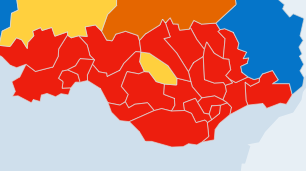
 Only truly proportional representation ensures no place for tactical voting. With 60 seats available, truly proportional representation would give a seat for even 1.7% of the vote achieved. Under FPTP, Labour won 27 of the 40 constituency seats – 67.5% of the seats for 35% of the votes cast. Even under Additional Member hybrid system, Labour still achieved 29 seats , or 48% of the total, that still significantly overstates the level of support they actually have.

 This means the battle to expose UKIP’s ideology and unsavoury under-belly has to be rejoined

 Of course, losing Leighton Andrews so spectacularly was a big blow. His Assembly career has been a bit chequered. His surplus places policies and school banding crap tarnished his time in charge of education – contributing nothing but anxiety and doing nothing to address Wales dismal performance in PISA comparisons. He oversaw
 Just a glance through

 Celtic Energy restore the site fully, as was a condition of their planning consents, in no small part because of Caerphilly-based Celtic Energy pulling that classic capitalist con trick of transferring ownership of the sites to a transferred ownership of the opencast sites to a British Virgin Islands registered subsidiaries, namely Oak Regeneration, Pine Regeneration, Beech Regeneration and Ash Regeneration, none of which appear to have the assets required for restoration. Five senior executives at Celtic Energy walked away with
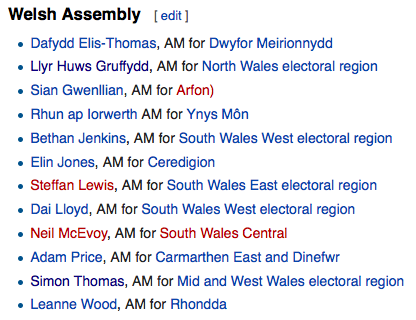
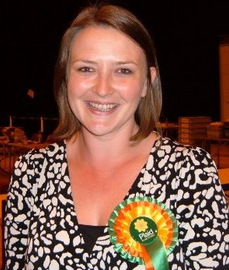 Plaid Cymru AM, Bethan Jenkins, has been at the forefront of attempts to raise this issue in the Senedd. Labour minister, Carl Sargeant has been just as evasive and ‘careful’ in his language over this issue as he has over fracking – i.e. uninspiring and untrustworthy. Carwyn Jones has had notably little to say – even though it impacts on his constituency.

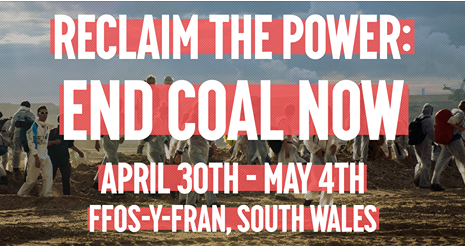
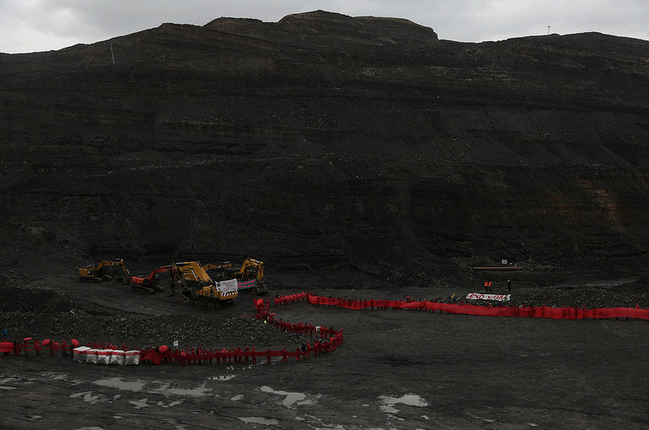
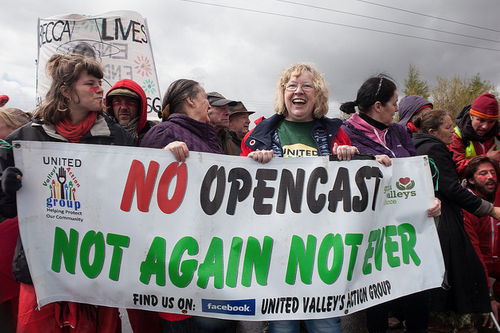 Ffos-y-Fran, near Merthyr Tydfil, was selected for the UK protest, as it is the UK’s biggest opencast site, one of the biggest in Europe. It’s pernicious effects on the local environment, local residents and their health has seen locals battling the company responsible, Miller Argent, every step of the way. Their
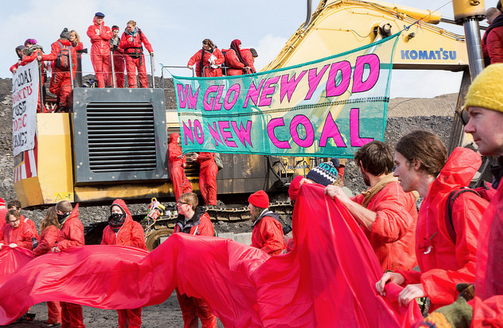 The mass trespass proceeded without any real opposition from the mine owners. Mining was suspended and both Police and private security just maintained a watching brief.
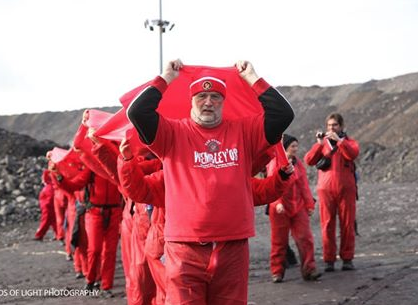 There was a bit of tension when the local chief inspector briefly attempted to address us and ‘lay the law’ down, but he was simply drowned out and ignored and he pretty much gave it up as a bad job. There was never a whiff of aggression from anybody and even though those more agile than me clambered all over the big machines, everyone was very careful to do no damage, and in fact, with conscious efforts to clear not just our own litter, but to clear flytipping and other rubbish from across the common, I am confident that the whole area will be left cleaner and tidier than when we arrived. Full marks, once again, to Reclaim The Power for actually having that as a stated objective.