Author Archives: Bridgend's Green Leftie

TTIP – why you need to know about, why you need to care about it and why you need to do something about it

I would urge you all to do three things:

  1. Screen Shot 2015-06-06 at 17.53.32Get a handle on why this is so important, and a serious threat too all of us, by reading (in about 10 mins) the report compiled by our Plaid Cymru MEP, Jill Evans >>, found HERE (although targeted at and referencing Wales, it applies to the whole UK)
  2. Voice your concerns to our MEPs using the tools provided by 38 Degrees below. It takes just one minute of your time. (For those in Wales, you can safely untick Jill’s name from the list of recipients – we should all be thankful she was returned last year!!!)
  3. Screen Shot 2015-06-06 at 18.09.31Wake up to the way the world works today by reading the very accessible, easy to understand guide by Noam Chomsky “How the World Works”. According to The New York Times, Noam Chomsky is “arguably the most important intellectual alive.” But he isn’t easy to read . . . or at least he wasn’t until this book came along. Made up of intensively edited speeches and interviews, they offer something not found anywhere else: pure Chomsky, with every dazzling idea and penetrating insight intact, delivered in clear, accessible, reader-friendly prose.

Jill’s introduction to the TTIP & Wales Report:

The Transatlantic Trade and Investment Partnership (TTIP) may soon have a major impact on Wales. TTIP is the bilateral trade agreement being negotiated between the EU and the USA. Not many people will have heard of it yet, but it could undermine the many high standards and good regulations that we have fought so hard for in the EU. This includes the fields of employment, food standards, the environment, public services, and many more. It could hand over greater power to global corporations at the expense of elected governments. The TTIP negotiations have been secretive and deliberately opaque. Considering the magnitude and scope of the agreement, it is unthinkable that it could be ratified without full democratic involvement and agreement. To date, the Welsh Government has not done a study of the potential effects of TTIP in Wales. This is badly needed and I will continue to call for it to be carried out. I welcome the fact that increasing numbers of people in Wales are getting actively involved in the campaign against TTIP and are making their voices heard. This report is a collection of the views of some organisations and individuals concerned about its implications. I very much thank the contributors for voicing their opinions which will help create the public debate we need.Screen Shot 2015-06-06 at 18.10.38

38 Degrees Logo
Caught red-handed: shady corporate lobbyists are spreading lies about TTIP. They’ve been emailing our MEPs, making false claims about widespread support for the dodgy trade deal. [1] Before MEPs start taking it seriously, let’s drown the lobbyists out.

It’s urgent – next week, all MEPs will take part in a series of votes about TTIP. They could have the chance to vote to scrap some of the most dangerous parts of the deal, like the bit that lets big businesses sue our government if they don’t like our laws. [2] Corporate lobbyists have been telling MEPs that their colleagues support this part of the deal – but in fact, many of them don’t.

Together, we need to make sure that in the final few days before the vote, MEPs inboxes are full of emails slamming TTIP. If thousands of us email our MEPs now, the lying lobbyist emails will soon be at the bottom of their email inbox, forgotten about.

So can you get in touch with your MEPs now to ask them to vote against TTIP next week?

Email your MEPs

It’s clear that corporate lobbyists are worried. They’ve run out of ‘credible’ arguments and now they’re just making things up to try and get MEPs to support TTIP.

But we’re the voters, and MEPs represent us. So we can focus on creating as much noise as possible about why TTIP is bad. When MEPs walk into the vote next week, they will know we’re backing them to vote against the worst parts of the deal.

The other side may have money, but we’ve got people-power. Will you email your MEP now, to ask them to vote against TTIP next week?

Email your MEPs

Thanks for being involved,

Bex, Amy, Blanche and the 38 Degrees team

PS: Great news – we were in the papers yesterday! Over 19,000 38 Degrees members chipped in and funded adverts to expose the MEPs who haven’t done enough to stop the worst parts of TTIP, the dodgy trade deal. [3] The adverts are now splashed across local newspapers in the areas where the politicians are elected. Click here to have a look at what they look like:
https://secure.38degrees.org.uk/were-in-the-papers

PPS: Next week’s vote isn’t the final vote on TTIP – the full text of the deal still hasn’t been published. However, It’s one of only a few chances MEPs will have to make recommendations that could change TTIP (or throw it out altogether). It’s not a legally binding vote, but what MEPs decide will send a strong message back to the European Commission about where we all stand on TTIP. If there’s enough opposition, especially to the worst parts of TTIP, it could damage the deal for good.

NOTES
[1] European Free Alliance: Distorted facts, blatant lies: business group’s big push to get ISDS through:
http://ttip2015.eu/blog-detail/blog/BUSINESSEUROPE%20ISDS.html
[2] MEPs will be voting on a resolution on TTIP in Strasbourg on June 10th, including ‘red lines’ they want to send to the TTIP negotiators. It’s one of only a few chances MEPs will have to make recommendations that could change TTIP (or throw it out altogether). It’s not a legally binding vote, but what MEPs decide will send a strong message back to the European Commission about where we all stand on TTIP. If there’s enough opposition, especially to the worst parts of TTIP, it could damage the deal for good:
Euractiv: What will Parliamentarians vote on TTIP?
http://www.euractiv.com/sections/trade-society/what-will-eu-parliamentarians-vote-ttip-313845
You can read more about the upcoming vote in this blog by War on Want’s John Hilary:
http://newint.org/blog/2015/05/26/ttip-vote-european-parliament/
[3] Euractiv: MEPs give passing vote to TTIP:
http://www.euractiv.com/sections/trade-society/meps-give-only-passing-vote-ttip-314959
You can read more about what happened in last week’s vote here:
https://home.38degrees.org.uk/2015/06/02/ttip-trade-committee-vote/

Pushing people beyond their limits

Chris Blackhurst is the former chief editor of the Independent . He has written a piece for the paper this week that I think goes to the very core of many of the problems in the neoliberal society we live in today.

He starts by recounting the cycle of bullying he endured at school, whereby the new intake are ‘initiated’ by the older boys, but go on to inflict the same thing on subsequent little kids when they become the big boys. Those that took it ‘on the chin’ would be considered to have passed through the initiation. Those that made a fuss (snivelling or snitching) would be targeted indefinitely. Personally, I was streetwise enough to know how it worked, but hated seeing the nastier bullies making the lives of the weak and meek a misery. I was fortunate enough to have additional tools in my armoury. I was big, strong and athletic. I took great pleasure in embarrassing the bullies to the fullest extent I could in any sporting activity. Some reacted badly to this, and on a couple occasions they started fights that I finished.

I guess this is was all the beginning of my socialist principles and lifelong tendency to stand up for the weak and the meek and to take on the bully boys. Not that I have always come out on top. I endured a couple of sound kickings in my formative years, and have succumbed in the fight a couple of times in my adult life, leading to a couple of meltdowns. Chris Blackhurst’s article stresses just how endemic the culture of relentless pressure has become. Pressure becomes stress. Stress becomes intolerable. The intolerable leads to calamity.

Blackhurst was prompted to write after the well-publicised cases of Army reservists being pushed beyond their limits on a hot day in the Brecon Beacons, and also the not-uncommon case of a Goldman Sachs banker being driven beyond his limits. In both cases we see needless deaths on the one hand and employers claiming they take their employees welfare seriously on the other. In both cases, there have been plenty of similar incidents both before and since. Talk to people within the organisations, however, and you soon get to the truth of the prevalent attitudes. You see, these things just happen. Some people simply aren’t cut out for the job. If the couldn’t stand the heat ……. etc.

It isn’t just the Army and the bankers of course. I expect that nearly all of us can relate to these attitudes in most of our workplaces to some extent. Increasingly so, no doubt in these ever-more austere times. I recognise it all too readily in the sector I work in. It is major reason why I have not been fit to work at all for the last 4 months. An ONS report states that 15.2 million working days a year were lost to stress or depression in Great Britain last year. That is 10 times the number lost to migraines and headaches. Research also suggests that this is little more than the tip of an iceberg as 71% of people surveyed report that they would worry about telling an employer if they had a mental health condition, for fear of getting a negative response.

I have not shrunk away from being upfront with my employer about it. They are very good at presenting a caring front. They put out regular ‘health and well-being’ emails and this has included ones about mental health with some ‘Top Tips’. Job done as far as their ‘Investors in People’ tick box sheet is concerned. When I offered information during ‘Mental Health Week’ about the mindfulness programme I had undertaken, my email was not even acknowledged. Now that I am trying to engage with them about a phased return to work, I am getting no response at all. While I have been off work (a period following a clumsily handled forced redundancy process) I have received reports of colleagues that survived the cut being pressured my completely unrealistic, un-negotiated targets for roles they were not even initially employed to do. Several have apparently quit, others have been told ‘perform or you will be sacked’.

Many in my position would probably have felt the financial pressure (just 2 weeks on full pay and two weeks on half pay in a rolling year) to return to work too soon, with potentially dire consequences to their well-being. I am nervous about what I am returning to. With genuinely caring and sympathetic employers I could possibly have been back in work by now (although had that been the case, I may have avoided my meltdown completely).

The thing that bothers me most about these situations is that so many managers in these organisations are so ready to serve these corporate ‘do or be damned’ mentalities. They are just like the basically decent kids that feel it is just the way of the world that they mete out the bullying. It is the only way they can avoid the bullying from above them. And so it goes on. Who is going to say ‘stop’? Who is going to realise that it’s not always acceptable to do to others as was done to us.

Screen Shot 2015-06-05 at 11.19.07Despite their emasculation since Thatcher’s time, trade unions still represent the best protection we have from workplace bullying. Find the best one for you here:  UNION FINDER

Lord Browne – a leopard changing its spots?

There was some very encouraging news in the battle to prevent critical climate change in the Independent / i newspapers yesterday.

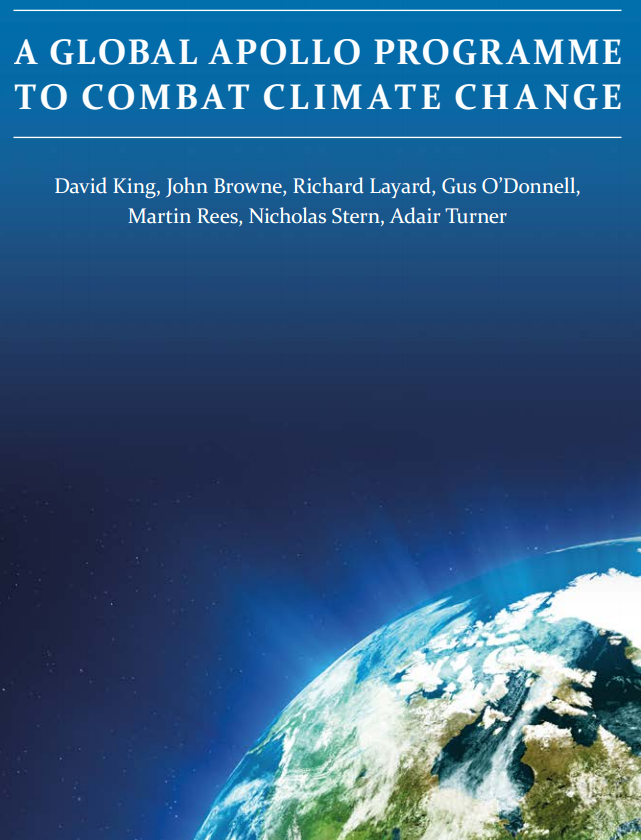
“Scientists and economists have joined forces to launch a global research initiative to make green energy cheaper than coal within 10 years, a target they believe is critical to avoid dangerous climate change. They have compared the goal to the Apollo programme of the 1960s when the United States stated that it would put a man on the Moon by the end of the decade.

Leading academics, including former government chief scientist Sir David King, past president of the Royal Society Lord Rees, and economists Lord Stern and Lord Layard, in effect said that the world cannot be saved from global warming unless coal – the dirtiest fossil fuel – is put out of business.

Screen Shot 2015-06-03 at 13.21.38They have called the plan the Global Apollo Programme and hope to recruit countries from around the world in an international commitment to boost research and development into key areas of renewable energy, storage and electricity transmission.”

Full story 

However, my innate cynicism kicked when I spotted our old ‘friend’ Lord Browne amongst the seven authors of the report. This man has a oil and gas coursing through his veins:

  • Screen Shot 2015-06-03 at 13.23.06Joined BP as an apprentice in 1966 while still at university.
  • Rises through the ranks to become BP’s chief executive between 1995 and 2007.
  • Responsible for the ruthless programme of cost-cutting at BP that is widely acknowledged to have compromised safety, leading to a string of major accidents, most notably the Deepwater Horizon catastrophe in 2010.
  • Chairman of notorious frackers, Cuadrilla Resources, since the inception of the company in 2007.
  • Managing Director and a Managing Partner of Riverstone Holdings, that includes Riverstone Energy – a Guernsey-domiciled (tax dodging?), closed-ended company planning to invest in energy companies and assets worldwide, focusing on exploration and production of oil and gas.
  • Resigns his Riverstone Energy directorship in April 2015 just weeks after agreeing to become executive chairman of L1 Energy, a $10bn venture established by Mikhail Fridman and German Khan, two of the Russian billionaire businessmen with whom BP went into partnership while Lord Browne ran Britain’s second-biggest oil company.

As reported by Sky News,  Lord Browne’s reshuffling of his business portfolio comes as capital-rich global investors target an array of opportunities thrown up by the slump in oil prices.

Since Riverstone Energy listed in London, raising hundreds of millions of pounds, it has bought stakes in nearly a dozen businesses, including the Calgary-based Canadian International Oil Corporation, Castex Energy, which explores for oil in the Gulf of Mexico, and Sierra Oil and Gas, which is focused on Mexico.

Lord Browne’s connections across the international energy sector are designed to assist L1 Energy at a time of acute political sensitivity, highlighted when the UK Government indicated in February its intention to block the fund’s purchase of a number of North Sea gas fields. Watch this change now.

In addition to his role at the listed Riverstone vehicle and its private equity firm, Lord Browne has also relinquished the chairmanship of Cuadrilla Resources, the privately-owned fracking company which has faced opposition to its efforts to extract gas in parts of the UK.

He recently stepped down as the Government’s lead non-executive director, a post that involved co-ordinating the appointment of dozens of private sector figures to the boards of Whitehall departments.

So, all of a sudden, we are expected to believe that this man is hoping to save us from climate catastrophe. I think not.

The not-very-well-hidden agenda in this Global Apollo Programme (GAP) is the explicit aim of putting COAL out of business. The academics involved rightly point out that coal is in many ways the dirtiest and nastiest fossil fuel, and there are sections looking to boost research and development into key areas of renewable energy, storage and electricity transmission. But what, if any, of this is exciting Lord Browne?

Although not explicitly mentioned in the GAP report, what I suspect and predict Lord Browne to jump up and down about is the evil that is coal. This will lead to him trying to re-incarnate the corpse of the “bridge fuel” fallacy (neatly summed up here ), to the clear and obvious benefit of his oil, and more specifically, gas fracking interests.

So what of the other authors of the GAP report?

  • Sir David King – Blair’s Chief Government Scientist, consistently strong on climate change, but pro-nuclear power.
  • Lord Stern – economist who pointedly said: “Climate change is the result of the greatest market failure the world has seen”.
  • Lord O’Donnell – Cabinet Secretary for Blair, Brown and Cameron. No obvious credentials for being involved at all.
  • Lord Rees – Astronomer Royal and notable astrophysicist. Has an interest in the interface between science, ethics and politics.
  • Lord Turner – Chair of the FSA presiding over the near-total collapse of several major banks and chair of the ineffectual Committee on Climate Change
  • Lord Layard – old Etonian Blairite whose ideas informed New Labour concepts like ‘welfare-to-work’ (he’s a Labour life peer). Has Russian connections.

So what should we make of the Global Apollo Programme?

Read it. It is good stuff, but nothing new and little more than a good ‘A’ level geography project based on existing published resources that we have been using for years.

That it is written by a bunch of establishment cronies can be taken at least two ways. Firstly, it could be taken as a positive sign that the establishment is finally prepared to take the whole issue seriously at last. I might be prepared to accept that had Lord Browne not been involved. Personally, I think the whole thing is going to be used as a way of softening the public up to the onslaught of fracked gas as a purported ‘bridge fuel’. Some of the signatories may not have that as their primary intention – but I, for one, see no reason to suspect that Lord Browne is anything but the dirty fracker he has always been.

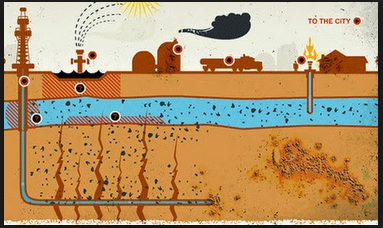
Fracking and related activity planning applications live in Wales at the moment

Screen Shot 2015-06-01 at 23.23.25

Remember that UK Methane and Coastal Oil & Gas are both Gerwyn Williams companies. He is scratching around trying to fund some drilling activity so he doesn’t have his licences taken off him. Re the Bridgend sites, Cwmcedfyw has seen test drilling for CBM done and dusted. It is not a major concern. Similarly, Ffaldau has been generating electricity on a small scale from CBM extraction without fracking and is not a significant concern. St John’s Colliery saw drilling aborted sometime ago and is unlikely to be revisited anytime soon. This leaves Merthyr Mawr as the focus of attention in the Bridgend area at present. Gerwyn has just recently applied for an Environmental permit for this site – and two other in South Wales, namely Five Mile Lane, and Llandow ). These are clearly top of his initial hit list. Watch this space.

What does FRACKING stand for? (a poem)

Forever gone when it’s gone, as it’s non-renewable                                                                       Forever sorry once it goes wrong, as it’s utterly un-doable

Regrets from believing those that lied
Regrets for the list of the harmed that have died

Screen Shot 2015-06-01 at 17.07.04

Anger at the blatant disregard for humanity
Anger that profit’s seen as god, instead of a profanity

Screen Shot 2015-06-01 at 17.12.37

Corruption in government, selling us out for a buck
to Corrupt multinationals that don’t give a fuck

Knowledge that calamity is a lottery we can’t win
Knowledge ignored by our ‘leaders’ to the cost of our kin

Screen Shot 2015-06-01 at 17.22.07

Irreversible consequences of our actions and inactions today
Irreversible contempt from the future generations that will pay

No way can we stand by at this historical intersection
when No mandate was given at the recent election

Screen Shot 2015-06-01 at 17.35.11

Galvanise resistance to the capitalist 1% band
Galvanise for the fight to protect our precious land

Screen Shot 2015-06-01 at 17.48.53

(AC)

Here we go! Tory savagery unleashed

Here we go! While traders at banks that illegally fixed markets to the tune of £billions are allowed to laugh in the face of the law, illegal workers in care homes, factories and farms etc. face having their pitiful wages confiscated.

Illegal workers fall into various categories:

  • entered the UK without authority
  • entered with false documents
  • overstayed their visas
  • worked while on a tourist visa
  • entered into a forced or fraudulent marriage

I have met and got know people in most of these categories, and especially the third category, in which they come to work in places such as the care homes I visit in the course of my own job. Their stories are usually full of courage and tragedy. I would not swap lives with any of them. I would swap Cameron’s life with all of them!

Cameron’s approach is so crudely thought through that it is virtually unworkable – which is the the closest I can get to saying anything positive about it. Most of the people it is targeting are, or soon will be if not already, living in the shadows.

I have worked with people whose working visas have expired. They have been working in the car sector tending to our frail senior citizens, dealing daily with severe dementia and incontinence, for less than the minimum wage, on zero hours contracts (if contracted at all), with working days well in excess of 12 hours. They generally cannot afford to rent more than a room, with that sometimes shared, and generally look to spend as little of their meagre income as possible so that they can send it home to relatives in even worse circumstances than themselves, often including their children that they have left out of desperation to try and find a way of supporting them. This can mean that when their visas run out, they generally have not got the means to even finance a return home. For some a return home is a return to a living nightmare of oppression, persecution and destitution. In these circumstances, choosing to disappear, to fade into the shadows, is their only realistic option.

THere is no way of knowing how many people are driven to this form of existence. Sky News ran a story that gives more of an insight:

No one can be sure exactly how many people live life in the shadows. 

We visited a Hindu temple which offers support to the local community – with a rising backlog of unresolved asylum cases many have struggled with immigration issues. Last year there was a 34% national increase in the number of people whose applications have not yet been dealt with. It prompted claims the delay is driving people underground. One man told us he thought the Home Office was trying to give the impression to people not to come to Britain by making the processing of applying for asylum drawn out. He said: “After being here for 10 or 12 to 15 years, if you ask them to go back to a place where they don’t want to go, I don’t think it is easy for them to do it.  And once that happens I know people will attempt to go underground.”

But among the congregation was a 52-year-old woman who says her plight has driven her to contemplate suicide. Bavani Amrithalingam came to Britain from Sri Lanka in 2010 – she says to avoid persecution. When all of her appeals to stay were exhausted she too simply disappeared from the authorities. With no home or job she relies on temples and the generosity of others for food. She says she left her children behind to try to make a life for them in Britain but this is not how she dreamt it would be. Unable to get a proper job, Bavani cooks and cleans for people she knows within the Tamil community – in return sleeping at their houses.

She said: “When I came here I never thought it was going to be like this. But I wanted to save my life. That was the reason I came here. I thought this country would protect me. I thought that Britain would grant me refugee status so that I could bring my children here to live in this country.”

Bavani is a former Tamil activist. Despite the trauma of being separated from her children she believes if she returned to Sri Lanka her life – and theirs – would be in danger.  Yet she lives in limbo because the UK authorities have told her she must leave – but have failed to do anything about it. 

“Every day I wake up and I am upset. I get depressed,” she said. “I’m having an extremely difficult life. I have no one to help me. I go to some people’s houses and do some odd jobs. I get some food, but no money at all. Like a beggar I ask people to give me five or ten pounds. I use that money for travel. I never had a life like this. I have so many problems. I’m doing any kind of odd jobs just to survive, to feed myself.  I can’t afford to send anything to my children. I have nothing, I don’t know what to do and sometimes I feel like killing myself rather than living in this country. I think about my children all of the time. Only a mother would understand this feeling. When I think about my children I don’t know what to do because I can’t get a visa to stay here. If I could get a visa then I could live with them and have some peace of mind. I have nothing like that.”

The Reverend Canon Giles Fraser, of St Mary’s in Newington, says Bavani’s desperation is not uncommon among those trying to resolve their status. He is used to dealing with migration issues amongst his south London congregation but says there is no political will to tackle the problems of those who are trapped in the system. He said: “What politician is going to want to put money into improving immigration services? No politician in our election is saying we should just make our immigration system more efficient or better, no one’s saying that. Most people are saying push them all out – it’s a very convenient form of scapegoating. Actually what’s happening is there’s loads of people here who are going to the sort of brutal faceless soulless places, dealing with the bureaucracy they don’t understand, that has no sympathy to them – it doesn’t listen to them.”

It’s difficult to know exactly how many illegal immigrants are in Britain. In 2009 the London School of Economics estimated the figure was between 417,000 and 863,000. There’s been no major study since.  

Immigration solicitor Fozia Iqbal said: “I don’t think there’s ever a full admission of how badly the system works and I think that’s the main problem. “There are people here who are perhaps not here legally and don’t have a lawful right to be here, but then they are not being removed, but then they develop rights here.”

THEY DEVELOP RIGHTS HERE!! I don’t know who told him that, and if he he is right, it won’t so much longer if Cameron and his fascist scumbag mates have anything to do about it.

Ironically, the most effective backlash to this pogrom is likely to come from Cameron’s business chums. They revel in a plentiful supply of cheap, low-skilled labour. It keeps costs down and profits up for God’s sake!! It is not as if it is costing British jobs as the Tories are constantly reminding us that unemployment is falling (thanks to zero-hours contracts and driving down of wages), so from the business point of view, if it is working for them, stop meddling David!

So given this state of affairs, the only reason for this campaign is the ideological war on the poor that is part of the Tory genetic make-up.

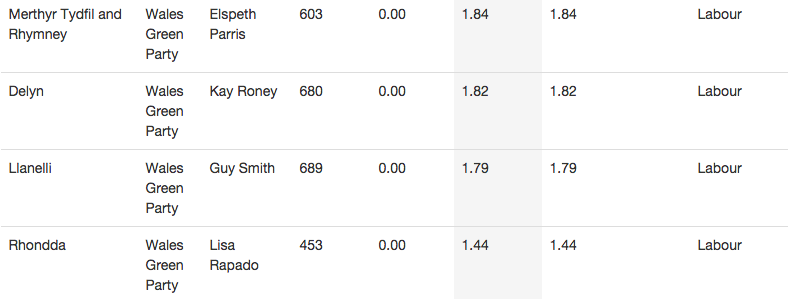
Wales Green Party General election results 2015

Wales Green Party General Election results, ranked by vote share:

Screen Shot 2015-05-20 at 15.36.20Screen Shot 2015-05-20 at 15.38.09Screen Shot 2015-05-20 at 15.38.42Screen Shot 2015-05-20 at 15.39.05

Note: Constituencies not listed did not have a Green candidate.

Five ways to well-being

I am coming towards the end of my 6 week Open University ‘Futurelearn’ Psychology course and the the conclusions it comes to are essentially that our mental well-being, while influenced by ‘nature’ and ‘nurture’ factors, is primarily down to the interface between the two – how we respond to life-events. The good news in this is that we can learn to respond differently, and taken proactive steps to help facilitate better responses. These are listed below. They are not rocket science and I am sure most will recognise the positive benefits of this advice. All it really takes is a conscious effort to take the advice and act on it.

Source : Report by the Centre for Well-being, NEF (New Economics Foundation)

38 degrees – people power worth supporting

Rather than remain involved in the murky world of party politics, the more I find out about 38 degrees and the people behind it, the more I like it.

38 Degrees is an independent British not-for-profit political-activism organisation that campaigns on a wide range of issues. It describes itself as “progressive” and claims to “campaign for fairness, defend rights, promote peace, preserve the planet and deepen democracy in the UK”. In October 2013, it was reported to claim 1.9 million UK members.
38 Degrees takes its name from the critical angle at which the incidence of a human-triggered avalanche is greatest.

The organisation launched on 26 May 2009. Its founders included Gordon Roddick, co-founder of The Body Shop and Henry Tinsley, ex-chairman of Green & Black’s fair trade chocolate. The organisation launched during the United Kingdom parliamentary expenses scandal, and this formed the backdrop to early campaigns demanding voters were given more powers to sack MPs.
The founding Executive Director was David Babbs. Babbs was formerly Head of Activism at Friends of the Earth where he was responsible for the Big Ask Campaign. Babbs also previously worked at People & Planet.
At launch 38 Degrees said it was inspired by groups like MoveOn in the United States, GetUp! in Australia and Avaaz globally. These organisations all use the internet to mobilise people and connect them and their governments. 38 Degrees said that an organisation based on a similar model was needed in the UK.
In February 2014, Total Politics wrote: “For an organisation only set up in 2009, 38 Degrees has notched up its fair share of victories. It forced the coalition government’s first big U-turn, on the forests sell-off. It called for more free school meals – and Nick Clegg duly announced they were being rolled out for all infants. It raised enough cash to pay for the judicial review which successfully challenged health secretary Jeremy Hunt’s plans to shut down key services at Lewisham hospital.”
It is not perfect and has its critics, but most of those are the predictable ones from the far right of the Conservative Party that I, for one, have no respect for at all. Their criticism is as sure a sign that they are on the right tracks and having an impact as you could possibly have.
Watch this video, and whether or not you are involved in a political party, consider supporting 38 degrees as force for good.

The Green Party – progress of a sort, but nowhere near enough

One thing the Green Party is getting good at is spin. Of course it is possible to draw out some positive statistics from this weeks elections:

  • Membership at an all-time high
  • More candidates than ever before
  • More deposits saved than ever before
  • Increased share of the vote
  • Councillor gains in local authority elections
  • 4 second places in general election

The reality behind all these claims is a bit more sobering however.

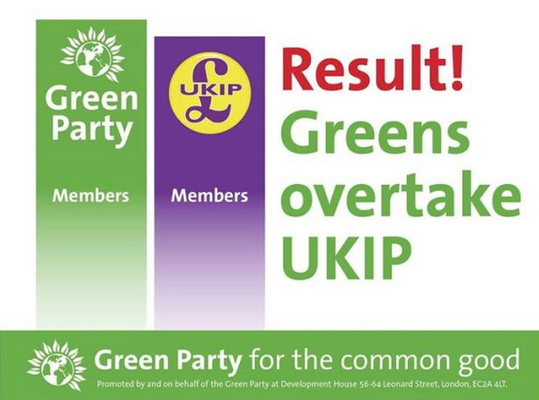
Screen Shot 2015-05-11 at 21.09.56We heard a lot about our membership surging to become bigger than the Lib Dems and UKIP. In numbers that really count however we are still miles behind them both.
In terms of General Election:

  • Lib Dems 8 MPs still, with 2.42 million votes (vote share down 15.2% to 7.9%)
  • UKIP 1 MP, but 120 second places and 3.89 million votes (vote share up 9.5% to 12.6%)
  • Greens 1 MP, with 4 second places and 1.16 million votes (vote share up 1.8% to 3.8% )

In terms of the local council elections held in 279 councils on the same day:

  • Lib Dems 603 councillors (down 365), 4 councils controlled (down 4)
  • UKIP 195 councillors (up 171), 1 council controlled (up 1)
  • Greens 84 councillors (up 9), 0 councils controlled (losing the minority administration in Brighton as the party slipped form 1st to 3rd)

‘More candidates than ever before’ was a given with the huge rise in membership. What is more questionable was the policy of standing in as many seats as possible, even where there was absolutely no prospect of saving the deposit, and even when it was potentially obstructive to an anti-austerity candidate from another party. I’ll save the subjective arguments about that for now, but deal with some cold facts.

Yes, the party saved 123 deposits across England and Wales, compared to just 6 in 2010, but the other side of this coin is that the Party lost 442 deposits this time around (I think it was less than 100 last time). This translates to a whopping £221,000 blown on lost deposits – far more than ANY other party:

LOST DEPOSITS:

  1. Green Party £221,000
  2. Lib Dems £170,500
  3. TUSC £ 66,000
  4. UKIP £ 39,500
  5. Tories £ 5,500
  6. Labour £ 1,500

Value for money? You be the judge.

This has to be seen in the context of unprecedented exposure in the TV debates and much wider media coverage. The Party and Natalie Bennett clearly were not fully prepared for this and equally clearly failed to make the most of it.

As for Wales, over and above the national coverage, the Greens had the additional bonus of two Wales Leaders debates on TV and the advantage of a leader that had built her successful defence of her position on being a strong media performer in an age where media is all important, or so she claimed. The result:

  • 38, 000 votes for 35 candidates at an average of 1,100 votes each, or 2.6% (less than Greens UK average of 1980 votes and 3.8%)
  • 32 deposits lost (over 90% of them, compared to less than 80% lost nationally)
  • Lost deposits of £16,000 (around 800 average membership fees)
  • Bartolotti’s personal performance, given all the exposure she had, was 1,300 votes at 3.2% of the vote in Newport West

Looking at the three deposits saved offers some insight and pointers to the way forward, should they wish to learn anything.

CARDIFF CENTRAL 6.2% (5th place)
Screen Shot 2015-05-11 at 21.28.52This seat was the focus of all the effort to get Jake Griffiths elected as an AM 4 years ago, effort that was largely squandered afterwards. It is also the seat that, independent studies of Green Party support demographics suggest, should be the best prospect for the Greens, not just in Wales, but the whole of the UK. In other words, if we could not save a deposit here then we really should give up! Having said this, given the turmoil and churn in the local party in recent times, I am not sure many actually expected the best result to be here.

SWANSEA WEST 5.1% (6th place)
Screen Shot 2015-05-11 at 21.31.26This was the the area in which Ashley Wakeling put in such a huge effort in the Uplands by-election last year. His relative success here has therefore been earned by the good old time-honoured methods of knocking doors and having a profile in the community. With another 10 years of such effort he could earn the right to get close. But he won’t do that. He is a student who is unlikely to make a long-term commitment to staying in Swansea. The impetuosity of youth was also shown the the night of the by-election last year when he expressed the view that his (perfectly creditable performance) was unsatisfactory and indicative that he should look for another ward that he could storm more successfully. It just doesn’t work like that!

CEREDIGION 5.6% (6th and last place)
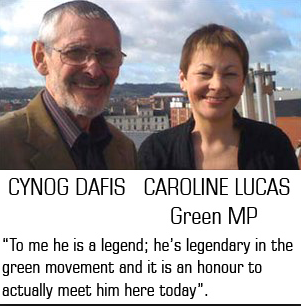
Screen Shot 2015-05-11 at 21.33.01I mention the ‘last place’ because it was significant that there were only 6 candidates, unlike the two above that had to contend with 8 and 9 respectively (there were 10 in Bridgend!). This makes it all the easier to secure the magic 5% figure. Beyond this, it is also the seat with the longest history of meaningful Green activism and electoral activity. Indeed, the very first Green Party MP was elected here in 1992 – Cynog Dafis was elected on a joint Green Party/Plaid Cymru ticket. Chris Simpson put up his own deposit there in the 2011 Welsh assembly Election and got it back with 5.2% of the votes. Again, if they were not going to get it back here, given all the conducive circumstances, they would have to be doing something seriously wrong.

There is, of course, another dimension to the Ceredigion story. It is the seat that I have courted controversy over by urging the Greens to stand aside, in order to help the ecosocialst Plaid Cymru candidate to take the seat from the neoliberal Lib Dem incumbent. As it turned out, it would not have made the crucial difference that it might. Mike Parker needed another 3000 votes and the Greens only had 2000 votes. What proved critical here was the astonishingly strong local support for ‘Mark Williams, the man’, rather ‘Mark Williams, the Lib Dem’. Given the fortunes of Lib Dems more widely, he deserves respect for this achievement. Well done him!

This is not to say that I was wrong in the principle of what I was asking for. I continue to believe that a strong, united anti-austerity voice is needed if we are to ever defeat the establishment parties. Wales Green Party stand steadfastly against this and continues to bask in the shimmer of superficial success.

I have long maintained that political success has to be built from the ground upwards. Greens cannot breakthrough in big elections until they do it in local elections first. What hope is there of that in 2017 with the current approach of the Wales Leadership? I predict another attempt to run before they can walk next year at the Welsh Assembly Elections. Pippa will be spouting off about expecting at least 3 assembly seats before you know it. They will fall flat on their faces again, and further jeopardise the prospects of breakthroughs in 2017. Every effort and every resource should have been focussed on active party target wards for the last three years, rather than blown on vanity projects. With two years to go, no properly focussed ‘Target-to-Win’ work is going on anywhere in Wales to my knowledge.

Former WGP leader Martyn Shrewsbury has crawled out from under his stone hoping no-one will remember his fraud conviction and charlatan hypnotherapy practices.

Former WGP leader Martyn Shrewsbury has crawled out from under his stone hoping no-one will remember his fraud conviction and charlatan hypnotherapy practices. He is also a vicious internet troll who hides behind a range of names and persona.

In the circumstances, working with, rather than against potential allies has become more important than ever. But it is a call that continues to largely fall on deaf ears in Wales Green Party. There are several dangerously big egos blocking Wales Green Party doing the right things. Until the (new, naive) membership wake up to how politics actually works and signs up to the years of slog involved, and wakes up to the need for true progressives to work together across party divides , as advocated by Caroline Lucas this week, no real progress will be possible.

Screen Shot 2015-05-11 at 21.42.12

On this basis, I am finally at a point of reaching out to Plaid Cymru and seriously considering joining them for the first time. I have lost patience with the strategic naivety of the Greens at all levels. There are serious issues within PC too, but I sense a greater willingness to address them. Their General Election was more a story of disaster averted (they were predicted to lose 2 of their 3 seats at one point) than meaningful progress made. They kept their 3 seats and kept their vote share. They lost only 8 deposits (£4,000) from all 40 contested. More encouraging is good progress in numerous areas, with a clutch of second places and stronger showings in some areas outside the traditional heartlands. They are in a good position to make good advances next year if (a big if) they can get the messaging right.

Life is a continuous learning curve. Those that learn quickest steal the advantages. The SNP showed this ability in adjusting its messaging post independence referendum. Therein lay the basis of their stupendous success. Let us see who learns quickest in Wales.