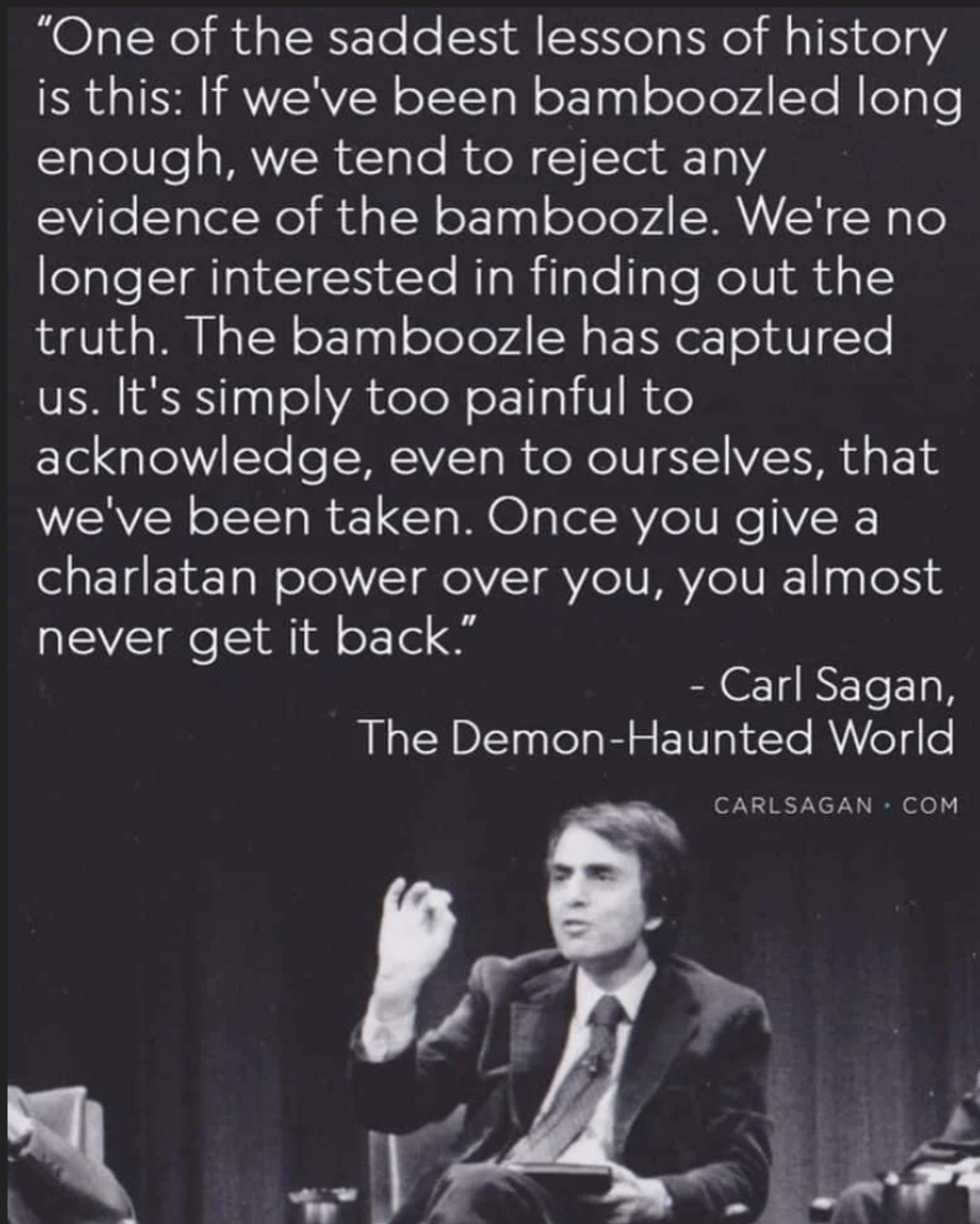
Carl Sagan, in The Demon-Haunted World, presents a set of tools for sceptical thinking that he calls the “baloney detection kit”. Sceptical thinking consists both of constructing a reasoned argument and recognizing a fallacious or fraudulent one. In order to identify a fallacious argument, Sagan suggests employing such tools as independent confirmation of facts, debate, development of different hypotheses, quantification, the use of Occam’s razor, and the possibility of falsification. Sagan’s “baloney detection kit” also provides tools for detecting “the most common fallacies of logic and rhetoric”, such as argument from authority and statistics of small numbers. Through these tools, Sagan argues the benefits of a critical mind and the self-correcting nature of science can take place.

Sagan provides nine tools as the first part of this kit.
- There must be independent confirmation of the facts given when possible.
- Encourage debate on the evidence from all points of view.
- Realize that an argument from authority is not always reliable. Sagan supports this by telling us that “authorities” have made mistakes in the past and they will again in the future.
- Consider more than one hypothesis. Sagan adds to this by telling us that we must think of the argument from all angles and think all the ways it can be explained or disproved. The hypothesis that then still hasn’t been disproved has a much higher chance of being correct.
- Try to avoid clinging obdurately to your own hypothesis and so become biased. Sagan tells us to compare our own hypothesis with others to see if we can find reasons to reject our own hypothesis.
- Quantify. Sagan tells us that if whatever we are trying to explain has numerical value or quantitative data related to it, then we’ll be much more able to compete against other hypotheses.
- If there is a chain of argument, every link in that chain must be correct.
- The use of Occam’s razor, which says to choose the hypothesis that is simpler and requires the fewest assumptions.
- Ask if a given hypothesis can be falsified. Sagan tells us that if a hypothesis cannot be tested or falsified then it is not worth considering.
Sagan suggests that with the use of this “baloney detection kit” it is easier to critically think and find the truth
Logical fallacies
There is a second part to the kit. This consists of twenty logical fallacies that one must not commit when offering up a new claim.
- Ad hominem. An arguer attacks the opposing arguer and not the actual argument.
- Argument from authority. Someone expects another to immediately believe that a person of authority or higher knowledge is correct.
- Argument from adverse consequences. Someone says that something must be done a certain way or else there will be adverse consequences.
- Appeal to ignorance. One argues a claim in that whatever has not been proved false must be true, and vice versa.
- Special pleading. An arguer responds to a deeply complex or rhetorical question or statement by, usually, saying “oh you don’t understand how so and so works.”
- Begging the question. An arguer assumes the answer and makes a claim such as, this happened because of that, or, this needs to happen in order for that to happen.
- Observational selection. Someone talks about how great something is by explaining all of the positive aspects of it while purposely not mentioning any of the negative aspects.
- Statistics of small numbers. Someone argues something by giving the statistics in small numbers, which isn’t very reliable.
- Misunderstanding of the nature of statistics. Someone misinterprets statistics given to them.
- Fallacy of inconsistency. An arguer is very inconsistent in their claims.
- Non sequitur. This is Latin for “it doesn’t follow”. A claim is made that doesn’t make much sense, such as “Our nation will prevail because God is great.”
- Post hoc ergo propter hoc. Latin for “it happened after, so it was caused by”. An arguer claims that something happened because of a past event when really it probably didn’t.
- Meaningless question. Someone asks a question that has no real meaning or doesn’t add to the argument at all.
- The excluded middle. An arguer only considers or mentions the two opposite extremes of the conversation and excludes the aspects in between the two extremes.
- Short-term vs. long-term. A subset of the excluded middle, but so important it was pulled it out for special attention.
- Slippery slope, related to excluded middle (e.g., If we allow abortion in the first weeks of pregnancy, it will be impossible to prevent the killing of a full-term infant. Or, conversely: If the state prohibits…).
- Confusion of correlation and causation. The latter causes the former.
- Straw man. Caricaturing a position to make it easier to attack. This is also a short-term/long-term fallacy.
- Suppressed evidence, or half-truth.
- Weasel word. Talleyrand said: “An important art of politicians is to find new names for institutions which under old names have become odious to the public.”
Sagan provides a skeptical analysis of several examples of what he refers to as superstition, fraud, and pseudoscience such as witches, UFOs, ESP, faith healing and organised religion.
An alternative to The Demon-Haunted World is the equally accessible Nonsense on Stilts: How to Tell Science from Bunk, by Massimo Pigliucci (2008). One reviewer sums it it up well:
“No one—not the public intellectuals in the culture wars between defenders and detractors of science nor the believers of pseudoscience themselves—is spared Pigliucci’s incisive analysis. In the end, Nonsense on Stilts is a timely reminder of the need to maintain a line between expertise and assumption. Broad in scope and implication, it is also ultimately a captivating guide for the intelligent citizen who wishes to make up her own mind while navigating the perilous debates that will affect the future of our planet.”
Reading and absorbing these two books is possibly the best bit of education you can deliver to yourself. It is sad, but no accident methinks, that every child leaving school is not imbued with this understanding.
 Bridgend's Green Leftie