
As an Englishman, by accident of birth, it often causes raised eyebrows, at the very least, when people find out just how committed I have become to the cause of independence for Wales.
 This is in no small part because I have long been a vociferous critic of nationalism. I devoted a small chapter of my 2011 book, The Asylum of the Universe, to this perspective, at a time when I was still far from convinced of the case for Welsh independence. I have to admit that this was an intellectual stumbling block to me getting my head around an unambiguous position in favour of independence.
NO to NATIONALISM

Leanne Wood’s ecosocialist manifesto, 2011.
In my time with the Green Party, and as an ecosocialist, I found myself having large amounts in common with fellow ecosocialists within Plaid Cymru, most notably its leader at the time, Leanne Wood. She and others all took considerable trouble to try and differentiate their form of cuddly ‘civic nationalism’ from the far more distasteful ‘ethnic nationalism’. This was kinda comforting, but doesn’t actually bear too close scrutiny. Only the other day, one of my Yes Cymru colleagues was jesting that I was ok for an Englishman as I have lived here long enough to have drunk enough Welsh water!

Nicked from a school ppt.
For a full exposition of why civic and ethnic nationalisms are false opposites, and actually little more than different conceptions of one ideology and movement, I would encourage the reading of this dissertation, False Opposites in Nationalism: An Examination of the Dichotomy of Civic Nationalism and Ethnic Nationalism in Modern Europe. From its conclusions:
“What these two different conceptions do however provide is different subjective or “ideological bonds” for their members, that provides the glue by which a community of people regard themselves as belonging and sharing a feeling of kinship, solidarity and unity. Citizenship is the key to the bonds within civic nationalisms, and ethnicity within ethnic nationalisms; the cement of civic nationalisms are legal codes and institutions, but within ethnic nationalisms it is customs, myths and symbols.”
The common denominator of the two is the apparatus used to support the ideology. Louis Althusser (French Marxist philosopher who, admittedly, ended up insane) recognised two key categories of this apparatus. On the one hand, we have the “repressive state apparatuses” of the the armed forces and police, which will use coercion where necessary to maintain order and/or repress opposition to the political establishment. And on the other hand, we have the “ideological state apparatuses” of the education system, media, churches and the like, which disseminate ideologies acceptable to the political establishment. Through these apparatuses you are identified as either a member, and incorporated, or an outsider, and ostracised. If you want ‘in’ but don’t share the ideology, Blaise Pascal offered this advice way back in the 16th century:
“Kneel down, move your lips in prayer, and you will believe”
Whatever the prevailing balance between the expressions of civic and ethnic nationalism, not to mention all the other variants that I have no inclination to explore here, as they all are elements of the same whole, there can be little denying the role of the collective identities of nation and ethnicity in the worst episodes of history.
This is explored by Etienne Balibar ( a student of Althusser) in his influential 1988 essay, The Nation Form: History and Ideology. (Outlined here) He illuminates the common assertion that ethnic and/or cultural homogeneity is not only desirable but a necessary basis for a democratic and harmonious society, with his own concept of “fictive ethnicity”. He argues that:
“No nation possesses an ethnic base naturally, but as social formations are nationalised, the populations included within them, divided up among them or dominated by them, are ethnicised.”
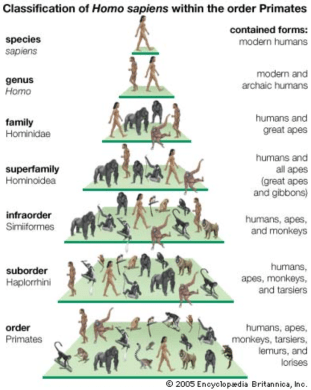 This is basic anthropology and ancient history. There were once no nations and no borders. Indeed there were once no people, and apart from the points of origin of our species (why stop there? Genus? Family? etc.), well, the point is that who belongs where is ALWAYS subjective and distorted by assertions of the significance of who actually was where at some arbitrary point in history. ‘Fictive ethnicity’ is therefore the idea that all the people who seek to ‘belong’ to the ‘nation’ are required to share certain characteristics, be they biological or cultural. This can be used to assert the distinctiveness of people at different scales: Coity v Wildmill, valleys v the vale, SE Wales v SW Wales, South Wales v North Wales, Wales v England, Britain v Ireland, UK v Europe, Europe v Asia, white people v the rest of the world.
Not all these scales will seem relevant to concepts of nationhood, but they can be. We see supposed ‘nations’ at everything from city state to United States. There are no problems in applying civic nationalism concepts at all these scales. Ethnic nationalists will have greater issues with this notion of nationhood. This can be, and often is, the starting point for fascism.
It is a surely a matter of personal choice whether I choose to identify as a Welsh, English, Polish, British or European. Most people would probably concede this. I have lived in Wales for nearly 30 years, was born and bred in England of an English mother and Polish father, who himself had some German ancestry. This would seem to give me some entitlement to that range of identities.
 Strangely though, people start to have issues if I try to claim more than one and I would probably struggle to get away with claiming to be Icelandic, which would be my first choice, or Jamaican, for example, which also has some appeal. Ok, I may be getting a little facile, but my point is a serious one. Does ’national identity’ matter? Should it matter? And why?
I also agree with Balibar in asserting that nationalism, with its systems of inclusions and exclusions, can never fully coincide with national borders. In his 2002 essay “What is a border?”, he points out that borders represent only one part of a complex set of boundaries, shaped by the aspirations, and histories on either side of them. Take a look at the history of the border in Ireland, of Poland, of Monmouthshire, to grasp this point.
It is not only borders that move around, of course. Human populations have always been migratory in nature, going all the way back to our hunter-gatherer roots, with major migrations in response to resource pressures. These pressures still exist, of course, but with the invention of nation-states and borders, it has been like putting a lid on a pressure cooker. The combinations of man-made and natural calamities (oft intertwined) will never cease to crank up these pressures. The result is the ever greater refugee crises we see. The story of these crises always shines a light on the fundamental immorality of nationalism and nationhood.
It has to be recognised that all nationalisms are particular and the enemies they choose vary. Balibar does, however, recognise a “competitive mimicry” in much of it. Johnson, Farage, Trump, Bolsanoro, et al, all employ similar rhetoric and slogans, targeting locally identifiable scapegoats. But is it fair to label these people as nationalists rather than fascists? It is a fine line at best. Balibar’s contemporary, Alain Badiou expresses well:
“When the state starts being concerned about the legitimacy of people’s identities, it can only mean we are in a period of darkest reaction, as historical experience has shown …. This is because an identity-based definition of the population runs up against the fact that since every population in the world today is composite, heterogenous and multi-faceted, the only reality such a definition will have is a negative one.”
YES to INDEPENDENCE
Thus, I hope I have adequately laid out my position with regards to any form of nationalism. I reject it. So how can I be so committed to the campaign for Welsh independence? It’s actually pretty straightforward. It is built on a belief in certain forms of localism, rather than nationalism, and on a conviction that we need to have a far more effective form of democracy. These two things go hand in hand.
 Like nationalism, localism describes a range of related political philosophies that can range from the far left to the far right. My localism comes from the more anarchic, environmentalist end of the spectrum. In general terms, localism supports local production and consumption of goods, local control of government, and promotion of local culture and identity.
It promotes deliberative democracy that seeks to engage as many people was possible in the decision making that effects them. It seeks more than just an X in a box and strives for consensus, or at least clear overall majorities. It leans heavily on the principle of subsidiarity that holds that social and political issues should be dealt with at the most immediate (or local) level that is consistent with their resolution. This in turn will lead to a general rejection of economic globalisation. Production and consumption at local level is founded on sound environmental arguments, with a drive for self-sufficiency having a range of other benefits too. This is not to deny that there are not downsides and negatives to this approach. It needs to be focused on environmental sustainability and respect of every individual (i.e. left wing priorities) rather than economic sustainability and the wishes of dominant groups (i.e. right wing priorities)
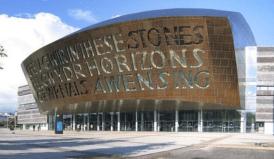 Independence for Wales is not necessarily going to achieve these aspirations in itself , but it is a huge stepping stone towards it. Is there anything that effects the lives of people in Wales that is inherently better decided in Westminster at a UK scale, than in Cardiff (or somewhere else in Wales – I’m not convinced that Cardiff is the most appropriate location for whole-of-Wales decision-making) for Wales or even at more local level where practicable? It is, at best, cumbersome and inefficient (a bit like that last sentence!) and at worst, prejudicial, detrimental and anti-democratic. Wales has never backed a Tory government in Westminster, yet has suffered immeasurably from the consequences of being ruled by one. If nothing else, it has created a degree of subservience and sapped the self-belief from the people of Wales. I have explored this recently in the context of the Covid-19 pandemic.
Independence based on these principles is not insular and self-serving. It is not about denying ourselves bananas and coffee, for example. But where we do get involved in international trade it should respect and maintain the same principles in the areas we go to for trade. Cut out the big multinational corporations. Foster relationships built on fair trade principles and mutual respect with local suppliers of bananas or coffee or whatever. Utilise environmentally friendly routes and modes of transport wherever possible. Likewise, trade our surpluses in accordance with similar ethics. Recognise and celebrate the diversity that exists in our communities, with very few people in Wales having welsh roots that go back more than a few generations at best. Extend the culture of our ‘cities of sanctuary‘ across the whole country. Equally, recognise and celebrate the culture and traditions that have evolved in this part of the world that enrich us rather than diminish us.
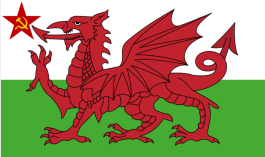 This is beginning to sound like a manifesto for the a new Welsh republic, and it is of sorts. I have a dream! But none of this is assured in an independent Wales. Far from it. In the hands of the far-right it would look utterly different. But the essential point is that it is all possible in an Independent Wales and virtually impossible in a Wales tied to a deeply conservative/Conservative England. Whereas ethnic and/or cultural homogeneity may be dangerous goals, political consensus must be a worthwhile aspiration. There is obviously some overlap in this, but it is patently easier to achieve in smaller countries than big ones.
 The late 20th century saw the breaking up of many unwieldy, fractured blocs, such as Yugoslavia, the USSR, Czechoslovakia, and parts of east Africa. The early 21st century has seen growing pressure for independence of viable smaller countries in many parts of the world, from here in the UK, across many parts of Europe and beyond.
 Few would surely argue that the breaking up of the supposed superpowers of USA, Russia and China, along with perhaps massive countries like Brazil and India, would not be of huge benefit to the whole planet. In the history of the breaking up of empires I have yet to find an example of a country anywhere, at any time, gaining independence from an imperial power that ever regretted it and asked to return.
On this basis, so long as nationalist extremism is kept at bay, it is hard to see how independence for Wales cannot be the way to go.

 I doubt you’ll be surprised by this, but having spent a couple of weeks reflecting and soul-searching, I have decided my time with the Labour Party is done once again.
 I came back to the party, after a hiatus of nigh on 30 yrs, along with many thousands of others, once Corbyn became established as leader and it was clear that the Labour Party had finally returned to its socialist values. Except it was only ever the leadership and huge influx of new members that ever properly bought into this.
 Carwyn Jones and Madeleine Moon, who did more than their fair share to undermine the new zeitgeist. But slowly and seemingly surely we were dragging things in the left direction. With Jones and Moon discarded to the dustbin of history, despite the circumstances, I still felt a degree of optimism that with new blood in the leadership of the right calibre, momentum could be regained.
 I was further encouraged by a slate of candidates for Leader that included 4 women and only one dull grey suit (well, Tory blue suit in fact). When this became the final four (with Clive Lewis and the awful Jess Phillips gone), there were three acceptable women candidates, all of whom I could have given a real chance to, but no.
  The dull grey suit wins it. The knight of the realm wins it. The establishment lawyer wins it. The heir to Blair wins.
 I can no longer bear to have my name associated with the Party that so actively undermined and destroyed the possibility of a Corbyn government today. I cannot countenance another penny of my money or a minute of my time being used and abused.
 Carwyn Jones made a very nice career for himself using the Tories in Westminster as the ready-made excuse for failing to achieve the bare minimum you’d expect from Labour after 20 years of supposed-government; the eradication of poverty and homelessness, substantially less inequality, the restructuring of industry and employment for the 21st century. We can and should still have these aspirations.
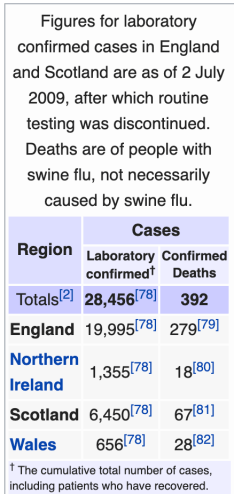 This story needs to start well before the onset of this pandemic. The last pandemic we encountered was the 2009 H1N1 ’Swine flu’ pandemic which saw Wales escape with relatively few confirmed cases, but a higher death rate than the UK average, even if that did amount to just 28 deaths (if just is ever an acceptable word to describe multiple deaths). As a consequence there was a flurry of post-pandemic reviews across the UK and attempts to update pandemic preparedness and response guides. The most recent substantial document I can find from Welsh Government is
  I have no inclination to pore over this and dissect it as I’m not even sure it is the most up-to-date pre-Covid-19 advice in Wales. But It is essentially a supplement to UK guidance rather than a stand alone document, as acknowledged on pg 2:


 This probably also explains the nauseating Amazon adverts currently running where Amazon tries to pretend it is a lovely caring company that cherishes it workers, rather than arguably the worst employer on the planet. Not a good look for a Labour Party association.
 The neoliberal sociopathy of a deeply Conservative England really ought to be anathema to the people of Wales, built as it is on richly diverse working class communities. The NHS was, after all, born in Wales through Nye Bevan. It was Tredegar Medical Aid Society that gave Bevan the model and inspiration for the entire NHS.
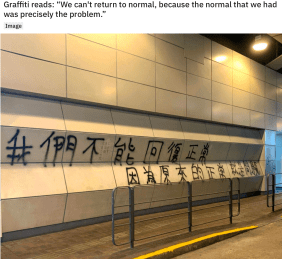 A common mantra emerging from this crisis across the world is that there can be no return to normal, as what we had as ‘normal’ was very much the essence of the problem. Such a crisis has enabled everyone (well, all those that will look up and see at least) to see the full evil of disaster capitalism – which is not really any different than everyday capitalism in that it promotes the welfare of capital and capitalist elites above the needs of the common people. It will no doubt lead to the





 Bridgend's Green Leftie