
Yesterday (18/04/25), a new article was published that focussed on the last ever television interview of Carl Sagan, back in 1996.
I am always heartened to see anything that brings attention to this great man, given that he has been gone approaching 30 years now. It dawned on me yesterday that he died at the same age that I am now, and this has given me further reason to reflect on the influence that he had on me in my formative years. More on this shortly.
But first, let us look at this article on the Open Culture website yesterday.
It has the link to the interview video at the top:
The Open Culture Foundation is a nonpartisan, nonprofit organisation founded in 2014 to promote open technology as the core to securing digital rights and internet freedom. “Open technology” includes three dimensions: (1) open source software & hardware that can freely used, developed and redistributed by anyone; (2) open data that can similarly be freely used, reused and redistributed by anyone; and (3) open government that promotes transparent, participatory, inclusive and accountable governance.
Hopefully you can see why Carl Sagan’s interview (and work) resonates with them so much. Sagan was a pioneering scientist, focussing on astronomy and astro-physics during the immensely progressive period of scientific advance during and beyond the 1960s; the era of the Apollo missions to the moon and deep-space probes. In this interview and in his seminal, sadly final book, The Demon-Haunted World, he identifies a problem that continues to grow and blight the futures of us all; namely people losing respect and understanding for science and scientists.
At the end of his life, Sagan cared deeply about where science stood in the public imagination. Sagan sensed that scientific thinking was losing ground in America, and especially worryingly in Congress. During his final interview, aired on May 27, 1996, Sagan issued a strong warning:
We’ve arranged a society on science and technology in which nobody understands anything about science and technology, and this combustible mixture of ignorance and power sooner or later is going to blow up in our faces. I mean, who is running the science and technology in a democracy if the people don’t know anything about it.
And he also went on to add:
And the second reason that I’m worried about this is that science is more than a body of knowledge. It’s a way of thinking. A way of skeptically interrogating the universe with a fine understanding of human fallibility. If we are not able to ask skeptical questions, to interrogate those who tell us that something is true, to be skeptical of those in authority, then we’re up for grabs for the next charlatan political or religious who comes ambling along.
This brings to my mind one of favourite Carl Sagan quotes:
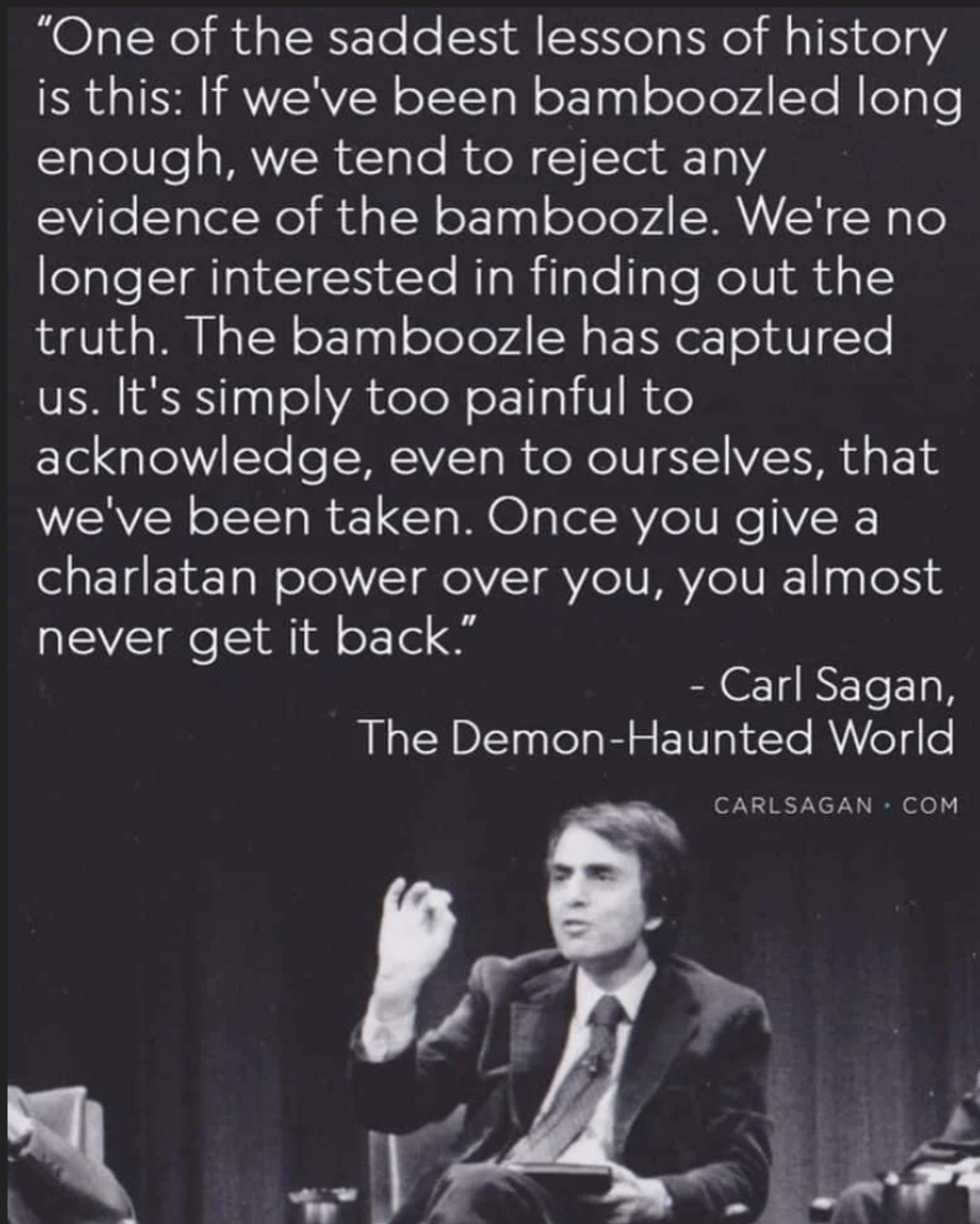
The Open Culture article concludes:
“Nearly 30 years later, we have reached this point. Under the second Trump administration, DOGE has rushed to dismantle the scientific infrastructure of the US government, haphazardly cutting the National Science Foundation, the National Institutes of Health, and NASA. Next, they’re going after leading research universities, intentionally weakening the research engine that has fueled the growth of American corporations—and the overall American economy—since World War II. And they’re replacing scientific leaders with charlatans like RFK Jr. who dabble in the very pseudoscience that Sagan warned us about. Needless to say, our competitors aren’t making the same mistakes. Few serious governments are stupid enough to cut off their nose to spite their face.”
Carl Sagan was not just a brilliant scientist and a thoroughly decent human being, he was a prophet!
First and foremost, for me, he was a brilliant, inspirational communicator of difficult concepts. I first encountered him in my first year at University, when the BBC screened his exquisite series “Cosmos: A Personal Voyage (with Carl Sagan)” (13 episodes, 1980/81).
Thankfully, the whole series is still available to us all. https://archive.org/details/CosmosAPersonalVoyage/1980+Cosmos+(A+Personal+Voyage)+-+Ep+01+The+Shores+of+the+Cosmic+Ocean.mp4
If you are not inclined to watch it all, at least watch the first 10 minutes or so. I wager many of you will be drawn in by his voice and words and end up watching more. But whatever; you will get the feel for what drew me in.
At the very least, spare three and a half minutes to watch this video that presents the essence of my worldview so beautifully.
I find it even more powerful when I read it slowly to myself:
From this distant vantage point [that of ‘an alien scientist newly arrived at the
outskirts of our solar system’ where Voyager 1 took the photograph], the Earth
might not seem of any particular interest.
But for us, it’s different. Look again at that dot. That’s here. That’s home. That’s
us. On it everyone you love, everyone you know, everyone you ever heard of, every
human being who ever was, lived out their lives. The aggregate of our joy and
suffering, thousands of confident religions, ideologies, and economic doctrines,
every hunter and forager, every hero and coward, every creator and destroyer of
civilization, every king and peasant, every young couple in love, every mother and
father, hopeful child, inventor and explorer, every teacher of morals, every
corrupt politician, every ‘superstar,’ every ‘supreme leader,’ every saint and
sinner in the history of our species lived there — on a mote of dust suspended in a
sunbeam.
The Earth is a very small stage in a vast cosmic arena. Think of the rivers of
blood spilled by all those generals and emperors so that, in glory and triumph,
they could become the momentary masters of a fraction of a dot. Think of the
endless cruelties visited by the inhabitants of one corner of this pixel on the
scarcely distinguishable inhabitants of some other corner, how frequent their
misunderstandings, how eager they are to kill one another, how fervent their
hatreds.
Our posturings, our imagined self-importance, the delusion that we have some
privileged position in the Universe, are challenged by this point of pale light. Our
planet is a lonely speck in the great enveloping cosmic dark. In our obscurity, in
all this vastness, there is no hint that help will come from elsewhere to save us
from ourselves.
The Earth is the only world known so far to harbour life. There is nowhere else, at
least in the near future, to which our species could migrate. Visit, yes. Settle, not
yet. Like it or not, for the moment the Earth is where we make our stand.
It has been said that astronomy is a humbling and character-building experience.
There is perhaps no better demonstration of the folly of human conceits than this
distant image of our tiny world. To me, it underscores our responsibility to deal
more kindly with one another, and to preserve and cherish the pale blue dot, the
only home we’ve ever known.
If he were still around today, he would be appalled, but sadly not shocked. As I am. As many of you, no doubt, are too. The question is, what are we going to do about it? The very least that we can all do is take on board the last sentence of ‘The Pale Blue Dot’:
To me, it underscores our responsibility to deal more kindly with one another, and to preserve and cherish the pale blue dot, the only home we’ve ever known.
Amen.
 Bridgend's Green Leftie