Category Archives: Uncategorized

TEN SIMPLE RESOLUTIONS THAT WILL MAKE THE WORLD A BETTER PLACE TO LIVE IN

From: Andy & Natalie ChybaDate: 26/12/2011 21:06:40
To: GreenParty Blog Post
Subject:SOME SIMPLE NEW YEAR’S RESOLUTIONS THAT WILL MAKE THE WORLD A BETTER PLACE TO LIVE IN

  1. Reduce your carbon footprint – We rely on the Earth every day for the most basic of needs: air, food, water, energy, and many other things that enable our survival. What most of us are only starting to realize is that it is also a very delicate system. Just upsetting one element will make many other pieces fall quickly out of place. 23100r6Az42OSWRUPRQOQPTXTQSVWe must love and care for our home planet as much as we can, and it can be done via simple little actions that won’t even cost us a lot of effort, like declining plastic bags and containers, recycling, turning off appliances that aren’t in use, conserving water. You know the drill. If you need more help: http://www.carbonfootprint.com/athome.html

  2. Work less and go out more – Do you ever get the feeling that you’re missing out on life when you spend the whole day cooped up working inside an office? The world be so much better if everyone took time off from work and went ahead and followed their dreams. It’s a win-win situation. The happier and more fulfilled everyone is, the more they will want to spread that joy to others. That’s not even counting the good it will do the earth when all those computers and office gadgets are given a break. So explore the world and do something new and worthwhile. As a step towards enabling this for everyone, we are working on making the four day week Green Party policy, inspired by this 1932 essay by Bertrand Russell: http://www.zpub.com/notes/idle.html

  3. Walk or bike to your destination instead of taking your car, or use public transportation as much as possible – Cars use up a lot of precious fuel and energy and not only do they pollute our air, too many cars on the road will cause traffic and not to mention, accidents. The result, very many upset and angry people. Not a healthy way to live. Green cars are helping solve the fuel & pollution problem but they still don’t solve traffic. Walking, hiking, biking and taking public transportation will greatly reduce this problem and what’s more, you will become healthier and fitter too. What’s not to like about that? This is one reason we will continue to support this campaign: http://www.20splentyforus.org.uk

  4. Make it a habit to smile more often – You probably know that it only takes seventeen face muscles to smile and, in contrast, a whopping forty-three muscles for your mouth to go the other way? Yet smiles are often underused, under-rated and under-appreciated. A simple smile can make the world a better and brighter place if only everyone took more time to do it and really mean it. Smiling makes us more attractive; can change our mood in an instant; can relieve stress; and releases endorphins, natural pain killers and serotonin. So remember, you are never properly dressed without a smile! (Apologies for not remembering where I heard this quote – maybe it was my grandma, which leads me nicely to ….)

  5. Spend more time with someone from a different generation and learn cool stuff you never knew before – Spending time with children and/or older people will expand your mind and open it up to a universe of thoughts you’ve never even pondered about before. Looking at the world from a broader perspective makes you a better and well-rounded person. How do you think I get to know so much about Indie rock if I didn’t spend a lot of time with my sons and their mates? Or those classic musicals if I didn’t watch them with my grandma when I was a child? (Was that quote earlier from Annie?) Sharing knowledge and insights between generations allow us to become more aware of how things work on this planet.

  6. Support local products as much as possible, and promote tourism to where we live – Buying local products and supporting industry in your home area reduces environmental impact, puts your taxes to good use, ensures a better economy and encourages local prosperity. Localism is a fundamental strand of Green economics. We should not be blind to the wonderful environment in which we live, here in South Wales: http://www.southernwales.com/explore-the-area/the-glamorgan-heritage-coast.aspx and http://www.bridgendfarmersmarket.co.UK/Cymraeg/index.html

  7. Lend a helping hand if you’re able, and give without expecting anything back – This can be as simple as opening a door for someone whose hands are full, assisting an elderly person carry books, or helping a child or elderly person cross the street. Giving is also as easy as baking two cakes and sending the extra one to a dear friend (it makes my day when I am on the receiving end of this gesture – hint, hint!), or clearing out your closet and sending your unwanted pile to your local charity shop to benefit others. You don’t even have to move from where you are seated right now to help promote causes/petitions ( http://www.avaaz.org/en/ ) or support worthwhile charities (e.g. http://www.amnesty.org.uk/ )

  8. Write to someone who inspired you – There is nothing like receiving a sincere, heartfelt letter from someone thanking you for inspiring them to become a better person so just imagine what the recipients will feel when they read it. You not only made their day, you also encouraged them to continue inspiring others like you. I also commend the following campaign as a way of making a difference to inspirational people in dire straits: http://www.amnesty.org.uk/content.asp?CategoryID=10673

  9. Share your knowledge and life experiences with people you’ve never met – Everyone’s an expert on something so if you want to be able to share your expertise with others, it has never been easier. Facebook and other social media are great, as are blogs like this one and ones on every topic under the sun (I would love contributions to this blog from as many of you as possible. Send to greens@chyba.go-plus.net) . They reckon everyone has at least one book in them too, and that is easier than ever as well (Click on the Lulu logo in the top left here: http://www.lulu.com/spotlight/AsylumoftheUniverse )

  10. Reach out and hug someone you care for each day, and don’t forget to tell them you love them as well – A hug is one of the best therapies ever. It is positive energy and validation transmitted in its simplest form and is such a simple, effortless gesture that can convey so much more than a million words. Have you heard of the Free Hugs campaign? It’s the story of Juan Mann whose mission was to reach out and hug a stranger to brighten up their lives. Indeed the world would be a much better place if it were full of happy, loving people, wouldn’t it? Making a difference really is this simple:http://www.youtube.com/watch?feature=player_embedded&v=vr3x_RRJdd4

A HAPPY NEW YEAR TO ALL OUR SUPPORTERS

Fracking Contamination ‘Will Get Worse’: says Alberta University Expert

I have been making most of these points about the problems of well case integrity from the outset of the campaign based on my own knowledge of first principles and the evidence of experts like Prof Tony Ingraffea. Here we have Karlis Muehlenbachs, a geochemist and a leading authority on identifying the unique carbon fingerprint or isotopes of shale and conventional gases, at the University of Alberta, expanding on these points based his own research and U.S. Federal studies:
http://thetyee.ca/News/2011/12/19/Fracking-Contamination/

The findings, which clearly contradict industry assurances, didn’t surprise Muehlenbachs, who has studied leaking wells in Alberta’s heavy oil fields for decades.

“The shale gas boom combined with hydraulic fracking will cause wellbores to leak more often than run-of-the-mill conventional wells,” says Muehlenbachs. “The problem is going to get worse, not better.”

Muehlenbachs, who has been fingerprinting leaking gases since 1994, says that hydraulic fracking, which as we know, injects water, chemicals and sand into rock formations at high pressures, may create more leaks in wellbores overtime. (As industry searches for deeper and more extreme hydrocarbons, it must blast open tight rocks with more brute force over larger land bases than conventional operations.)
“They’ll frack each well up to 20 times. Each time the pressure will shudder and bang the pipes in the wellbore. The cement is hard and the steel is soft. If you do it all the time you are going to break bonds and cause leaks. It’s a real major issue. ”

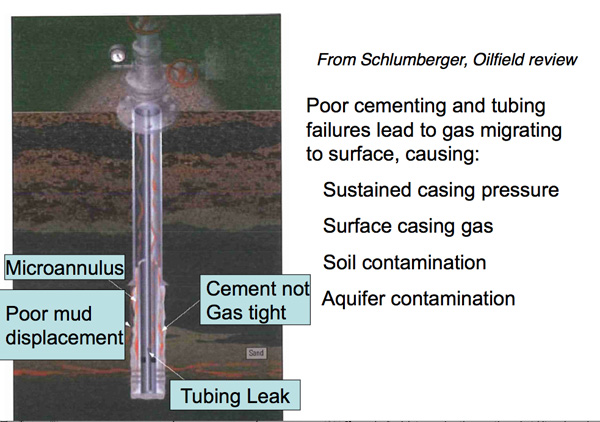
According to Schlumberger, the world’s largest oilfield company, there are problems galore. In 2003, the company reported that 43 per cent of 6,692 offshore wells tested in the Gulf of Mexico by U.S. Regulators were found to be leaking. In fact, by the time a well gets 15 years old, there is a 50/50 probability it will leak significantly and therefore contaminate other zones, wells, or groundwater.

“That’s amazing. It’s not Greenpeace reporting this but Schlumberger in the Oilfield Review,” says Muehlenbachs. (Reliable data on well integrity – see below – is hard to find, but a University of Calgary study found that in Alberta approximately five per cent of all wells leak, while leakage rates in Norway range from 13 to 19 per cent from producing wells.)

The University of Calgary study on ‘Well Design and Well Integrity’ can be found here: http://www.ucalgary.ca/wasp/Well%20Integrity%20Analysis.pdf

Muehlenbachs also recognises the industry’s propensity to tell blatant lies.

Although petroleum engineers now admit that companies routinely blast fluids and gas into other industry wells hundreds of metres away (B.C., Texas and North Dakota have all documented such cases), they still claim that “fracture communication incidents” can’t happen with groundwater.

Muehlenbachs, who has documented numerous cases of groundwater contamination, calls such denials dishonest. “Such claims do more harm than good to industry. Don’t they realize that social license matters to industry?”

Whenever methane leaks from one well into a neighboring wellsite, “industry says let’s fix the leaks,” says Muehlenbachs. “But as soon as the leaks enter groundwater, everyone abandons the same logic and technology and says it can’t happen and the denials come out. In Alberta, it’s almost a religious belief that gas leaks can’t contaminate groundwater.”

Yet it happens routinely. At a conference in Washington D.C. last month sponsored by ‘Resources for the Future’, Muehlenbachs showed evidence that shale gas drilling activity in Quebec and Pennsylvania had in several cases resulted in surface contamination.

The debate about whether leaking shale methane comes from heavily fracked zones creating faults into groundwater or along poorly cemented wellbores is immaterial to landowners, says Muehlenbachs. “You don’t care if it comes from fracking or a bad cement job, you suffer the consequences all the same, and lose your well water.”

Given these findings and a Duke University study that found extensive methane contamination of domestic water wells in a heavily fracked area, Muehlenbachs recommends that regulators do rigorous gas and water testing. In addition to baseline isotope testing of methane for all water wells and groundwater sources, Muehlenbachs says regulators must also test for ethane and propane (the shale gas fingerprint) as well as gas from abandoned wells and natural seeps and gases from well casings.

This is certainly is not part of our Environment Agencies regime of testing at present.

FOOTNOTE – Courtesy of Will Cottrell:

For the record, the audio for the event you mention is at http://video.rff.org:8000/~rff/111411.mp3, while Muehlenbachs’ slides are here – http://www.rff.org/Documents/Events/Seminars/111114_Managing_the_Risks_of_Shale_Gas/Muehlenbachs%20Nov%2014%20FINAL.pdf


We will have a post carbon future – one way or another!

This is a brilliant presentation of what, I trust, we all know to be true. Share it far and wide, especially with anyone you suspect has not got the message yet.

http://www.youtube.com/watch?feature=player_embedded&v=_XQIxr4gRQM

Climate Crisis – The Collapse In Corporate Media Coverage

This is an excellent Media Lens article on a very real and worrying aspect of the Climate Change issue – namely the changing tone of media coverage and editorial attitudes.
I commend Media Lens to for probing the way the media covers all manner of issues.
Sign up here: http://www.medialens.org/index.php?option=com_content&view=article&id=28&Itemid=19

December 16, 2011

The latest round of UN climate talks has just begun in Durban, South Africa, but the world’s richest nations are already planning to prevent any new treaty from taking effect before 2020. Achim Steiner, head of the UN environment programme, has condemned the action as a ‘political choice’, rather than one based on science, calling it ‘very high risk’.

With the Kyoto Treaty due to expire in 2012, the so-called ‘international community’ has failed abysmally to fulfil its commitments to protect the planet. This should surprise no-one. As senior Nasa climate scientist James Hansen pointed out after the previous climate summit in Mexico in 2010, UN talks are ‘doomed to failure’ since they do not address the fundamental physical constraints of the Earth’s climate system and how to live within them.

Public concern about climate change continues to rise. According to the latest Eurobarometer opinion poll (October 2011), 68% of Europeans polled consider climate change a very serious problem (up from 64% in 2009). Altogether 89% see it as a serious problem (either ‘very serious’ or ‘fairly serious’). On a scale of 1 (least) to 10 (most), the seriousness of climate change is ranked at 7.4, against 7.1 in 2009.

Meanwhile, media interest in the subject has crashed. Dr. Robert J. Brulle of Drexel University describes a ‘collapse of any significant coverage of climate change in the [US] media. We know that 2010 was a record low year, and 2011 will probably look much the same. If the media doesn’t draw attention to the issue, public opinion will decline’.

In his authoritative Climate Progress blog, Joe Romm notes, for example, that the New York Times ‘cut coverage sharply since its peak in 2006 and 2007’.

Equally disturbing is the variation in media performance across the globe. A wide-ranging Reuters study on the prevalence of climate scepticism in the world’s media Poles Apart The international reporting of climate scepticism – focused on newspapers in Brazil, China, France, India, the UK and the USA. The periods studied were February to April 2007 and mid-November 2009 to mid-February 2010 (a period that included the UN climate change summit in Copenhagen and ‘Climategate’). Remarkably, the study concluded that climate scepticism is ‘predominantly an Anglo-Saxon phenomenon’, found most frequently in US and British newspapers:

‘In general the UK and the US print media quoted or mentioned significantly more sceptical voices than the other four countries. Together they represented more than 80% of the times such voices were quoted across all six countries.’

The study concluded:

‘In general, the data suggests a strong correspondence between the perspective of a newspaper and the prevalence of sceptical voices within it, particularly in the opinion pages. By most measures (but not all), the more right-leaning tend to have more such voices, the left-leaning less.’

But in all ten UK newspapers studied, there was an increase ‘both in the absolute numbers of articles with sceptical voices in them and the percentage of articles with sceptical voices in them’.

And so we find that Britain and the US the two countries responding most aggressively to alleged ‘threats’ to human security in countries like Afghanistan, Iraq and Libya are also the two countries least interested in responding to the very real threat of climate change.

‘Capitalism Is Trampling On Journalism’

As the Reuters study suggests, media reporting is heavily influenced by editorial stance which, in turn, is heavily influenced by commercial interests. In October, the former Daily Star journalist Richard Peppiatt told the Leveson inquiry into the culture and ethics of the British press the truth about about the UK’s newsroom culture:

‘In approximately 900 newspaper bylines I can probably count on fingers and toes the times I felt I was genuinely telling the truth, yet only a similar number could be classed as outright lies. This is because as much as the skill of a journalist today is about finding facts, it is also, particularly at the tabloid end of the market, about knowing what facts to ignore. The job is about making the facts fit the story, because the story is almost pre-defined.

‘Laid out before you is a canon of ideologically and commercially driven narratives that must be adhered to. The newspaper appoints itself moral arbiter, and it is your job to stamp their worldview on all the journalism you do… The ideological imperative comes before the journalistic one – drugs are always bad, British justice is always soft.’

Peppiatt noted:

‘Tabloid newsrooms are often bullying and aggressive environments, in which dissent is simply not tolerated. It is difficult to stand up and walk out the door with a mortgage to pay, knowing another opportunity is unlikely to be waiting beyond.’

The issue that is not being discussed by Leveson is the extent to which these observations generalise to the ‘quality’ corporate media, and why. By contrast, in soft-pedalling the level of interference from owners and advertisers, the Guardian’s Nick Davies wrote:

‘Journalists with whom I have discussed this agree that if you could quantify it, you could attribute only 5% or 10% of the problem to the total impact of these two forms of interference.’ (Davies, Flat Earth News, Vintage 2008, p.22)

Compare this with corporate escapee Peppiatt’s unfettered conclusion:

‘Capitalism is trampling on journalism.’

A prime example of this trampling was supplied by the high-profile BBC series Frozen Planet, narrated by David Attenborough, focusing on life and the environment in the Arctic and Antarctic. British viewers will see a total of seven episodes, the last of which, ‘On thin ice’, deals with the threat of climate change.

However, viewers in some other countries will only watch six episodes. This is because the BBC packaged the series in such a way that the climate change episode was an ‘optional extra’ that foreign networks could choose to reject. And reject it they did – of 30 networks across the world that have bought the series, 10 have opted not to buy the episode on climate change. Most notable among them is the United States, the world’s leading contributor both to climate crisis and disinformation about the problem.

A spokesman for Greenpeace said:

‘It’s a bit like pressing the stop button on Titanic just as the iceberg appears.

‘Climate change is the most important part of the polar story, the warming in the Arctic can’t be denied, it’s changing the environment there in ways that are making experts fearful for the future.’

The BBC’s helpful packaging of Frozen Planet generated little interest in the media, although some praise. Lord Leach of Fairford, the Tory peer and former director of the British Library, commented:

‘I don’t think what Attenborough has to say about climate change is worth listening to. He’s very endearing but I don’t think there’s any truth to what he says – he has no idea about it. The fact is you can be jolly nice to monkeys but it isn’t the same as knowing what you’re talking about on climate change.’

Leach added: ‘It’s quite right to cut the episode.’

Journalist John Gibbons covered the issue of climate change for the Irish Times for two years. He wrote his last, damning column in February 2010:

‘Ireland’s most senior climate expert, Prof John Sweeney of NUI [National University of Ireland] Maynooth, acknowledged last week that climate-change deniers were “winning the propaganda war”. Chief among them, he added, were deniers from the ranks of journalism and lobbying.

‘Hang on a minute, you might ask, aren’t journalists supposed to be the good guys, the ones who investigate, not propagate, scams? Well, yes and no. “A media and telecommunications industry fuelled by advertising and profit maximisation is part of the problem,” [Justin] Lewis and [Tammy] Boyce [of the Cardiff School of Journalism] point out.’

Gibbons stated the obvious:

‘Millionaire “journalists” have a profound yet undeclared personal vested interest in the consumption-driven economic status quo upon which their wealth is predicated. As, of course, do billionaire media proprietors. They in turn seek out affirmation of their own biases, and ridicule dissenters.’

While The Media Fiddles, 2010’s Monster Increase Burns

While public concern grows and media coverage collapses, the climate change problem is going through the roof. According to a recent study by the US Department of Energy, the global output of heat-trapping carbon dioxide jumped by the biggest amount on record in 2010. The world pumped about 564 million more tons of carbon into the air in 2010 than it did in 2009, an increase of 6 per cent. The latest figures mean that levels of greenhouse gases ‘are higher than the worst case scenario outlined by climate experts just four years ago’, USA Today reports.

Gregg Marland, a professor of geology at Appalachian State University, who has helped calculate Department of Energy figures in the past, said:

‘It is a “monster” increase that is unheard of.’

Granger Morgan, head of the engineering and public policy department at Carnegie Mellon University, said of the new figures:

‘Really dismaying. We are building up a horrible legacy for our children and grandchildren.’

So why is nothing being done about the problem? In a new study, Who’s Holding Us Back?, Greenpeace reports:

‘The corporations most responsible for contributing to climate change emissions and profiting from those activities are campaigning to increase their access to international negotiations and, at the same time, working to defeat progressive legislation on climate change and energy around the world.’

While making public statements that ‘appear to show their concern for climate change’, these corporations are fighting fiercely to prevent action. This helps explain, Greenpeace notes, ‘why decisive action on the climate is being increasingly ousted from the political agenda’. They add:

‘These polluting corporations often exert their influence behind the scenes, employing a variety of techniques, including using trade associations and think tanks as front groups; confusing the public through climate denial or advertising campaigns; making corporate political donations; as well as making use of the “revolving door” between public servants and carbon-intensive corporations.’

In the US alone, approximately $3.5 bn is invested annually in lobbying activities at the federal level. In recent years, Royal Dutch Shell, the US Chamber of Commerce, Edison Electric Institute, PG&E, Southern Company, ExxonMobil, Chevron, BP and ConocoPhillips all made the top 20 list of lobbyists. The climate campaign organisation 350.org estimates that 94 per cent of US Chamber of Commerce contributions went to climate denier candidates.

Groups like the American Petroleum Institute, the Canadian Association of Petroleum Producers and the Australian Coal Association, often campaign directly ‘against measures that would cut greenhouse gas emissions, or run campaigns in support of unfettered fossil fuel energy’.

Attempts by the EU to increase its emissions reductions target for 2020 from 20 per cent to 30 per cent has been undermined by the heavy lobbying of carbon-intensive interests, including BASF, ArcelorMittal and Business Europe.

Tzeporah Berman, Co-director of the Climate and Energy Program at Greenpeace International, says that this latest study:

‘shows beyond a doubt that there are a handful of powerful polluting corporations who are exerting undue influence on the political process to protect their vested interests’.

Two years ago, we challenged James Hansen to sum up governments’ responses to the threat of climate change in a single word. He chose ‘misleading’. Why misleading? Because ‘it’s mostly greenwash’, he told us. (Email, June 18, 2009)

We then asked him to give a rough figure to indicate how far he felt governments had moved towards tackling climate change. Would he say that governments were 1%, 20%, 50%, 70%,… of the way there? We knew this was imprecise, but we wanted to get an idea of his gut feeling. He responded:

‘0%, because they are starting down a wrong track, requiring 1-2 decades to reset. “Goals” for emission reduction, cap-and-trade with offsets, while continuing to build more coal-fired power plants and developing unconventional fossil fuels is a disastrous path. It is meant to fool people, even themselves. A strategic approach would instead recognize the geophysical boundary conditions, specifically that coal emissions must be rapidly phased out.’

He added some disturbing analysis:

‘The fundamental economic requirement concerns the price of (cheap, subsidized) fossil fuels relative to alternatives (energy efficiency, renewables, and other carbon-free energies) — there must be a rising price on carbon emissions (a fee, at the coal/oil/gas source or port of entry). As that price rises and the competition ensues we would reach a point where alternatives suddenly take off and we move beyond the dirty fossil fuel era. The fear that this will in fact occur is what drives the fossil interests who have totally taken control of our governments’ actions.’

Even the cautious and conservative International Energy Authority has now warned that under currently planned policies:

‘rising fossil energy use will lead to irreversible and potentially catastrophic climate change.’

Be in no doubt, the corporate takeover of government policy really has taken humanity to the very edge of the climate abyss. Naturally enough, the corporate media is keen to avoid honestly addressing an issue that so violently conflicts with its profit-maximising agenda, its need for endless economic growth, its heavy dependence on corporate advertising.

We need to Occupy Wall Street, of course – we need to win back our governments from corporate control. But we also need to occupy the media space that for so long has been monopolised by Wall Street’s propaganda arm. We need to occupy the corporate media system that is fiddling the same idiotic tune even as our world – this precious, threatened planet on which we depend for our very survival – burns.

SUGGESTED ACTION

The goal of Media Lens is to promote rationality, compassion and respect for others. If you do write to journalists, we strongly urge you to maintain a polite, non-aggressive and non-abusive tone.

Please write to:

Alan Rusbridger, editor of the Guardian

Email: alan.rusbridger

Chris Blackhurst, editor of the Independent

Email: c.blackhurst

John Mullin, editor of the Independent on Sunday

Email: j.mullin

James Stephenson, BBC News at Ten editor

Email: james.stephenson

This Alert is Archived here:

Climate Crisis The Collapse In Corporate Media Coverage

Follow us on Twitter, on Youtube and on Facebook

Poisoning link threatens future of fracking – headline in today’s Independent

http://www.independent.co.uk/news/business/news/poisoning-link-threatens-future-of-fracking-6276590.html

The full quote from the Green Party in response was:

“As evidence mounts of the potentially negative effects of shale gas extraction both here in the UK and abroad, the need for a thorough and fully independent investigation into the environmental and health impacts of fracking becomes ever more urgent.

The proposed changes to the UK’s planning laws could make it far easier for companies such as Cuadrilla to gain permission for shale gas operations, while at the same time Ministers are failing to address the weaknesses in the regulatory framework which should protect local communities. Green Party Leader Caroline Lucas MP recently quizzed Defra Secretary Caroline Spelman about the fact that, according to the European Commission, the chemicals used in fracking are not registered for this purpose under the REACH regulation, which could make it illegal. Almost one month on, we are still waiting for a response.

Given these concerns, and the fact that any significant investment in shale gas will seriously undermine the UK’s transition towards genuinely clean energy, the Government should halt operations and impose a moratorium on new shale gas exploration – at least until a more detailed and independent assessment is forthcoming.”

I can also reveal that I am involved in the early stages of planning a high profile national fracking meeting that will hopefully launch a national consortium of anti-fracking interests and raise the profile of the issue among the general public. We are provisionally planning it for mid-March, which could be ideal timing as I have a hunch we could be fighting a General Election campaign in May. (Remember you heard that here first!)

Andy

Euro-zone Summit: Green Party calls for sustainable economics that puts society, democracy and jobs first.

The official party response to the recent Euro-zone summit is here:

http://www.greenparty.org.uk/news/green-party-calls-for-sustainable-economics-that-puts-society-democracy-and-jobs-first..html

Green Party economic policy is here:

http://policy.greenparty.org.uk/ec

For a brilliant overview of a range of ‘greener’ alternatives I highly recommend:

‘Babylon and Beyond: The Economics of Anti-Capitalist, Anti-Globalist and Radical Green Movement’ by Derek Wall

Or ‘The No-Nonsense Guide to Green Politics’ also by Derek Wall.

For an alternative perspective, check out Molly Scott Cato’s blog and website:

http://gaianeconomics.blogspot.com/

http://www.gaianeconomics.org/molly.htm

Bridgend Green Party Meeting Agenda and seasonal get together

Meeting preceded by informal seasonal get together over a bar meal (c.£5) and a drink at 7pm
(RSVP as kitchen is opening just for us and I need to give approximate numbers – thank you)

Bridgend Green Party Meeting
Thursday 15th December 2011 at the COITY CASTLE INN Lounge.
Bottom of Tremains Road, (by big railway bridge) Bridgend, CF31 1HA . 8.00pm (ish)

ALL WELCOME
AGENDA

  1. Welcome and Introductions
  2. Apologies for Absence
  3. Minutes and matters arising
  4. Officers’ reports
  5. Campaigns update – esp. fracking/pv for free
  6. Elections – BCBC 2012 – Nomination of Candidates
  7. AOB
  8. DoNM

NOTE – Venue is 2 minutes walk from both the Bus and Train stations in Bridgend.
See map: https://bridgendgreens.wordpress.com/2011/07/16/next-meeting/

IF ANYONE NEEDS A LIFT, PLEASE LET ME KNOW

Andy.

PS – On a purely personal level, and as a humanist, may I take this opportunity to wish you an enjoyable festive season and a happy winter solstice – bringing the return of lengthening days on 22nd December; something we can all celebrate!

National Emergency Shortfall Appeal

(I am amending a personalised letter sent out to all members in the hope that non-members who frequent this blog may feel they they have sufficient respect for the aims and work of the Party to feel that they may wish to help us continue our work)

Dear Members and Supporters,

I am writing to you ask you help the Green Party make up a shortfall of £104,000.

Donations are very urgently needed, please reply by 19th December, with a gift of whatever you can afford.

We are very grateful for everything you have done in the last year, but the situation is now serious. £104,000 must be raised to cover a the shortfall created by the costs of the successful campaign to get our first MP elected, alongside under-performing appeals earlier this year.

As you should know, the Green Party is funded purely by its members – not by millionaire corporate donors. That means it is much harder for us to raise money than for other parties, but it also means we are a truly independent voice – locally, nationally and in the EU.

It would be most unfortunate to have to cut our budget just at the time we should be attempting to grow it. It would seriously hamper our ability to support getting more Greens elected at all levels, as well as hampering the fight against the most dangerous and damaging Government since Thatcher’s.

We all share Caroline’s concern at the way the Tories are so openly looking after their powerful friends at the expense of the most vulnerable segments of our society – a society that they are making more unequal with every day.

And unsurprisingly it seems they’ve now discarded any pretence to be “the greenest Government ever”. They have:

  • Encouraged the frackers
  • Slashed marine renewable energy
  • Caused chaos and dismay in the solar industry
  • Promoted deep water oil drilling
  • Refused to cut UK carbon emissions unless other European countries do
  • Proposed to let developers carve up the countryside, including Green Belts

Add to this the deepest cuts to benefits and public services in peacetime, and attempts to privatise NHS services and schools, and the scale of the work we need to do becomes clear.

Caroline has been recognised as the most influential MP in Parliament (https://bridgendgreens.wordpress.com/2011/12/02/gpmedianet-green-mp-named-biggest-influencer-in-UK-politics-thisyear/), yet she has to operate without our ability to fund policy research and other fundamental resources that other parties can put at the disposal of their MPs. Such resources would also be invaluable to our other elected representatives at all levels.

With vital elections next year, including here in Bridgend CBC, It is vital we clear this deficit now.

With the right response, we hope to be able to fulfill the following vital expenditure:

  • The appointment of Regional Co-ordinators – to support candidates in all future elections
  • Investment in policy research and development
  • Campaign spends – to get our voice heard on key issues

Again, many thanks for all your support in all manner of ways. We hope we can continue to rely on this support in the future, irrespective of whether you are able to help with this appeal at this time of hardship for so many.

With best wishes and thanks,
      
Andy Chyba
Bridgend Green Party

Please send your donation via www.greenparty.org/urgent

Or post a Cheque payable to The Green Party to:
EMERGENCY SHORTFALL APPEAL
THE GREEN PARTY
FREEPOST RSLK-URKB-SRYL
LONDON
EC2A ALT

Global Greens endorse Carl Sagan’s view of the world

More powerful insight from a great mind which underlines why we have to persevere my Green friends!

http://www.youtube.com/watch?feature=player_embedded&v=drAWo_zFh8M

I commend the whole series to you.

Remember how Iceland went bankrupt? Why no news since?

http://bellacaledonia.org.uk/2011/08/25/why-iceland-shold-be-in-the-news-but-is-not/

“Five years of a pure neo-liberal regime had made Iceland, (population 320 thousand, no army), one of the richest countries in the world. In 2003 all the countrys banks were privatized, and in an effort to attract foreign investors, they offered on-line banking whose minimal costs allowed them to offer relatively high rates of return. The accounts, called IceSave, attracted many English and Dutch small investors. But as investments grew, so did the banks foreign debt. In 2003 Icelands debt was equal to 200 times its GNP, but in 2007, it was 900 percent. The 2008 world financial crisis was the coup de grace. The three main Icelandic banks, Landbanki, Kapthing and Glitnir, went belly up and were nationalized, while the Kroner lost 85% of its value with respect to the Euro. At the end of the year Iceland declared bankruptcy.”

What has happened since is a shining example of participatory democracy resting control of a country’s destiny away from capitalist interest groups. It can be done. It has to be done. The fact we have heard nothing of it in our media tells you all you need to know about who pulls the strings.

“What happened next was extraordinary. The belief that citizens had to pay for the mistakes of a financial monopoly, that an entire nation must be taxed to pay off private debts was shattered, transforming the relationship between citizens and their political institutions and eventually driving Icelands leaders to the side of their constituents. The Head of State, Olafur Ragnar Grimsson, refused to ratify the law that would have made Icelands citizens responsible for its bankers debts, and accepted calls for a referendum.” “Of course the international community only increased the pressure on Iceland. Great Britain and Holland threatened dire reprisals that would isolate the country. As Icelanders went to vote, foreign bankers threatened to block any aid from the IMF. The British government threatened to freeze Icelander savings and checking accounts. As Grimsson said: We were told that if we refused the international communitys conditions, we would become the Cuba of the North. But if we had accepted, we would have become the Haiti of the North.

“In the March 2010 referendum, 93% voted against repayment of the debt. The IMF immediately froze its loan. But the revolution (though not televised in the rest of Europe, unlike Greece’s), would not be intimidated. With the support of a furious citizenry, the government launched civil and penal investigations into those responsible for the financial crisis. Interpol put out an international arrest warrant for the ex-president of Kaupthing, Sigurdur Einarsson, as the other bankers implicated in the crash fled the country.”

“But Icelanders didn’t stop there: they decided to draft a new constitution that would free the country from the exaggerated power of international finance and virtual money.”

“The people of Greece have been told that the privatization of their public sector is the only solution. And those of Italy, Spain and Portugal are facing the same threat.”

“They should look to Iceland. Refusing to bow to foreign interests, that small country stated loud and clear that the people are sovereign.”

“Thats why it is not in the news anymore.”